Feb 23, 2026
Asynchronous Audio Communication for Global Enterprise Teams
Andy Suter
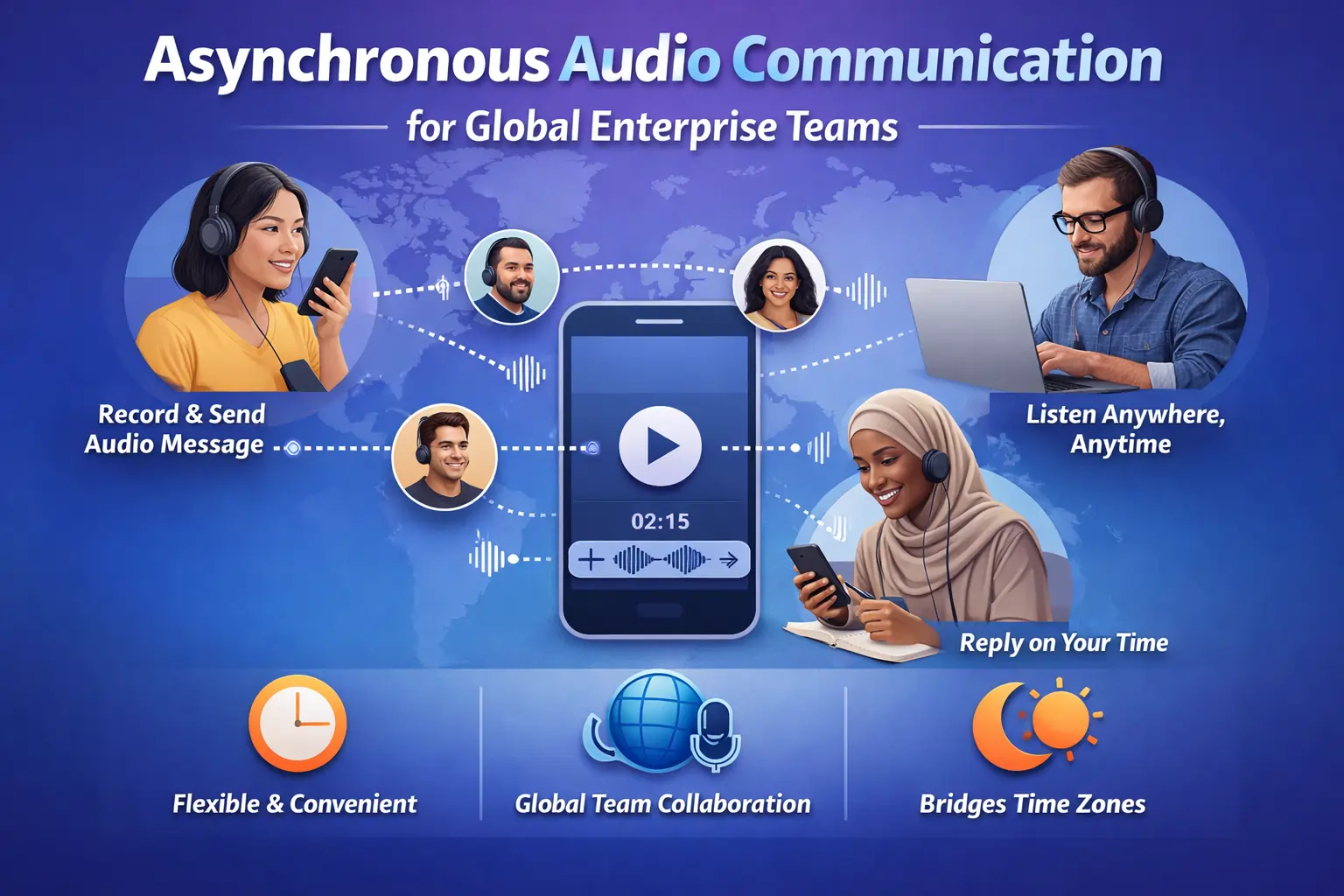
See how asynchronous audio communication enables global enterprise teams to stay aligned without time-zone conflicts or meeting overload.
Introduction: The Time Zone Problem No One Has Solved
Global enterprises today operate across countries, continents, and time zones. While collaboration tools have improved, one fundamental challenge remains unresolved: real-time communication does not scale globally.
Meetings favor certain time zones. Emails get buried. Long documents are skimmed or ignored. Teams are expected to stay aligned while working asynchronously, yet most communication formats are still designed for synchronous use.
This is where asynchronous audio communication is emerging as a powerful solution. By allowing teams to listen on their own time- without scheduling conflicts- audio enables global enterprises to communicate more clearly, consistently, and humanely.
Read Also: Human-Validated AI Audio: Why Review Matters in Enterprise Communication
What Is Asynchronous Audio Communication?
Asynchronous audio communication refers to sharing spoken messages that do not require real-time participation. Instead of joining a live meeting or call, employees listen to audio updates, briefings, or explanations when it fits their schedule.
In enterprise environments, this can include:
Leadership updates
Team announcements
Training and learning modules
Knowledge sharing briefings
Operational or policy explanations
The defining feature is flexibility. Audio is delivered once, consumed many times, and accessed without time-zone dependency.
Why Synchronous Communication Breaks at Global Scale
Real-time communication works well in small, co-located teams. In global enterprises, it creates friction.
Time zone inequality
Meetings often favor headquarters or leadership locations, leaving other regions at a disadvantage.
Meeting overload
As teams grow, calendars fill up, reducing time for focused work.
Missed context
Employees who cannot attend live sessions often miss nuance, even when recordings are shared later.
Fatigue and disengagement
Constant meetings across odd hours lead to burnout and reduced engagement.
These issues make synchronous communication inefficient for global alignment.
Why Audio Is Ideal for Asynchronous Enterprise Communication
Audio sits between text and meetings, combining the strengths of both.
Unlike text, audio conveys tone, emphasis, and intent. Unlike meetings, it does not require everyone to be present at the same time.
Audio enables:
Clearer context than written updates
Higher engagement than long documents
Flexibility across time zones
Reduced reliance on meetings
For global enterprises, this balance is critical.
How Asynchronous Audio Improves Global Team Alignment
Consistent messaging
Every employee hears the same message, delivered in the same way, regardless of location.
Better comprehension
Listening helps teams understand not just what is being communicated, but why it matters.
Reduced repetition
Leaders and managers no longer need to repeat the same updates in multiple meetings.
More inclusive communication
Teams in all regions receive equal access to information without scheduling bias.
These benefits make audio especially effective for enterprise-wide communication.
Common Use Cases in Global Enterprises
Leadership communication
Executives share strategy, priorities, and context through audio briefings that teams can listen to anytime.
Cross-regional updates
Global initiatives and changes are explained once and distributed everywhere.
Training and enablement
Learning content is delivered as short audio modules that employees can revisit.
Knowledge sharing
Best practices and insights are shared across regions without relying on long documents.
Change communication
Audio helps reduce confusion by explaining changes clearly and consistently.
The Role of AI in Asynchronous Audio Communication
AI has made asynchronous audio scalable. Instead of recording and editing manually, enterprises can now convert existing documents into audio quickly.
AI supports:
Document-to-audio conversion
Consistent formatting across regions
Faster updates when content changes
Scalable distribution across teams
This allows global organizations to adopt audio without increasing operational burden.
Why Human Validation Still Matters
While AI enables speed, human validation ensures accuracy and trust. Global enterprise communication often involves sensitive or complex information.
Human review ensures:
Correct interpretation of content
Appropriate tone across cultures
Alignment with enterprise standards
Compliance with internal policies
Asynchronous audio is powerful- but only when it is reliable.
Asynchronous Audio vs Written Updates
Aspect | Asynchronous Audio | Written Communication |
Time-zone friendly | High | Medium |
Engagement | High | Low to Medium |
Context & tone | Strong | Limited |
Flexibility | Very high | Moderate |
Retention | Better | Inconsistent |
Read Also: Multilingual Audio Engines for Enterprises: Scaling Communication Globally
This comparison explains why many enterprises are adding audio as a primary communication layer.
Challenges to Watch Out For
Asynchronous audio is not without challenges.
One risk is producing audio that is too long or unfocused, recreating the same problems as long documents. Another is distributing audio without structure, making it hard to find or revisit.
These issues are solved through clear formats, validation workflows, and pairing audio with written reference material.
Best Practices for Asynchronous Audio in Global Teams
Enterprises that succeed with asynchronous audio follow clear principles.
They keep messages concise and focused.
They validate content before distribution.
They standardize formats for consistency.
They respect cultural and regional context.
They integrate audio into existing workflows.
These practices ensure audio remains helpful rather than overwhelming.
How Platforms Like Sprep Support Asynchronous Audio
Platforms like Sprep are designed for enterprise asynchronous audio communication. Sprep enables organizations to convert internal documents into human-validated, compliance-ready audio briefings that can be shared securely across global teams.
With private distribution, approval workflows, and AI-powered conversion, enterprises can communicate once and scale understanding everywhere—without relying on meetings or time-zone coordination.
Explore how asynchronous audio can simplify global enterprise communication.
Is Asynchronous Audio Right for Every Message?
Not every interaction should be asynchronous. Discussions, brainstorming, and decision-making still benefit from real-time collaboration.
However, for updates, explanations, training, and alignment, asynchronous audio often outperforms meetings and long emails. The key is choosing the right format for the right purpose.
The Future of Global Enterprise Communication
As enterprises become more distributed, asynchronous communication will continue to grow. Audio offers a human, flexible, and scalable way to keep teams aligned without exhausting calendars.
The future of enterprise communication is not about more meetings-it is about better delivery of information.
Read Also: Enterprise Knowledge Sharing: Why Audio Works Better Than Text
Final Thoughts
Asynchronous audio communication for global enterprise teams addresses one of the most persistent challenges of modern work: communicating clearly across time zones at scale.
By combining audio’s engagement with AI’s scalability and human validation’s reliability, enterprises can create a communication system that is inclusive, efficient, and trusted.
For global teams, asynchronous audio is no longer an experiment. It is becoming a necessity.
Frequently Asked Questions (FAQs)
What is asynchronous audio communication?
Audio messages that can be listened to anytime without real-time participation.
Why is it useful for global teams?
It removes time-zone dependency and meeting overload.
Does asynchronous audio replace meetings?
It reduces unnecessary meetings but does not replace collaboration discussions.
Is AI required to create audio at scale?
AI helps scale production, but human review is important.
Can asynchronous audio support training?
Yes, it is widely used for learning and onboarding.
Is it suitable for regulated enterprises?
Yes, with validation and governance.
How long should enterprise audio updates be?
Short and focused- usually a few minutes.
Can audio work alongside written communication?
Yes, audio complements text rather than replacing it.