Feb 14, 2026
Enterprise Knowledge Sharing: Why Audio Works Better Than Text
Enterprise Knowledge Sharing: Why Audio Works Better Than Text
Andy Suter
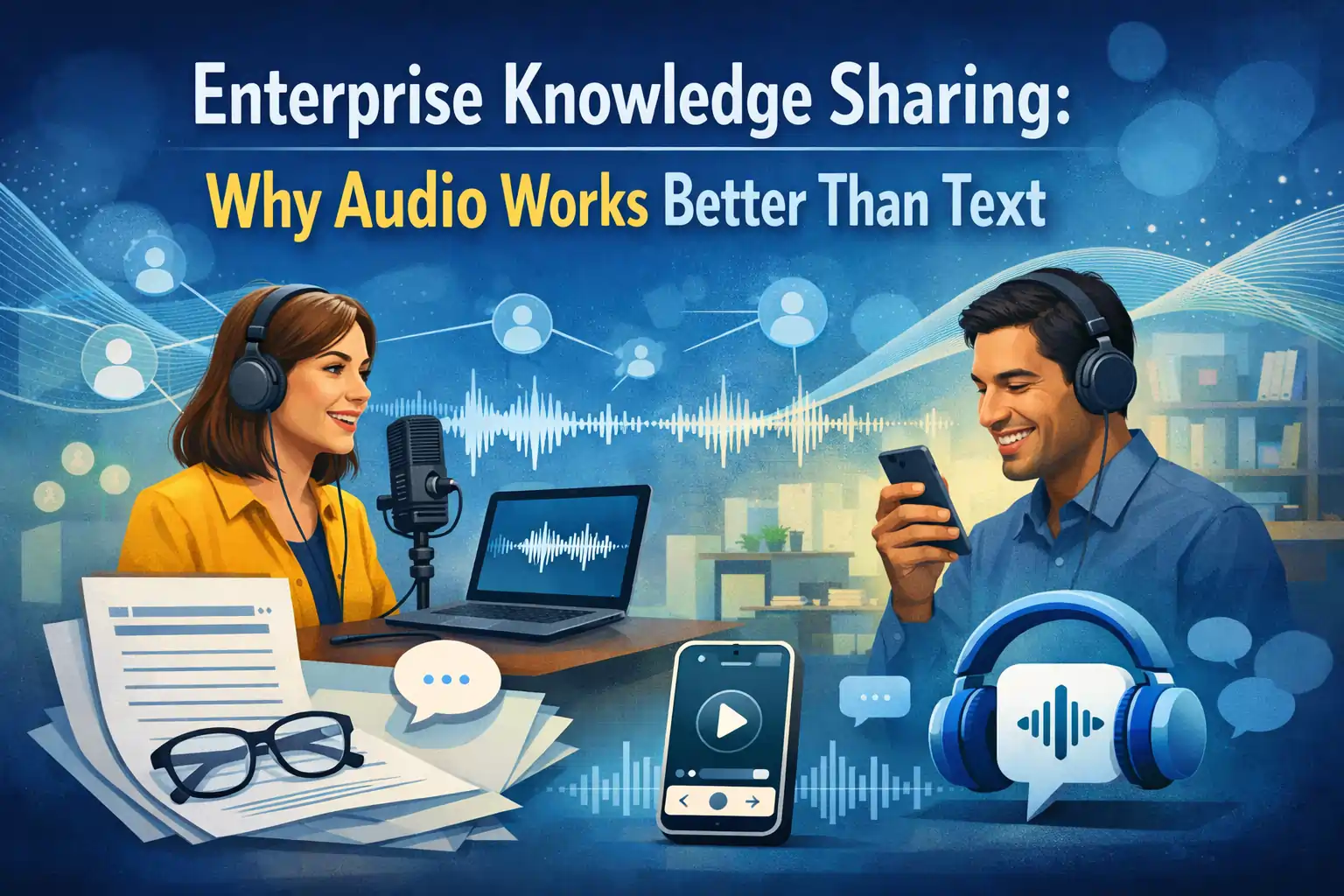
Discover why enterprises use audio instead of text to improve knowledge sharing, engagement, and retention across distributed teams.
Introduction: The Knowledge Gap Inside Modern Enterprises
Enterprises today generate enormous amounts of knowledge. Policies, training manuals, reports, leadership updates, and best practices are created continuously. Yet despite this abundance, one persistent problem remains: knowledge does not always reach people effectively.
Most organizations rely heavily on text-based communication-documents, emails, PDFs, and intranet posts. While necessary, text alone is struggling to keep up with modern work environments. Employees are busy, attention spans are fragmented, and reading long documents often feels like a burden rather than a benefit.
As a result, important information is skimmed, delayed, or ignored. This is why many enterprises are rethinking how knowledge is shared and consumed. Increasingly, they are discovering that audio works better than text for enterprise knowledge sharing.
What Is Enterprise Knowledge Sharing?
Enterprise knowledge sharing refers to how organizations distribute information, expertise, and insights across teams. This includes both formal and informal communication, such as:
Training and learning content
Internal updates and announcements
Policies and compliance information
Leadership communication
Operational guidance and best practices
The goal is not just to store information, but to ensure it is understood, retained, and applied.
Why Text-Based Knowledge Sharing Is Reaching Its Limits
Text will always be important in enterprises, but it has clear limitations as a primary delivery format.
Information overload
Employees receive more written content than they can realistically read. Important messages compete with countless emails and documents.
Low engagement
Long documents are often skimmed or postponed. Many employees never return to them.
Screen fatigue
Constant reading increases fatigue, especially for desk-based and remote workers.
Accessibility challenges
Text-heavy content can disadvantage frontline workers or employees operating in non-desk environments.
These challenges make it difficult for text alone to scale knowledge sharing effectively.
Why Audio Fits Modern Enterprise Workflows
Audio aligns more naturally with how people work today. Unlike text, audio does not demand full visual attention and can be consumed alongside other tasks.
Employees can listen:
During commutes
Between meetings
While performing routine work
During focused listening time
This flexibility makes audio easier to integrate into daily workflows, especially in fast-paced enterprise environments.
How Audio Improves Knowledge Consumption
Audio changes not just how information is delivered, but how it is absorbed.
Higher engagement
People are more likely to listen to a short audio briefing than read a long document.
Better retention
Tone, pacing, and emphasis help reinforce key points, improving memory and understanding.
Human connection
Spoken communication feels more personal and contextual than written text.
Reduced cognitive load
Listening often requires less effort than reading complex material.
For these reasons, audio often outperforms text in knowledge transfer.
Audio vs Text: A Practical Enterprise Comparison
Aspect | Audio | Text |
Engagement | High | Medium to Low |
Time to consume | Low | High |
Retention | Strong | Inconsistent |
Accessibility | Flexible | Limited |
Fatigue | Low | High |
This comparison explains why enterprises increasingly treat text as reference material and audio as a delivery layer.
The Role of AI in Scaling Audio-Based Knowledge Sharing
Traditionally, producing audio at scale was difficult. Recording, editing, and distributing audio required time and resources. AI has changed this.
AI-powered platforms can:
Convert documents into audio quickly
Summarize long content into concise briefings
Maintain consistent formats across teams
Update audio when source content changes
This allows enterprises to scale audio knowledge sharing without proportionally increasing effort.
Why Human Validation Still Matters
While AI enables speed, human validation ensures trust. Enterprise knowledge is often sensitive, complex, or regulated. Fully automated audio risks misinterpretation or loss of nuance.
Human review ensures that:
Facts are accurate
Context is preserved
Tone aligns with enterprise standards
Compliance requirements are met
The most effective enterprises combine AI efficiency with human accountability.
Key Use Cases Where Audio Outperforms Text
Training and learning
Audio modules reinforce learning and support microlearning without overwhelming employees.
Leadership communication
Executives can explain decisions and priorities more clearly through voice.
Internal updates
Short audio briefings replace long update emails and reduce meeting load.
Onboarding
New hires absorb information faster when it is explained rather than read.
Knowledge reinforcement
Audio summaries help employees revisit key ideas without rereading full documents.
In each case, audio improves reach and understanding.
Asynchronous Knowledge Sharing with Audio
One of audio’s biggest advantages is its support for asynchronous communication. Employees do not need to be present at the same time to receive information.
This is especially valuable for:
Remote and hybrid teams
Global organizations
Frontline workers
Time-zone–distributed teams
Audio allows knowledge to flow without scheduling friction.
Common Concerns About Audio in Enterprises
Some organizations hesitate to adopt audio due to concerns.
One concern is loss of control. This is addressed through approval workflows and governance. Another is discoverability. Audio works best when paired with written reference material and clear indexing.
Audio is not a replacement for text-it is a complement that improves delivery.
How Enterprises Use Audio Platforms Like Sprep
Platforms like Sprep are designed to support enterprise knowledge sharing through audio. Sprep enables organizations to convert documents, training materials, and internal updates into human-validated, compliance-ready audio briefings.
With secure internal distribution, approval workflows, and AI-powered conversion, enterprises can scale audio knowledge sharing while maintaining control and accuracy.
Explore how enterprises use AI audio platforms to make knowledge easier to consume and retain.
Best Practices for Audio-Based Knowledge Sharing
Enterprises that succeed with audio follow clear principles.
They keep audio concise and focused.
They validate content before distribution.
They pair audio with written reference material.
They integrate audio into existing workflows.
They treat audio as an official communication channel.
These practices ensure audio enhances knowledge sharing rather than adding noise.
Is Audio Always Better Than Text?
Audio is not universally better, but it is often more effective for delivery and reinforcement. Text remains essential for documentation, compliance, and detailed reference.
The most effective enterprise knowledge strategies use:
Text for structure and record-keeping
Audio for explanation, updates, and reinforcement
Together, they create a balanced communication ecosystem.
The Future of Enterprise Knowledge Sharing
As work becomes more distributed and information volume increases, enterprises will continue to struggle with text-only communication. Audio, supported by AI and governance, offers a scalable alternative.
Future knowledge systems will blend formats intelligently, delivering information in the way employees are most likely to consume it.
Final Thoughts
Enterprise knowledge sharing succeeds not when information exists, but when it is understood and used. Text alone is no longer sufficient to meet this goal at scale.
Audio works better than text because it fits modern workflows, improves engagement, and enhances retention. When combined with AI and human validation, audio becomes a powerful layer in enterprise knowledge systems.
For organizations looking to scale understanding-not just information-audio is becoming essential.
Frequently Asked Questions (FAQs)
Why does audio work better than text for enterprise knowledge sharing?
Because it is easier to consume, more engaging, and fits modern workflows.
Does audio replace written documentation?
No. Audio complements text rather than replacing it.
Is AI required for enterprise audio?
AI helps scale audio creation, but human validation remains important.
Can audio support training and onboarding?
Yes, audio is widely used for learning and onboarding.
Is audio suitable for regulated enterprises?
Yes, when supported by governance and approval workflows.
How do enterprises measure audio effectiveness?
Through listening metrics, feedback, and learning outcomes.
Can audio work for global teams?
Yes, especially when combined with multilingual support.
Is audio more engaging than email updates? In most cases, yes-especially for short, focused updates.