Feb 11, 2026
Human-Validated AI Audio: Why Review Matters in Enterprise Communication
Human-Validated AI Audio: Why Review Matters in Enterprise Communication
Andy Suter
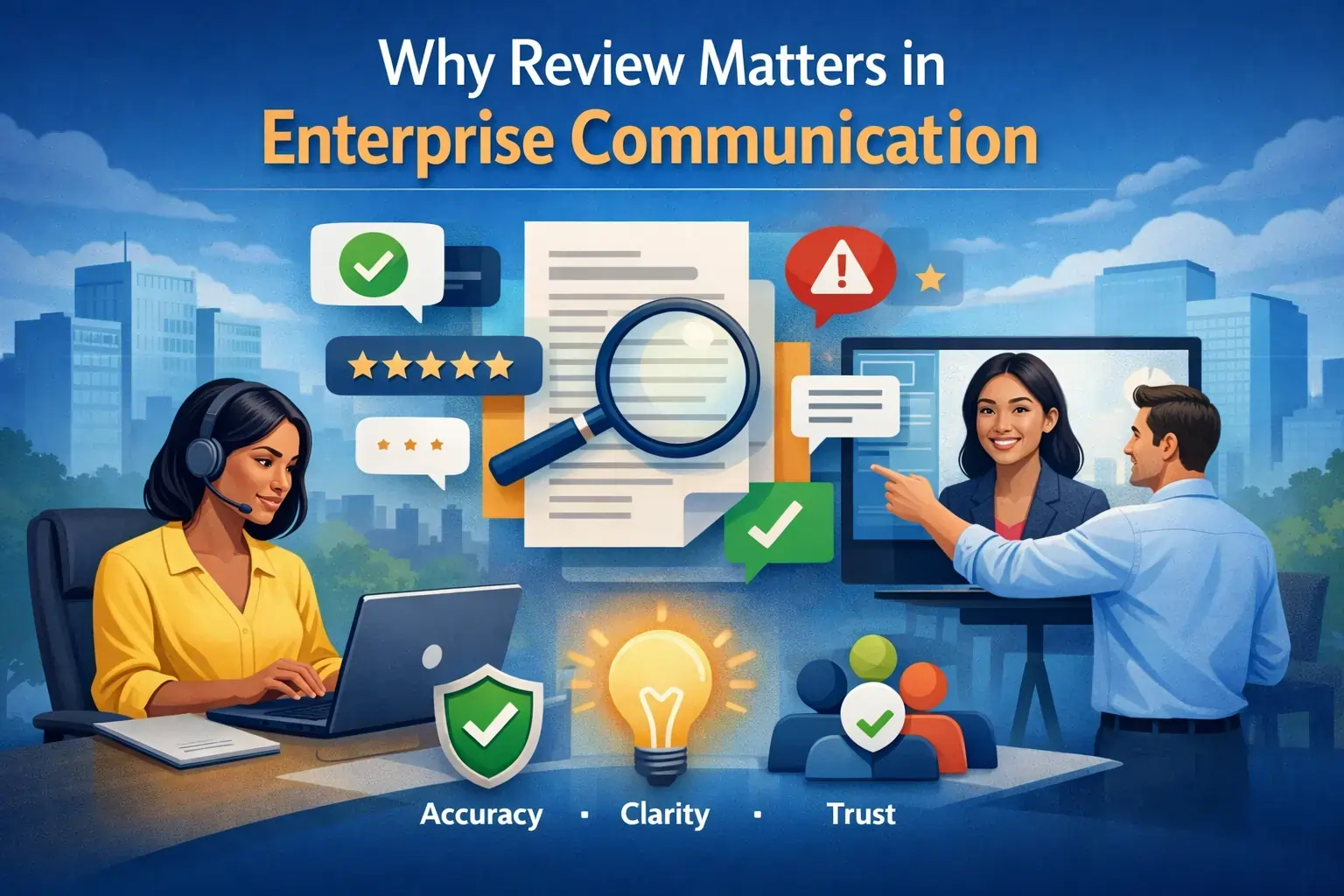
Discover why human-validated AI audio improves accuracy, trust, and compliance in enterprise communication. Learn how review enhances clarity and brand safety.
Introduction: When AI Speaks for the Enterprise
AI audio is rapidly becoming part of enterprise communication. Organizations are using AI to convert documents into audio briefings, create training content, share leadership updates, and distribute internal knowledge at scale. The promise is speed, efficiency, and consistency.
But when AI speaks on behalf of an enterprise, accuracy becomes non-negotiable.
In enterprise environments, communication is not casual. Internal messages influence decisions, behavior, compliance, and trust. A single incorrect or poorly framed audio update can create confusion, misalignment, or regulatory risk. This is why human-validated AI audio is emerging as a critical requirement-not an optional safeguard.
This article explains why review matters, where AI alone falls short, and how enterprises can balance automation with accountability.
What Is Human-Validated AI Audio?
Human-validated AI audio refers to AI-generated audio content that is reviewed, edited, and approved by humans before distribution. AI is used to accelerate content creation, but humans remain responsible for the final message.
This approach ensures that:
Facts are correct
Context is preserved
Tone aligns with enterprise standards
Compliance and governance requirements are met
Human validation does not slow down communication-it protects it.
Why Enterprises Cannot Rely on Fully Automated AI Audio
AI systems generate content based on patterns, not understanding. They do not fully grasp business context, legal nuance, or organizational sensitivity.
In enterprise communication, this creates several risks.
Confident but incorrect output
AI can produce audio that sounds professional while containing subtle inaccuracies.
Loss of nuance
Complex policies, strategic decisions, or compliance updates require careful framing that AI may oversimplify.
Accountability gaps
Without human review, it becomes unclear who is responsible for the message.
Trust erosion
If employees detect errors, trust in both the content and the system declines quickly.
These risks increase as AI audio is scaled across larger audiences.
Where AI Audio Is Most Vulnerable Without Review
Human validation is especially important in certain enterprise use cases.
Leadership and executive communication
Messages from leadership carry authority. Any ambiguity or error can cause confusion at scale.
Training and learning content
Incorrect explanations can affect performance, safety, or compliance.
Policy and compliance communication
Small wording changes can alter meaning and create legal exposure.
Audio summaries of reports
AI may misinterpret conclusions or emphasize the wrong insights.
In all these cases, review is essential.
Why Audio Increases the Need for Validation
Audio feels more authoritative than text. When people hear information spoken aloud, they are more likely to accept it as accurate.
This makes validation even more important. Errors in audio are harder to skim past or question, especially in internal environments where trust is assumed. Once incorrect audio is distributed, correcting it can be difficult.
Human validation ensures that audio amplifies clarity-not mistakes.
The Role of Human Review in Enterprise AI Workflows
Human validation is not about rewriting everything manually. It is about placing humans at the right checkpoints.
In effective enterprise workflows:
AI generates a draft script or audio
A subject-matter expert reviews accuracy
A content owner validates tone and intent
Compliance or legal teams review when needed
The audio is approved and distributed
This structured process preserves speed while maintaining control.
Balancing Speed and Accuracy: A False Trade-Off
Some enterprises worry that adding review will slow them down. In practice, the opposite is often true.
Human-validated AI audio:
Reduces rework caused by errors
Prevents miscommunication
Builds confidence in AI adoption
Enables wider, safer scaling
Speed without accuracy creates risk. Accuracy with smart workflows enables sustainable speed.
Human-Validated AI Audio in Regulated Enterprises
For regulated industries, review is not optional. Financial services, healthcare, legal, and government organizations must meet strict standards for communication.
Human validation supports:
Audit readiness
Traceability to source documents
Clear ownership of content
Compliance with internal and external regulations
In these environments, AI audio must meet the same standards as written communication.
Common Mistakes Enterprises Make
Many organizations adopt AI audio without clear validation strategies.
One common mistake is assuming internal communication carries less risk than external messaging. Another is validating only after issues arise, rather than building review into workflows.
Some enterprises also rely on generic AI tools that lack enterprise-grade approval controls, making validation inconsistent.
Avoiding these mistakes requires intentional design, not just better tools.
Best Practices for Implementing Human-Validated AI Audio
Enterprises that succeed with AI audio follow clear principles.
They define which content requires mandatory review.
They assign clear ownership for approvals.
They integrate validation into existing workflows.
They document decisions and versions.
They treat audio as an official communication channel.
These practices ensure AI audio remains trustworthy and scalable.
How Human Validation Supports Better AI Adoption
Ironically, human validation often accelerates AI adoption. When employees trust the accuracy of AI-generated audio, they are more likely to listen, engage, and rely on it.
Validation builds confidence across:
Leadership
Compliance teams
Employees
IT and operations
This confidence is essential for scaling AI audio beyond pilot projects.
How Platforms Like Sprep Enable Human-Validated AI Audio
Enterprise-focused platforms such as Sprep are built with validation in mind. Sprep allows organizations to convert internal documents into AI-generated audio while keeping humans in control of the final output.
With approval workflows, secure distribution, and compliance-ready processes, enterprises can scale audio communication without losing accountability. This makes it easier to adopt AI audio responsibly across training, onboarding, leadership updates, and knowledge sharing.
Explore how human-validated AI audio enables safer, more effective enterprise communication.
Is Human-Validated AI Audio Worth the Effort?
For enterprises, the answer is yes.
The cost of miscommunication-lost trust, compliance issues, confusion-is far higher than the cost of review. Human-validated AI audio ensures that automation supports the business rather than undermining it.
AI should accelerate communication, not replace responsibility.
Final Thoughts
Human-validated AI audio represents a mature approach to enterprise communication. It acknowledges the strengths of AI while respecting its limitations.
By keeping humans in the loop, enterprises can move faster without sacrificing accuracy, trust, or compliance. In a world where AI increasingly speaks for organizations, review is not a bottleneck-it is a safeguard.
The future of enterprise AI audio is not fully automated. It is intelligently validated.
Frequently Asked Questions (FAQs)
What is human-validated AI audio?
AI-generated audio that is reviewed and approved by humans before use.
Why is validation important in enterprise communication?
Because accuracy, context, and accountability are critical at scale.
Does human review slow down AI audio production?
No. It reduces errors and rework, improving overall efficiency.
Which content needs the most validation?
Leadership, training, compliance, and policy-related audio.
Can AI audio be used safely in regulated industries?
Yes, with structured human validation and governance.
Is validation required for internal communication?
Yes, internal messages still carry business and compliance risk.
How does validation improve trust?
It ensures consistency and accuracy, increasing confidence in AI systems.
Do all enterprises need human-validated AI audio?
Any organization scaling AI audio for critical communication should use it.