Feb 7, 2026
Multilingual Audio Engines for Enterprises: Scaling Communication Globally
Multilingual Audio Engines: How Enterprises Can Scale Communication Across Global Teams
Andy Suter
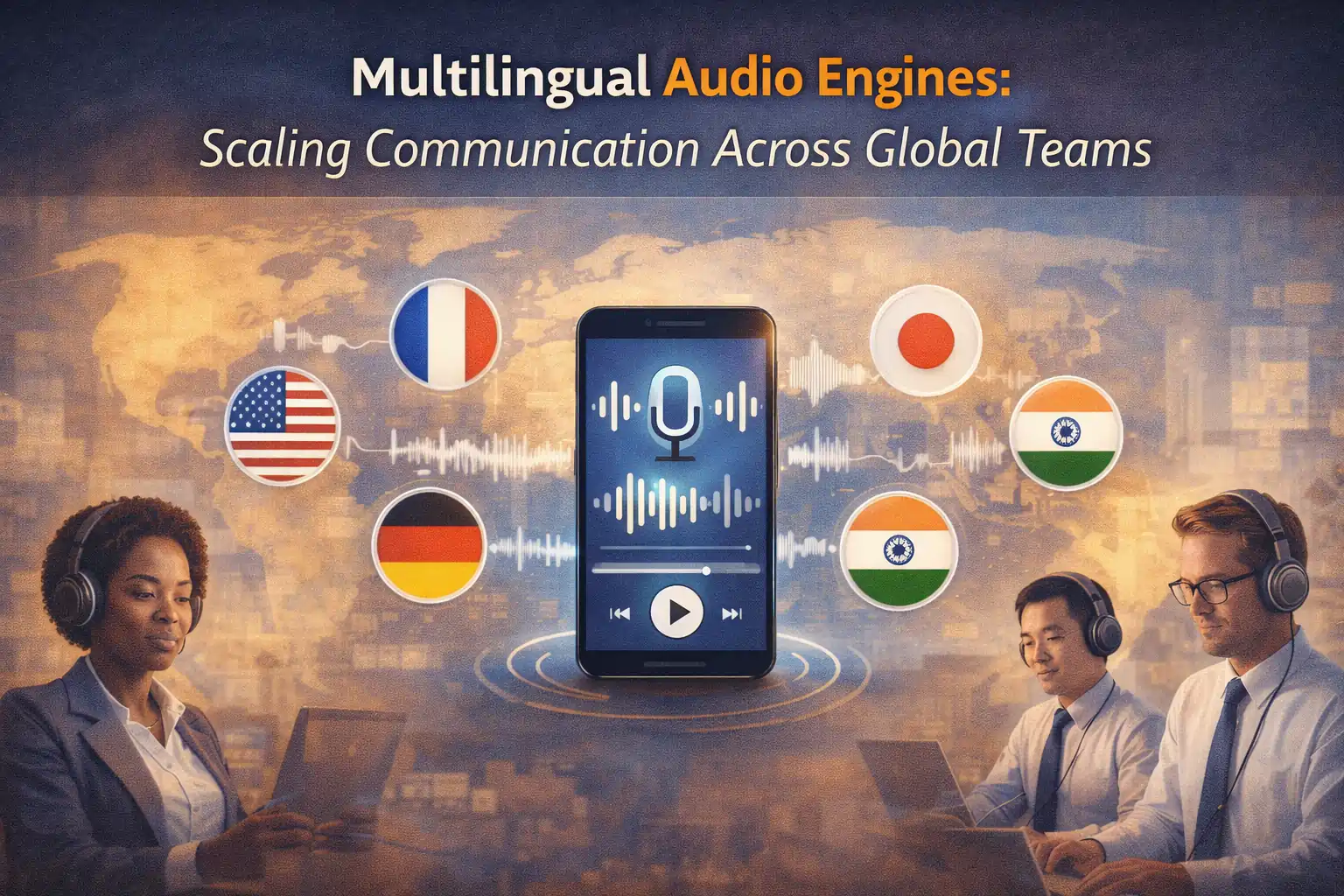
Discover how enterprises use multilingual audio engines to deliver consistent, localized communication across global teams without losing accuracy.
Introduction: The Communication Gap in Global Enterprises
Enterprises today are more global than ever. Teams are distributed across countries, regions, and time zones. While this global reach brings scale and opportunity, it also creates one of the most persistent challenges in enterprise operations: clear and consistent communication across languages.
Most organizations still rely heavily on written communication- emails, documents, reports, and training material. Even when translated, written content often fails to reach everyone effectively. Employees may skim, misunderstand, or delay reading long documents, especially when they are not in their primary language.
This is why multilingual audio engines for enterprises are gaining attention. Audio removes friction. When information is delivered in a familiar language and voice, employees are more likely to listen, understand, and retain key messages. For global enterprises, multilingual audio is no longer a nice-to-have- it is becoming essential for scaling communication effectively.
What Are Multilingual Audio Engines?
A multilingual audio engine is a system that converts enterprise content- such as documents, reports, training material, or updates- into spoken audio across multiple languages. Unlike basic text-to-speech tools, enterprise-grade multilingual audio engines are designed to support accuracy, consistency, governance, and scale.
These systems typically combine:
Language translation and localization
AI-generated or synthetic voice technology
Enterprise security and access control
Human validation workflows
The goal is not just translation, but clear communication that feels native to each audience.
Why Global Enterprises Struggle with Multilingual Communication
Language barriers are one of the biggest obstacles to alignment in large organizations.
Inconsistent understanding
Even when content is translated, nuance is often lost. Different regions interpret the same message differently.
Slow information flow
Waiting for manual translation delays critical updates, especially during change management or operational issues.
Uneven access to knowledge
Employees who are not fluent in the primary business language often receive less context or clarity.
Low engagement with written content
Reading long documents in a second language increases fatigue and reduces retention.
These challenges make it difficult to scale communication consistently across global teams.
Why Audio Works Better Than Text for Multilingual Communication
Audio has unique advantages in multilingual environments.
Listening is generally easier than reading in a non-native language. Tone, emphasis, and pacing help convey meaning even when vocabulary differs. Audio also allows employees to consume information without dedicating full visual attention.
Multilingual audio enables:
Faster comprehension
Better retention
Reduced dependency on written fluency
More inclusive communication
For enterprises aiming to reach frontline workers, remote teams, and global staff, audio often performs better than translated documents alone.
The Role of AI in Multilingual Enterprise Audio
AI has made multilingual audio scalable. Modern AI systems can translate content and generate audio in multiple languages quickly, something that was previously slow and expensive.
AI-powered multilingual audio engines can:
Convert source content into multiple languages
Generate consistent audio formats
Support rapid updates and changes
Scale across large organizations
However, AI alone is not enough for enterprise use. Translation accuracy, cultural context, and compliance still require human oversight.
Translation vs Localization: A Critical Enterprise Distinction
One of the biggest mistakes enterprises make is treating translation and localization as the same thing.
Translation
Focuses on converting words from one language to another.
Localization
Adapts meaning, tone, and context for a specific region or culture.
For enterprise communication, localization matters more than literal translation. A policy update, training message, or leadership briefing must sound appropriate and clear in every region. Multilingual audio engines that support localization help avoid misunderstandings and cultural misalignment.
Core Features of Enterprise-Grade Multilingual Audio Engines
Not all multilingual audio solutions are suitable for enterprise use. Effective systems share several key characteristics.
Language accuracy and consistency
Terminology must remain consistent across languages, especially for policies, compliance, and training.
Human-in-the-loop validation
Human reviewers ensure translations and audio outputs reflect intent and avoid critical errors.
Secure deployment
Sensitive enterprise content must be protected during translation and audio generation.
Role-based access control
Only authorized users should generate, review, or distribute audio content.
Version control and traceability
Enterprises must track which version of content was translated, approved, and shared.
These features ensure multilingual audio supports scale without increasing risk.
Real-World Use Cases for Multilingual Audio in Enterprises
Global training and learning
Training material delivered in local languages improves understanding and completion rates across regions.
Internal communication and updates
Company-wide announcements and updates reach all employees more effectively when delivered in their preferred language.
Employee onboarding
New hires in different regions can receive consistent onboarding information in a familiar language and format.
Policy and compliance communication
Audio explanations help employees understand complex policies without misinterpretation.
Leadership messaging
Executives can communicate vision and priorities globally while maintaining consistency.
Across these use cases, multilingual audio improves clarity and alignment.
Managing Compliance and Accuracy in Multilingual Audio
Global communication often intersects with regulatory and compliance requirements. Incorrect translation or audio output can create legal or operational risk.
To reduce risk, enterprises should:
Validate translated scripts before audio generation
Maintain audit trails linking audio to source content
Apply the same approval standards used for written communication
Document ownership and accountability
Multilingual audio must meet the same standards as any other enterprise communication.
Common Mistakes Enterprises Make with Multilingual Audio
Many organizations struggle because they focus on speed over structure.
One common mistake is relying entirely on automated translation without review. Another is using consumer-grade tools that lack governance and security. Some enterprises also fail to define ownership, making it unclear who is responsible for accuracy.
Multilingual audio succeeds when it is treated as a governed capability, not an ad-hoc solution.
Best Practices for Scaling Global Communication with Multilingual Audio
Enterprises that succeed with multilingual audio follow a disciplined approach.
They start with a single source of truth.
They prioritize localization over literal translation.
They combine AI efficiency with human validation.
They standardize audio formats and structure.
They continuously gather feedback from regional teams.
These practices help organizations scale communication without sacrificing clarity or trust.
Is Multilingual Audio Worth the Investment Today?
For globally distributed enterprises, the answer is increasingly yes.
The cost of miscommunication- missed updates, training gaps, compliance issues- is far higher than the investment required to implement multilingual audio workflows. Audio improves reach, speed, and inclusivity in ways that text alone cannot.
As enterprises continue to expand globally, multilingual audio becomes a strategic enabler rather than an optional enhancement.
The Future of Multilingual Enterprise Communication
As AI technology evolves, multilingual audio engines will become more accurate, natural, and integrated with enterprise systems. However, the need for governance and human oversight will remain.
Organizations that build responsible, validated multilingual audio workflows today will be better positioned to communicate effectively across borders tomorrow.
Global scale requires global understanding- and audio is one of the most effective ways to achieve it.
Final Verdict: Expert Insight
Multilingual audio engines for enterprises address one of the most difficult challenges in global organizations: communicating clearly across languages at scale.
By combining AI-powered translation, audio generation, and human validation, enterprises can deliver consistent, inclusive communication without slowing down. The result is better alignment, stronger engagement, and reduced risk.
In a global enterprise environment, the ability to speak to everyone—in their own language—is not just a communication advantage. It is a competitive one.
Frequently Asked Questions (FAQs)
What are multilingual audio engines for enterprises?
They are systems that convert enterprise content into audio across multiple languages.
How is multilingual audio different from translated documents?
Audio improves comprehension and retention, especially for non-native readers.
Is AI required for multilingual enterprise audio?
AI helps scale translation and audio generation, but human validation remains essential.
Can multilingual audio support regulated industries?
Yes, when combined with governance, approval workflows, and auditability.
Does multilingual audio replace written communication?
No. It complements written documentation.
How many languages can enterprises support with audio engines?
This depends on the platform, but many support dozens of languages.
Is localization really necessary?
Yes. Localization ensures messages make sense culturally, not just linguistically.
What is the biggest risk with multilingual audio?
Inaccurate translation without validation.