Feb 9, 2026
Enterprise AI Audio Platforms: How Companies Deliver Knowledge at Scale
Enterprise AI Audio Platforms: How Companies Deliver Knowledge at Scale
Andy Suter
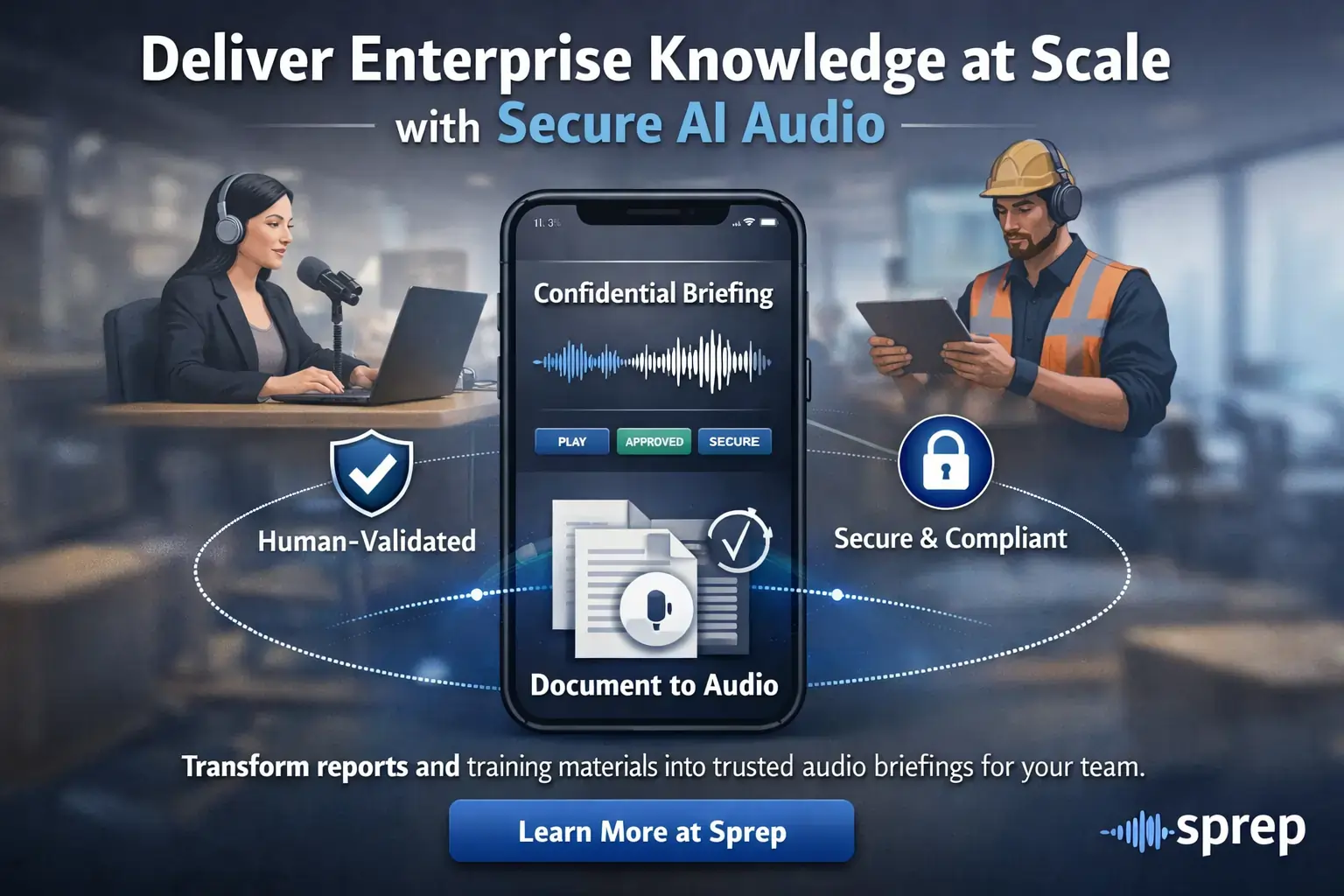
Discover how enterprise AI audio platforms help companies deliver training, updates, and knowledge at scale through secure, human-validated audio.
The Knowledge Distribution Problem in Modern Enterprises
Enterprises today generate more knowledge than ever before. Training materials, internal updates, policy documents, leadership communication, operational guidelines, and best practices are created continuously. Yet despite this abundance of information, one persistent problem remains: knowledge does not reach people effectively.
Employees are busy. Teams are distributed across time zones. Attention is fragmented across meetings, emails, dashboards, and tools. As a result, important information often sits unread in documents or shared drives. Knowledge exists, but it does not scale.
This challenge has led enterprises to explore new ways of delivering information. Among the most effective solutions emerging today are enterprise AI audio platforms-systems designed to convert written knowledge into accessible, scalable audio that employees actually consume.
What Are Enterprise AI Audio Platforms?
Enterprise AI audio platforms are systems that use artificial intelligence to transform enterprise knowledge-documents, reports, training content, and updates-into structured audio formats. These platforms are built specifically for organizational use, with a focus on scalability, consistency, governance, and security.
Unlike consumer text-to-speech tools, enterprise AI audio platforms are designed to:
Support large, distributed workforces
Integrate with internal systems
Maintain accuracy through validation
Operate within compliance and governance frameworks
Their purpose is not simply to create audio, but to deliver knowledge reliably at scale.
Why Traditional Knowledge Sharing Does Not Scale
Most enterprises still rely heavily on written communication. While documentation is essential, it is no longer sufficient as the primary delivery mechanism for knowledge.
Information overload
Employees receive more content than they can realistically read. Even critical updates compete for attention.
Low engagement
Long documents are often skimmed or postponed, reducing understanding and retention.
Inconsistent access
Distributed teams and frontline workers may not have the time or environment to read lengthy material.
Slow knowledge transfer
By the time information is read and understood, it may already be outdated.
These limitations make it difficult to scale knowledge sharing effectively across an organization.
Why Audio Is Effective for Knowledge Delivery at Scale
Audio works because it aligns with how people naturally consume information.
Listening requires less cognitive effort than reading and does not demand full visual attention. Audio can be consumed while commuting, between tasks, or during focused listening moments. This makes it particularly effective for busy professionals and frontline teams.
Enterprise audio enables:
Faster consumption of key insights
Higher engagement and retention
Reduced screen fatigue
More human and contextual communication
When combined with AI, audio becomes a scalable channel rather than a manual effort.
The Role of AI in Scaling Enterprise Knowledge Sharing
AI enables enterprises to scale audio without proportional increases in effort or cost. AI systems can analyze large volumes of content, identify key themes, and generate draft audio scripts quickly.
AI-powered enterprise audio platforms typically support:
Document-to-audio conversion
Automated summarization
Consistent formatting across content
Rapid updates when source material changes
However, AI alone is not sufficient. In enterprise environments, accuracy and accountability matter as much as speed.
Human Validation: The Key to Trust at Scale
One of the most important aspects of enterprise AI audio platforms is human-in-the-loop validation. While AI accelerates content generation, humans ensure correctness, context, and responsibility.
Human reviewers:
Validate factual accuracy
Ensure alignment with business intent
Check tone and clarity
Confirm compliance with internal and external policies
This balance allows enterprises to scale knowledge sharing without compromising trust.
Core Capabilities of Enterprise AI Audio Platforms
Effective enterprise AI audio platforms share several core capabilities that support scale.
Centralized knowledge ingestion
Platforms can pull content from approved sources such as documents, learning systems, or internal repositories.
Structured audio creation
Content is converted into clear, structured audio briefings rather than unfiltered narration.
Governance and access control
Role-based permissions define who can create, approve, and distribute audio.
Version control and traceability
Enterprises can track which audio corresponds to which source content and approval state.
Secure distribution
Audio is delivered through private, internal channels rather than public platforms.
These capabilities make audio a reliable enterprise communication layer.
Real-World Use Cases: How Companies Deliver Knowledge at Scale
Employee training and learning
Training materials converted into audio help employees learn faster and revisit key concepts easily.
Internal updates and announcements
Company-wide updates reach employees consistently, regardless of location or time zone.
Leadership communication
Executives share priorities and strategy in a more personal, engaging format.
Policy and compliance education
Complex policies are explained clearly, improving understanding and adherence.
Knowledge reinforcement
Audio summaries reinforce key points from written material without repeating entire documents.
Across these use cases, enterprise AI audio platforms turn static information into active knowledge.
Scaling Knowledge Across Distributed and Remote Teams
Distributed teams face unique challenges. Time zone differences, cultural variation, and asynchronous work make live communication difficult.
Enterprise AI audio platforms support asynchronous knowledge delivery, allowing employees to consume information when it fits their schedule. This flexibility improves alignment without increasing meeting load.
Audio also provides consistency. Every employee hears the same message, delivered in the same structure and tone.
Measuring the Impact of Audio-Based Knowledge Delivery
Enterprises increasingly want to understand whether audio is effective. While measurement approaches vary, audio platforms can support insights such as:
Completion and listening rates
Repeat listens
Feedback and engagement signals
Correlation with training outcomes
Compared to traditional documents, audio often shows higher completion and retention, especially for time-constrained teams.
Common Mistakes When Implementing Enterprise AI Audio
Some organizations struggle because they treat audio as a simple add-on rather than a strategic channel.
One common mistake is converting entire documents into long recordings. This recreates the same problem in a different format.
Another mistake is removing human oversight in the name of speed. This increases the risk of errors and reduces trust.
Successful enterprises design workflows first, then apply technology.
Best Practices for Delivering Knowledge at Scale with AI Audio
Enterprises that succeed with AI audio follow clear principles.
They focus on insights, not volume.
They keep audio concise and structured.
They validate content before distribution.
They integrate audio into existing knowledge systems.
They treat audio as an official communication channel.
These practices ensure that knowledge delivery scales sustainably.
Is an Enterprise AI Audio Platform Worth It?
For organizations struggling with knowledge distribution, the answer is increasingly yes.
The cost of misalignment, repeated explanations, and underutilized training is high. Enterprise AI audio platforms address these issues by making knowledge accessible, repeatable, and engaging.
Audio does not replace documentation-it amplifies it.
The Future of Knowledge Delivery in Enterprises
As enterprises grow more distributed and information volume increases, traditional communication methods will continue to struggle. Audio, supported by AI and governance, offers a scalable alternative.
Future enterprise knowledge systems will likely combine:
Written documentation for reference
Audio for communication and reinforcement
AI for scale and efficiency
Humans for judgment and accountability
Enterprise AI audio platforms sit at the center of this evolution.
Final Verdict: Expert Insight
Enterprise AI audio platforms solve a fundamental problem: how to deliver knowledge at scale without overwhelming employees or losing accuracy.
By combining AI efficiency with human validation and enterprise-grade governance, organizations can transform how information flows internally. Knowledge becomes easier to access, easier to understand, and more likely to drive action.
In modern enterprises, the ability to scale knowledge delivery is a competitive advantage. Audio is becoming one of the most effective ways to achieve it.
Deliver Enterprise Knowledge at Scale with Secure AI Audio
As enterprises look for better ways to share knowledge across teams, technology alone is not enough. The real challenge is delivering information in a format that employees actually consume-without compromising accuracy, security, or compliance.
Platforms like Sprep are designed specifically for this purpose. By converting reports, training materials, and internal documents into human-validated, enterprise-grade audio briefings, organizations can scale knowledge sharing while maintaining full control over content quality and access.
With secure internal audio channels, compliance-ready workflows, and AI-powered document-to-audio conversion, enterprises can move beyond static documents and create a more effective communication layer for distributed teams.
Frequently Asked Questions (FAQs)
What are enterprise AI audio platforms?
They are systems that convert enterprise knowledge into audio for scalable internal communication.
How do they differ from basic text-to-speech tools?
They include governance, validation, security, and enterprise integration.
Can enterprise AI audio platforms support training?
Yes, they are commonly used for training and knowledge reinforcement.
Do they replace written documentation?
No. They complement documentation by improving consumption and understanding.
Is human validation necessary?
Yes, especially for business-critical and regulated content.
Can audio scale across global teams?
Yes, particularly when combined with localization and multilingual support.
How do enterprises measure audio effectiveness?
Through listening metrics, feedback, and training outcomes.
Are enterprise AI audio platforms secure?
Enterprise-grade platforms are designed with security and access control in mind.