Feb 3, 2026
Document to Podcast: Making Internal Content More Consumable
Document to Podcast: Making Internal Content More Consumable
Andy Suter
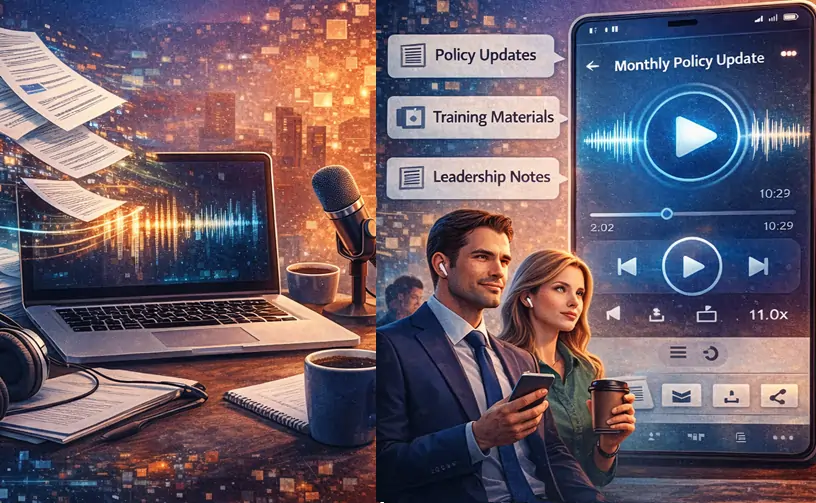
Learn how converting internal documents into podcasts helps enterprises improve engagement, retention, and internal communication without replacing documentation.
The Problem with Internal Documents
Enterprises create an enormous amount of internal content- policies, training manuals, operational updates, leadership notes, and compliance documentation. While this information is critical, it is often under-consumed. Long documents sit unread, important updates are skimmed, and key context is lost.
The issue is not the quality of content. The issue is format.
Modern workplaces are fast, distributed, and overloaded with information. Employees do not always have the time or mental space to read long internal documents. This is where document to podcast formats are changing how internal communication works.
By converting written content into audio, organizations make information easier to consume, retain, and act upon.
What Does “Document to Podcast” Mean in an Enterprise Context?
Document to podcast refers to the process of transforming internal written content into structured, audio-based communication that employees can listen to on demand.
This is not about public marketing podcasts. It is about:
Internal updates
Training explanations
Policy walk-throughs
Leadership messages
Knowledge sharing
Instead of sending another PDF, enterprises deliver a short, focused audio episode that explains the same information in a more human and accessible way.
Why Written Documents Struggle in Modern Workplaces
Internal documents still serve an important role, but they are not designed for attention.
Common challenges include:
Long reading time
Screen fatigue
Low completion rates
Limited engagement
Poor retention of key points
In distributed or frontline teams, these problems become even more visible. When employees are busy or away from desks, written content often gets postponed- or ignored.
How Podcasts Make Internal Content More Consumable
Audio changes the way information fits into the workday.
Instead of requiring focused reading time, podcasts allow employees to:
Listen while commuting
Consume updates between tasks
Revisit information easily
Absorb content without screens
The result is not just convenience, but better attention and understanding.
Audio also adds tone and context. A policy explanation spoken aloud often feels clearer and more approachable than the same text on a page.
Document to Podcast vs Traditional Internal Documents
Aspect | Document (PDF/Text) | Internal Podcast |
|---|---|---|
Engagement | Low to Medium | High |
Time Required | Dedicated reading time | Flexible listening |
Accessibility | Screen dependent | Hands-free |
Retention | Inconsistent | Stronger |
Human Context | Limited | High |
This is why many enterprises now treat documents as reference material and podcasts as the communication layer.
Common Internal Use Cases for Document to Podcast
Document-to-podcast workflows work best when clarity and understanding matter more than formality.
Leadership Communication
Executives can explain updates, strategy changes, or priorities in their own voice, creating trust and alignment.
Policy and Compliance Explanations
Policies are often complex. Audio explanations help employees understand not just what changed, but why.
Training Reinforcement
Instead of repeating long training sessions, audio summaries reinforce key concepts.
Operational Updates
Process changes and internal announcements are easier to digest when explained conversationally.
The Role of AI in Document to Podcast Workflows
AI plays a significant role in scaling document-to-podcast processes.
AI can:
Summarize long documents
Convert text into audio scripts
Generate consistent voice output
Speed up content production
However, AI alone is not enough. Accuracy, context, and tone matter in enterprise communication.
Why Human Validation Is Still Critical
AI can assist, but it should not replace human oversight.
Without validation, AI-generated audio can:
Misinterpret complex information
Introduce factual inaccuracies
Lose nuance in policy language
Human-in-the-loop review ensures that audio content remains aligned with original documents and organizational intent.
This balance between automation and validation is what makes document-to-podcast systems reliable at scale.
Making Internal Podcasts Short, Clear, and Useful
Internal podcasts are most effective when they are:
Focused on one topic
Structured around key takeaways
Short enough to respect attention
Clear in language and intent
The goal is not to replicate the entire document word-for-word, but to guide employees through what matters most.
Does Document to Podcast Replace Written Content?
No—and it shouldn’t.
Written documents are still necessary for:
Formal records
Detailed reference
Compliance requirements
Document-to-podcast formats work best as a layer on top of documentation, not a replacement.
Together, they create a more complete and accessible internal communication system.
Impact on Distributed and Frontline Teams
For teams that are remote, hybrid, or deskless, audio is often the most practical way to stay informed.
Podcasts reduce dependency on screens and allow employees to stay connected without interrupting work. This makes internal communication more inclusive and effective across roles.
Challenges to Watch For
Document-to-podcast initiatives also require discipline.
Common mistakes include:
Overly long episodes
Lack of structure
Publishing without review
Treating audio as an afterthought
Clear guidelines and ownership help avoid these issues.
The Future of Internal Content Consumption
As workplaces continue to evolve, attention will become more valuable than ever.
Enterprises that adapt their communication formats- by making content easier to consume- will see higher engagement, better understanding, and stronger alignment.
Document to podcast is not a trend. It is a response to how people actually work today.
Final Thoughts
Document to podcast workflows transform internal content from something employees should read into something they want to consume.
By combining written documentation with audio explanations, enterprises create communication that is more human, flexible, and effective. In a world where attention is limited, making internal content consumable is no longer optional—it is essential.