Feb 3, 2026
AI Hallucinations in Enterprise Communication: Risks and Solutions
AI Hallucinations in Enterprise Communication: Risks & Solutions
Andy Suter
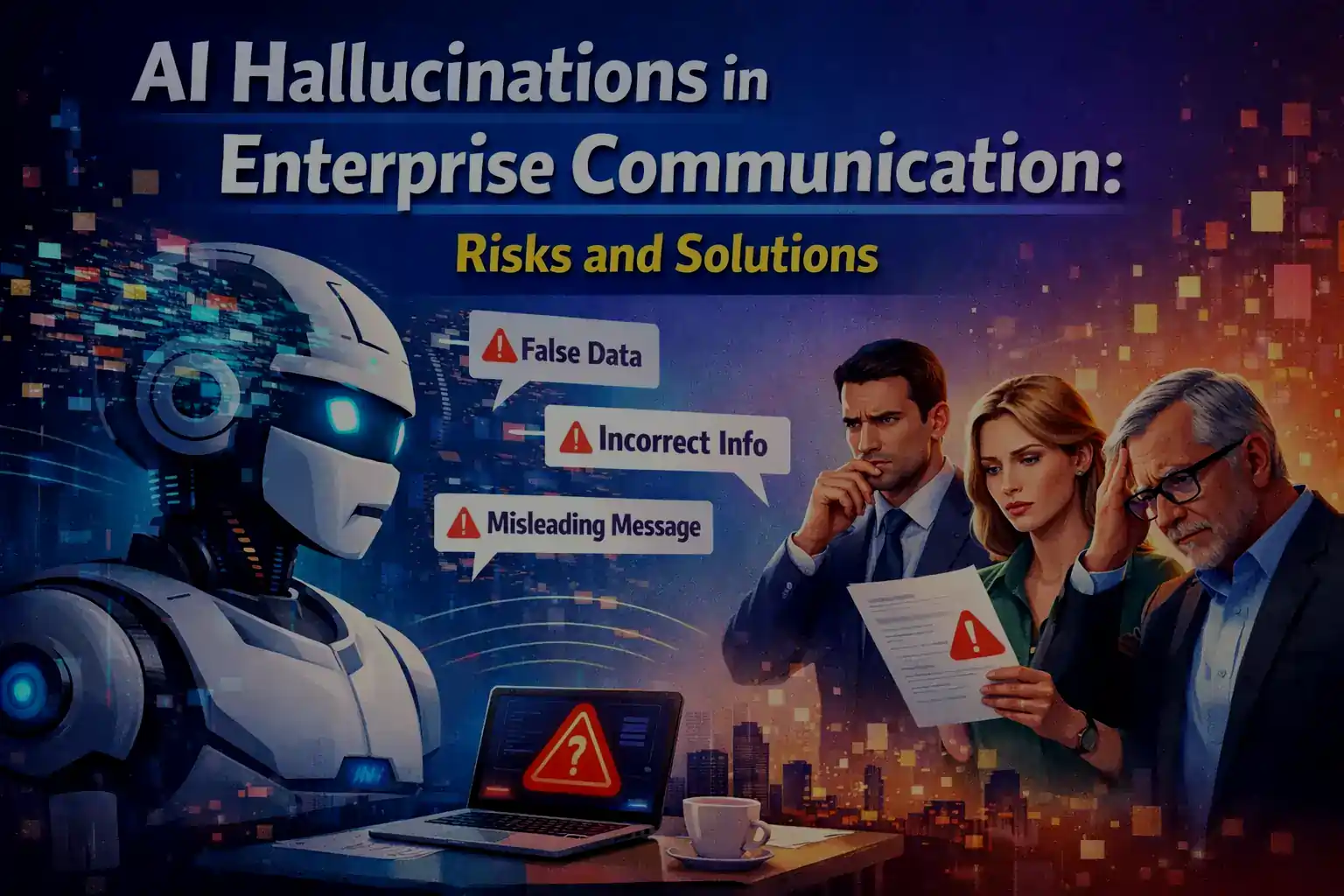
Learn what AI hallucinations are, why they are risky in enterprise communication, and how organizations can prevent errors with human validation.
Introduction- When AI Sounds Confident but Gets It Wrong
Artificial intelligence is rapidly becoming part of enterprise communication. Organizations now use AI to draft emails, summarize reports, generate internal updates, create training content, and even produce audio briefings. These tools promise speed, efficiency, and scale.
However, alongside these benefits comes a serious and often misunderstood risk: AI hallucinations.
In enterprise environments, AI hallucinations are not a minor inconvenience. They can lead to misinformation, compliance violations, loss of trust, and poor decision-making. When AI confidently generates content that sounds accurate but is factually incorrect or misleading, the consequences can be significant.
This is why understanding AI hallucinations in enterprise communication- and knowing how to prevent them- is critical for organizations that want to use AI responsibly.
What Are AI Hallucinations?
AI hallucinations occur when an AI system generates information that is incorrect, fabricated, or not grounded in verified data, while presenting it as factual.
In enterprise communication, this can look like:
Incorrect policy explanations
Invented data points or figures
Misinterpretation of reports
Confident but false summaries
Inaccurate training or compliance guidance
The dangerous part is not just that the information is wrong- but that it often sounds right.
Why AI Hallucinations Are Especially Risky for Enterprises
In casual or creative use cases, hallucinations may be harmless. In enterprise communication, they are not.
High trust environments
Employees often assume internal communication is accurate by default. Incorrect AI-generated content can quickly spread misinformation.
Decision-making impact
Enterprise content influences strategy, operations, and compliance. Errors can lead to poor decisions or regulatory exposure.
Compliance and legal risk
In regulated industries, incorrect communication can violate internal policies or external regulations.
Reputational damage
Loss of trust in internal systems can make employees skeptical of all AI-driven communication.
This is why AI hallucinations are not just a technical issue- they are a business risk.
Common Causes of AI Hallucinations in Enterprise Communication
Understanding why hallucinations happen helps enterprises design better safeguards.
Lack of reliable source grounding
AI models generate responses based on patterns, not understanding. If prompts are vague or data sources are unclear, hallucinations increase.
Over-generalization
AI may combine unrelated information or apply patterns incorrectly across contexts.
Missing or outdated data
If AI relies on incomplete or outdated information, it may fill gaps with fabricated content.
Overconfidence in automation
Enterprises sometimes assume AI output is accurate simply because it sounds professional.
Hallucinations are not a sign of “bad AI”- they are a natural limitation of how generative models work.
Where AI Hallucinations Commonly Appear in Enterprise Communication
AI hallucinations tend to surface in specific enterprise use cases.
Internal reports and summaries
AI-generated summaries may distort key findings or overstate conclusions.
Policy and compliance communication
Small inaccuracies in wording can change meaning and create compliance risk.
Training and learning content
Incorrect explanations can mislead employees and affect performance.
Executive and leadership messaging
Inaccurate or poorly framed messages can confuse teams or misrepresent strategy.
AI-generated audio briefings
Once hallucinated content is converted into audio, it becomes even harder to detect and correct.
Why Hallucinations Are Hard to Detect
One of the biggest challenges with AI hallucinations is that they often pass basic quality checks.
They are:
Grammatically correct
Confident in tone
Well-structured
Contextually plausible
This makes them difficult to spot without subject-matter expertise. In fast-moving enterprises, this increases the chance that incorrect information will be shared widely before anyone notices.
The Real Cost of Ignoring AI Hallucinations
Enterprises that ignore hallucination risks often pay a hidden price.
Rework and confusion increase
Employees lose trust in AI tools
Leaders become hesitant to adopt AI
Compliance teams face higher risk exposure
In the long run, unmanaged hallucinations slow down adoption rather than accelerating it.
Solutions: How Enterprises Can Reduce AI Hallucinations
The good news is that AI hallucinations can be managed effectively with the right approach.
1. Human-in-the-loop validation
Human review is the most important safeguard. AI should assist with drafts and summaries, but humans must validate final output- especially for business-critical communication.
Human reviewers check:
Factual accuracy
Context and intent
Regulatory alignment
Tone and clarity
This single step dramatically reduces risk.
2. Use AI for assistance, not authority
AI should support communication workflows, not replace decision-making. Enterprises must clearly define where AI can be used and where human judgment is mandatory.
Low-risk content can be more automated. High-risk content should always involve review.
3. Ground AI output in trusted sources
Whenever possible, AI should be constrained to specific, verified data sources such as:
Approved documents
Internal knowledge bases
Version-controlled reports
This reduces the chance of fabricated information.
4. Clear prompting and context
Vague prompts increase hallucination risk. Clear instructions, defined scope, and context-aware prompts improve output quality.
For example, asking AI to “summarize key findings from this report” is safer than asking it to “explain what this means” without constraints.
5. Strong governance and content ownership
Enterprises should assign ownership for AI-generated communication. Someone must be accountable for approving and maintaining content accuracy.
Governance ensures that AI usage remains consistent and controlled.
Managing AI Hallucinations in Audio-Based Enterprise Communication
Audio adds an extra layer of complexity. Once incorrect content is spoken, it can feel more authoritative and harder to challenge.
To reduce risk in AI-generated audio:
Validate scripts before audio generation
Keep audio brief and focused on verified insights
Maintain traceability to source documents
Allow easy updates or corrections
Audio should amplify clarity, not amplify errors.
Best Practices for Responsible Enterprise AI Communication
Organizations that successfully manage hallucination risk follow a disciplined mindset.
They:
Treat AI as a support tool
Require validation for critical content
Educate teams on AI limitations
Build workflows, not shortcuts
Measure accuracy, not just speed
This approach enables safe, scalable AI adoption.
Is Eliminating AI Hallucinations Completely Possible?
No system can eliminate hallucinations entirely. The goal is not perfection—it is risk management.
Enterprises that acknowledge AI limitations and design safeguards outperform those that assume AI will “figure it out.”
Responsible use creates confidence, while blind automation creates resistance.
The Future of AI in Enterprise Communication
AI will continue to play a growing role in enterprise communication. As models improve, hallucinations may decrease, but they will never disappear completely.
Organizations that succeed will be those that:
Combine AI efficiency with human accountability
Build trust through transparency
Treat accuracy as a core requirement
AI will not replace enterprise judgment—but it can strengthen it when used responsibly.
Final Thoughts
AI hallucinations in enterprise communication represent one of the biggest risks—and one of the biggest learning opportunities- in modern AI adoption.
AI can accelerate communication, but only humans can ensure correctness, context, and responsibility. Enterprises that balance automation with validation will move faster, communicate more clearly, and avoid costly mistakes.
The future of enterprise AI is not about removing humans from the loop- it is about putting them in the right place.
Frequently Asked Questions (FAQs)
What are AI hallucinations in enterprise communication?
They are instances where AI generates incorrect or fabricated information that appears accurate.
Why are hallucinations dangerous for enterprises?
Because they can lead to misinformation, compliance risk, and loss of trust.
Do all AI tools hallucinate?
All generative AI systems can hallucinate under certain conditions.
Can hallucinations be fully eliminated?
No, but they can be significantly reduced with proper safeguards.
What is the best way to reduce hallucinations?
Human validation combined with clear governance.
Are hallucinations more risky in audio content?
Yes, because spoken content feels more authoritative and is harder to challenge.
Should enterprises stop using AI because of hallucinations?
No. They should use AI responsibly with validation and controls.
Who should own AI-generated enterprise content?
A clearly defined human owner or reviewer.