Jan 23, 2026
Repurposing Enterprise Content into Audio Without Compliance Risk
Repurposing Enterprise Content into Audio Without Compliance Risk
Andy Suter
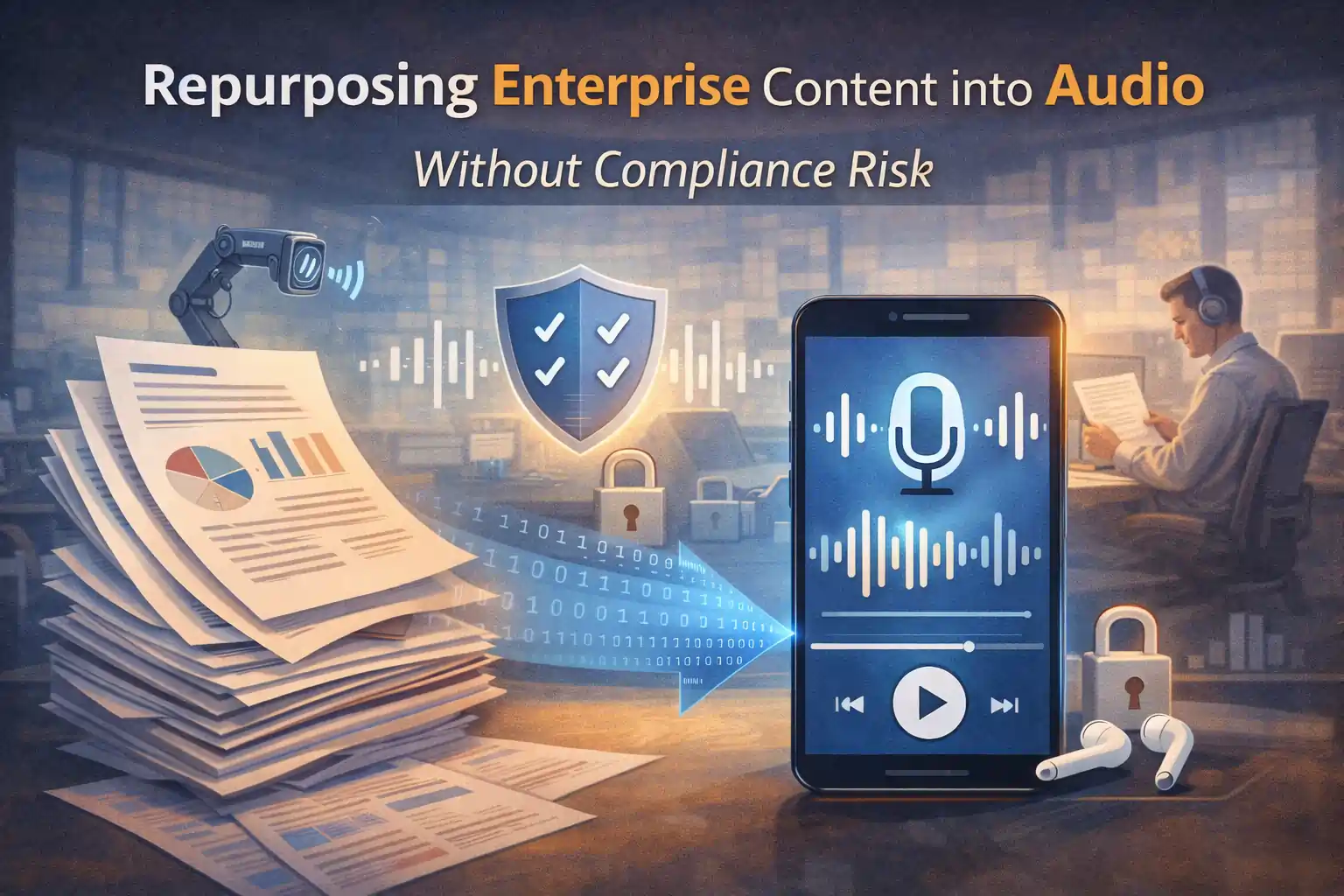
Learn how enterprises can repurpose content into audio while maintaining accuracy, governance, and compliance across internal communication.
Why Enterprises Want Audio- but Fear the Risk
Enterprises are sitting on massive amounts of content. Reports, policies, training manuals, internal updates, compliance documents, and leadership communications are created continuously. While this content is valuable, much of it remains underutilized because employees simply do not have the time to read everything.
Audio has emerged as a powerful solution. Converting enterprise content into audio makes information easier to consume, improves engagement, and supports distributed and remote teams. However, for enterprises- especially those operating in regulated or high-risk environments- this shift introduces a critical concern: compliance risk.
Repurposing enterprise content into audio is not just a formatting change. It is a communication decision with legal, regulatory, and reputational implications. The challenge for enterprises is clear: how to gain the speed and accessibility of audio without compromising accuracy, governance, or compliance.
What Repurposing Enterprise Content into Audio Really Means
Repurposing enterprise content into audio does not mean reading documents word for word. It means transforming existing business content into structured, spoken formats that highlight key insights while preserving meaning and intent.
In practice, this includes:
Converting reports into audio briefings
Turning policy documents into spoken explanations
Transforming training material into audio learning modules
Sharing leadership updates through voice
The goal is not to replace documentation but to create an audio communication layer that complements written content.
Why Enterprises Are Moving Toward Audio-Based Communication
Modern enterprise environments demand faster, clearer communication. Written content alone struggles to meet this demand.
Audio offers several advantages:
Reduced screen fatigue
Better engagement and retention
Easier consumption during daily workflows
More human and contextual communication
This is why enterprise audio content, AI-generated audio, and audio briefings for internal communication are becoming common across large organizations.
However, these benefits only matter if audio content is accurate, approved, and compliant.
The Compliance Risk Hidden in Audio Repurposing
Repurposing content into audio introduces risks that are often underestimated.
Loss of precision
Written documents are carefully worded, especially in regulated industries. Audio summaries can unintentionally oversimplify or change meaning.
Misinterpretation of sensitive information
Tone, emphasis, and phrasing in audio can influence how messages are understood.
Lack of auditability
Without proper workflows, it may be unclear who approved the audio or what source document was used.
Data privacy concerns
Enterprise content often contains sensitive or confidential information that must be protected throughout the conversion process.
These risks explain why many organizations hesitate to adopt audio, even when they see its value.
Why Compliance Cannot Be an Afterthought
In enterprises, compliance is not a checkbox. It is a system of accountability.
When content is repurposed into audio, the same standards must apply as they do to written material:
Accuracy
Traceability
Approval
Security
This is especially critical for regulated industries, such as finance, healthcare, legal services, government, and enterprise SaaS. In these environments, even internal communication can have regulatory implications.
The Role of AI in Repurposing Enterprise Content into Audio
AI has made content repurposing faster and more scalable. Modern AI systems can:
Analyze long documents
Identify key sections and themes
Generate draft summaries
Convert text into natural-sounding audio
This has accelerated adoption of AI audio for enterprises and document-to-audio conversion. However, AI alone cannot guarantee compliance.
AI does not understand regulatory nuance, legal responsibility, or organizational context. This is why human-validated AI audio is essential.
Human Validation: The Foundation of Compliance-Safe Audio
Human validation is the single most important safeguard when repurposing enterprise content into audio.
Human reviewers ensure that:
The audio reflects the original intent of the document
Critical details are not lost or distorted
Sensitive language is handled appropriately
Regulatory and internal policies are respected
In compliant workflows, AI accelerates production, but humans remain accountable for the final output.
How Enterprises Can Repurpose Content into Audio Safely
A compliance-safe approach relies on structured workflows rather than ad-hoc automation.
Step 1: Define what content can be repurposed
Not all documents are suitable for audio. Enterprises should clearly define which content types can be converted and which require stricter controls.
Step 2: Extract insights, not entire documents
Audio should focus on key messages, decisions, and implications rather than reproducing full text.
Step 3: Apply human review and approval
Every audio output should be reviewed by a responsible owner before distribution.
Step 4: Maintain traceability
The source document, version, reviewer, and approval date should be recorded.
Step 5: Secure distribution
Audio content should follow the same access controls as written enterprise content.
This approach balances efficiency with governance.
Real-World Enterprise Use Cases
Internal communication
Enterprises use audio to summarize updates, announcements, and operational changes while maintaining message accuracy.
Training and onboarding
Audio learning modules help employees absorb information faster, especially when paired with written reference material.
Policy and compliance communication
Audio explanations make complex policies easier to understand without changing their meaning.
Leadership messaging
Executives can communicate strategy and priorities more clearly through validated audio briefings.
Across these use cases, compliance-aware audio workflows ensure trust and consistency.
Common Mistakes Enterprises Make
Many organizations face issues because they approach audio repurposing incorrectly.
One common mistake is fully automating the process. Automation without oversight increases compliance risk rather than reducing effort.
Another mistake is treating audio as informal. Even internal audio must meet enterprise standards.
Some organizations also fail to document approvals, making audits difficult later.
Avoiding these mistakes requires a mindset shift—from speed-first to responsibility-first.
Best Practices for Compliance-Safe Audio Repurposing
Enterprises that succeed with audio follow clear principles.
They treat audio as an extension of official communication.
They use AI for efficiency, not authority.
They require human validation for accuracy.
They design workflows with governance in mind.
They prioritize security and access control.
These practices allow enterprises to scale audio confidently without increasing risk.
Is Repurposing Enterprise Content into Audio Worth It Today?
Yes- when done responsibly.
Organizations that repurpose content into audio without proper controls risk confusion, compliance issues, and loss of trust. Organizations that adopt responsible, validated audio workflows gain faster communication, better engagement, and stronger alignment.
The difference lies not in technology, but in execution.
The Future of Enterprise Audio and Compliance
Audio will continue to play a larger role in enterprise communication. As AI improves, content repurposing will become even faster and more accessible.
However, compliance expectations will also increase. Enterprises that build governance, validation, and accountability into their audio strategy today will be better prepared for the future.
Responsible audio is not a constraint—it is an enabler of sustainable scale.
Final Verdict: Expert Insight
Repurposing enterprise content into audio offers clear advantages, but only when compliance risk is addressed head-on. Speed without accuracy creates exposure. Automation without accountability creates mistrust.
The smartest enterprises treat audio as a governed capability, not a shortcut. By combining AI efficiency with human validation and strong governance, organizations can unlock the benefits of audio without compromising compliance.
In the end, the goal is not just to communicate faster—but to communicate correctly, consistently, and responsibly.
Frequently Asked Questions (FAQs)
What does repurposing enterprise content into audio mean?
It means converting existing business content into structured audio formats for easier consumption.
Is AI required for enterprise audio repurposing?
AI helps scale the process, but human validation remains essential.
Can audio be compliant in regulated industries?
Yes, when supported by governance, review, and security controls.
Does audio replace written enterprise content?
No. Audio complements written documentation.
What is the biggest compliance risk with audio?
Loss of accuracy, accountability, or traceability.
How can enterprises reduce audio compliance risk?
By using human-validated workflows and clear governance.
Is audio suitable for internal communication only?
It is most common internally, but can be used externally with stricter controls.
Does compliance slow down audio production?
Proper workflows reduce rework and long-term risk, improving efficiency overall