Jan 23, 2026
Responsible AI Audio: How Enterprises Can Balance Speed and Accuracy
Responsible AI Audio: How Enterprises Can Balance Speed and Accuracy
Andy Suter
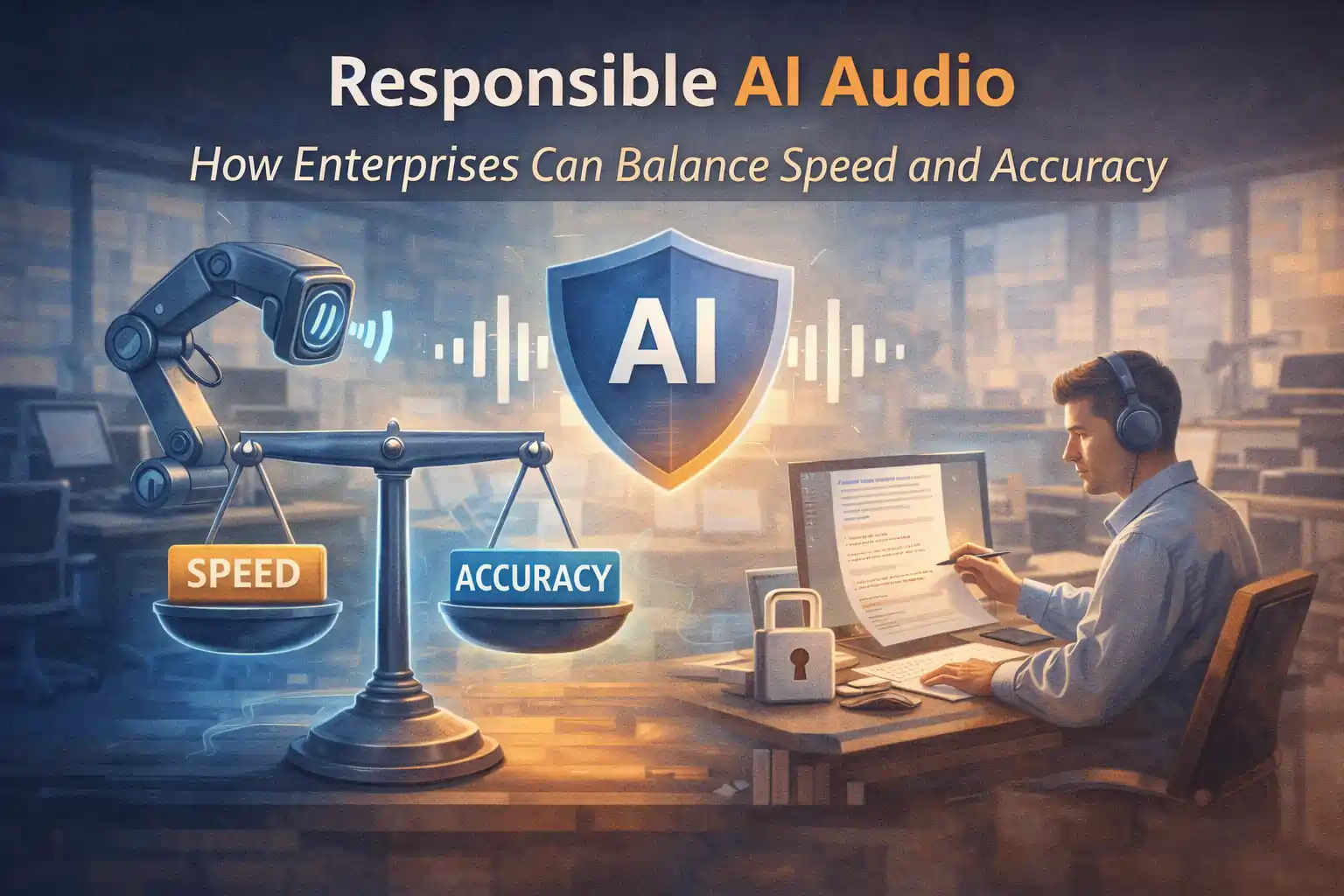
Learn how responsible AI audio helps enterprises balance speed and accuracy through human validation, governance, and trusted workflows.
The Promise and the Risk of AI Audio
AI-generated audio is rapidly becoming part of enterprise workflows. Organizations are using it to convert documents into briefings, deliver training, share leadership messages, and support accessibility. The appeal is obvious. AI audio enables speed, scale, and efficiency that traditional communication methods struggle to match.
However, as adoption increases, so do the risks. AI can generate audio quickly, but speed without control can create serious problems- misinformation, compliance issues, loss of trust, and reputational damage. For enterprises, especially those operating in regulated or high-stakes environments, the challenge is not whether to use AI audio, but how to use it responsibly.
This is where the concept of responsible AI audio becomes critical. Responsible AI audio focuses on balancing the speed and efficiency of AI with the accuracy, accountability, and judgment that only humans can provide.
What Is Responsible AI Audio?
Responsible AI audio refers to the use of AI-powered audio systems in a way that prioritizes accuracy, transparency, governance, and human oversight. It is not a specific tool or technology, but a framework for how AI audio is designed, implemented, and managed inside enterprises.
At its core, responsible AI audio answers three questions:
Is the content accurate and trustworthy?
Is there clear accountability for what is published?
Does the system respect business, legal, and ethical boundaries?
When these questions are addressed, AI audio becomes a reliable enterprise capability rather than a risky shortcut.
Why Speed Alone Is Not Enough in Enterprise AI Audio
One of the main reasons enterprises adopt AI audio is speed. AI can generate audio in minutes instead of days. While this is valuable, speed without validation introduces new risks.
AI systems work by identifying patterns in data. They do not truly understand context, intent, or consequence. This means AI-generated audio can sound confident while being incomplete, misleading, or incorrect.
In enterprise environments, even small errors can have large consequences. A misinterpreted policy update, an inaccurate training message, or an unclear leadership communication can lead to confusion, compliance issues, or poor decision-making.
Responsible AI audio recognizes that accuracy is not optional, even when speed is important.
The Enterprise Challenge: Balancing Speed and Accuracy
Enterprises face a constant tension between moving fast and maintaining control. On one side, there is pressure to communicate quickly and at scale. On the other, there is a responsibility to ensure correctness and consistency.
Balancing speed and accuracy requires a shift in mindset. AI should not be treated as an autonomous decision-maker. Instead, it should be treated as an assistant that accelerates workflows while humans remain accountable for outcomes.
This balance is achieved through process design, not technology alone.
The Role of Human Validation in Responsible AI Audio
Human validation is the foundation of responsible AI audio. While AI can generate drafts and summaries, humans provide judgment, context, and responsibility.
Human reviewers ensure that-
Facts are correct and up to date
Tone aligns with organizational values
Sensitive topics are handled appropriately
Regulatory and compliance requirements are met
Without human validation, AI audio becomes a liability. With it, AI audio becomes a powerful and reliable tool.
How Responsible AI Audio Workflows Actually Work
A responsible AI audio workflow is structured and intentional. It does not rely on automation alone.
A typical workflow includes:
AI generates a draft audio script or summary
A human expert reviews the content for accuracy and clarity
Adjustments are made to tone, emphasis, and messaging
The content is approved by a designated owner
Audio is distributed with clear context
This approach preserves speed while protecting quality and trust.
Core Principles of Responsible AI Audio
Responsible AI audio is guided by a few key principles that apply across industries.
Transparency
Stakeholders should know when content is AI-assisted and how it was reviewed.
Accountability
There must be a clear owner responsible for the final audio output.
Accuracy
Content should be fact-checked and validated before distribution.
Governance
Rules should define what content can be automated and what requires extra oversight.
Security and privacy
Sensitive data must be protected throughout the audio generation process.
These principles ensure that AI audio aligns with enterprise expectations.
Real-World Use Cases Where Responsible AI Audio Matters Most
Internal communication
AI audio can help scale internal updates, but accuracy and clarity are critical to avoid confusion.
Training and learning
Training content must be correct and consistent. Errors can lead to poor performance or safety risks.
Leadership messaging
Executive communication carries authority. Human validation ensures messages are intentional and aligned.
Regulated environments
Industries such as finance, healthcare, and government require strict controls over content accuracy and traceability.
In these use cases, responsible AI audio is not optional- it is essential.
Common Mistakes Enterprises Make with AI Audio
Many organizations struggle with AI audio because they focus too much on tools and not enough on process.
One common mistake is fully automating audio generation without review. This may work for low-risk content, but it fails in enterprise contexts.
Another mistake is assuming that faster communication is always better. In reality, unclear or incorrect communication can slow organizations down more than thoughtful, validated messaging.
Some enterprises also underestimate the importance of governance. Without clear policies, AI audio usage becomes inconsistent and risky.
Best Practices for Implementing Responsible AI Audio
Enterprises that succeed with AI audio follow a disciplined approach.
They define clear guidelines for AI usage.
They identify content that is suitable for automation.
They require human review for critical communication.
They document approval and decision-making processes.
They continuously evaluate outcomes and improve workflows.
These practices ensure that AI audio delivers value without compromising trust.
Is Responsible AI Audio Worth the Effort?
Some organizations worry that adding validation and governance will slow them down. In practice, the opposite is often true.
Responsible AI audio reduces rework, prevents errors, and builds confidence among teams. When people trust the system, adoption increases and communication becomes more effective.
Speed and accuracy are not opposing forces. When balanced correctly, they reinforce each other.
The Future of Responsible AI Audio in Enterprises
As AI capabilities continue to improve, audio will play an even larger role in enterprise communication. However, the organizations that succeed will be those that treat responsibility as a core requirement, not an afterthought.
Responsible AI audio represents a long-term strategy. It ensures that innovation does not outpace governance and that efficiency does not undermine trust.
Enterprises that adopt this approach early will be better positioned to scale AI safely and sustainably.
Final Thoughts
AI audio offers tremendous potential for enterprises, but only when used responsibly. Responsible AI audio is about balancing the speed of automation with the accuracy and judgment of human oversight.
When enterprises design workflows that combine AI efficiency with human accountability, they unlock the true value of AI audio. Communication becomes faster, clearer, and more trustworthy.
In the long run, the organizations that win will not be the ones that move the fastest at any cost, but the ones that move smartly, responsibly, and with intention.
Frequently Asked Questions (FAQs)
What is responsible AI audio?
It is the use of AI-generated audio with accuracy, governance, and human oversight.
Why is human validation important in AI audio?
Because AI can generate errors or misinterpret context without human judgment.
Does responsible AI audio slow down content creation?
No. It reduces errors and rework, making communication more efficient overall.
Can responsible AI audio scale in large enterprises?
Yes, with structured workflows and clear ownership.
Is responsible AI audio necessary for all content?
It is essential for business-critical and high-risk communication.
How does responsible AI audio support trust?
By ensuring accuracy, accountability, and transparency.
Can AI audio be used in regulated industries?
Yes, when supported by governance, validation, and security controls.
What is the biggest risk of unmanaged AI audio?
Loss of trust, misinformation, and compliance issues.