Jan 21, 2026
From Reports to Audio: A Smarter Way to Share Business Insights
From Reports to Audio: A Smarter Way to Share Business Insights
Andy Suter
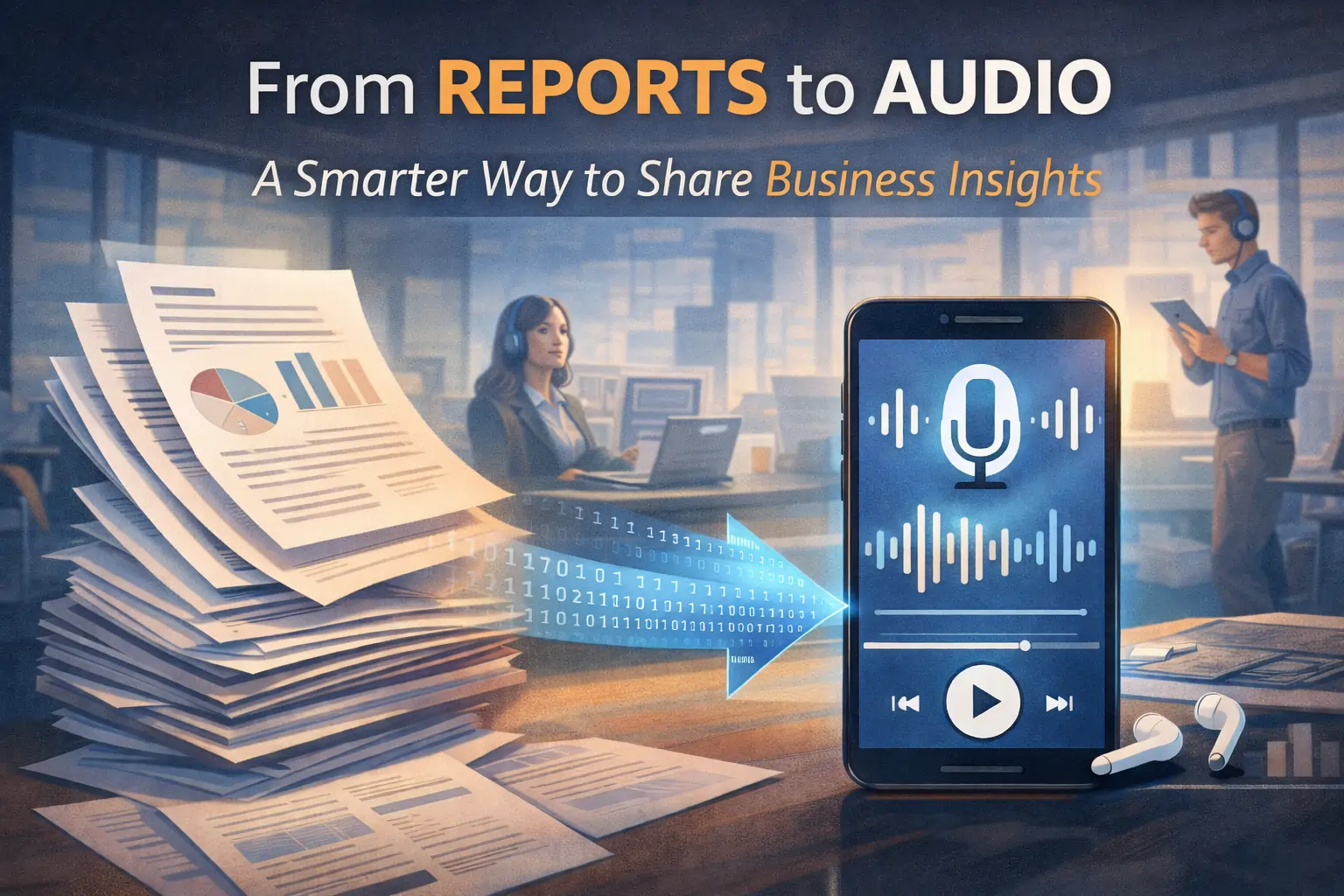
Learn how converting reports into audio helps businesses share insights faster, improve engagement, and align teams more effectively.
Why Traditional Reports No Longer Drive Real Impact
Business reports have always played a central role in organizations. Financial summaries, operational reports, strategy documents, compliance updates, and performance reviews are produced regularly with the intention of informing decisions and aligning teams. On paper, these reports contain valuable insights. In reality, many of them fail to create the impact they were meant to deliver.
Modern workplaces operate at a very different pace. Employees and leaders are constantly switching between meetings, dashboards, emails, and collaboration tools. Attention is fragmented, and uninterrupted reading time is limited. In this environment, long written reports are often postponed, skimmed, or ignored altogether.
This gap between information availability and information consumption is the real problem. Insights only create value when they are actually understood and acted upon. This is why organizations are increasingly moving from reports to audio as a smarter way to share business insights.
Audio transforms static documents into accessible, human-friendly communication that fits naturally into how people work today.
What “From Reports to Audio” Really Means
Shifting from reports to audio does not mean abandoning written documentation. Reports remain essential for compliance, record-keeping, and detailed reference. The change is not about removing reports- it is about changing how insights are communicated.
In practice, this approach involves:
Keeping reports as the source of truth
Extracting the most important insights, decisions, and implications
Converting those insights into structured audio briefings
Using audio as the primary communication layer
Audio becomes the medium through which insights are shared, while reports remain the foundation that supports accuracy and detail.
A Beginner-Friendly Explanation: Why Audio Works Better Than Reports
The simplest way to understand this shift is to look at how people naturally consume information.
Reading a report requires:
Dedicated time
Visual focus
Cognitive effort to interpret and prioritize content
Listening to audio, on the other hand:
Can happen alongside daily tasks
Requires less visual and mental strain
Feels more conversational and engaging
Makes repetition easy
When insights are delivered through audio, people are more likely to absorb the message instead of postponing it. This makes audio especially effective for busy professionals who struggle to keep up with written communication.
Why Traditional Reports Struggle in Modern Organizations
Reports were designed for a work environment that no longer exists. Several factors now limit their effectiveness.
Information overload
Employees are exposed to more content than ever before. Reports compete with emails, meetings, dashboards, and alerts.
Time constraints
Long blocks of uninterrupted reading time are rare, especially for managers and leaders.
Poor prioritization
Many reports mix critical insights with background detail, making it difficult to identify what truly matters.
Low engagement
Even well-written reports are often skimmed, reducing clarity and retention.
These challenges are not a failure of reporting itself. They are a sign that the format no longer matches the reality of modern work.
How Audio Turns Business Insights into Action
Audio changes the way information is received and remembered. When key insights are delivered through voice, listeners naturally focus on meaning rather than structure.
Audio enables organizations to:
Highlight priorities clearly
Add context through tone and emphasis
Reinforce key messages through repetition
Reach people who would never read full reports
Instead of asking whether a report was read, organizations can focus on whether the message was understood.
Core Elements of Effective Report-to-Audio Communication
Turning reports into audio requires intention. Simply reading a document aloud does not create value.
Insight-driven content
Audio works best when it focuses on conclusions, implications, and next steps—not raw data.
Clear structure
Effective audio briefings follow a logical flow: context, insight, impact, and action.
Controlled length
Short, focused briefings (typically 5–15 minutes) maintain attention and clarity.
Plain language
Complex terminology should be explained clearly, especially when reports contain technical or financial information.
When designed correctly, audio briefings feel purposeful rather than repetitive.
Real-World Use Cases Across Experience Levels
Leadership communication
Executives often produce long strategic or performance reports. Audio briefings help leaders communicate priorities clearly and consistently.
Financial and performance reporting
Audio explains what the numbers mean, not just what they are. This improves understanding across non-technical teams.
Cross-team alignment
Distributed teams receive the same message in the same tone, reducing misinterpretation.
Training and onboarding
New employees can listen to summaries of key documents, helping them understand the business faster.
Change management
During transitions, audio reduces uncertainty by explaining intent and context more clearly than written announcements.
These use cases show how audio scales from simple updates to strategic communication.
The Role of AI in Converting Reports to Audio
AI plays a significant role in making report-to-audio workflows scalable. AI systems can:
Analyze long documents
Identify key sections
Generate draft summaries
Convert text into natural-sounding audio
However, AI alone is not enough for business-critical content. While AI accelerates production, humans ensure accuracy, judgment, and accountability. The most effective workflows combine AI efficiency with human validation.
Common Mistakes Organizations Make
Many organizations struggle with audio because they approach it incorrectly.
One common mistake is converting entire reports into long audio recordings. This recreates the same problem in a different format.
Another mistake is skipping human review. AI-generated summaries may misinterpret data or emphasize the wrong points.
Some organizations also treat audio as a one-off experiment rather than a consistent communication channel, limiting adoption.
Best Practices: A Professional Mindset for Audio Communication
Organizations that succeed with audio follow a disciplined approach.
They respect the listener’s time by keeping content concise.
They focus on insight, not volume.
They maintain consistency in format and delivery.
They validate content before distribution.
They integrate audio into broader communication strategies.
This mindset transforms audio into a trusted source of insight rather than another content stream.
Is Moving From Reports to Audio Worth It Today?
Yes—especially in today’s work environment.
Remote and hybrid teams have increased the need for clear, accessible communication. Audio meets this need by making insights easier to consume and understand.
Organizations that rely only on reports risk slow alignment and missed understanding. Those that combine reports with audio move faster and communicate more effectively.
Final Verdict: Expert Insight
Moving from reports to audio is not about replacing documentation. It is about recognizing how people actually consume information today.
Reports store knowledge. Audio delivers insight.
When organizations use both together, insights stop sitting in documents and start driving action. Audio is not a trend—it is a smarter, more human way to share what matters.
Frequently Asked Questions (FAQs)
What does “from reports to audio” mean in practice?
It means converting key insights from reports into structured audio briefings.
Does audio replace written business reports?
No. Reports remain essential for documentation and compliance.
Who benefits most from audio briefings?
Executives, managers, remote teams, and busy professionals.
How long should an audio briefing be?
Ideally between 5 and 15 minutes.
Can audio work for complex business topics?
Yes, when focused on explaining insights rather than raw data.
Is AI required to convert reports into audio?
AI helps scale the process, but human validation remains essential.
Do employees actually listen to audio briefings?
Yes, especially when audio is concise and relevant.
Is audio suitable for regulated industries?
Yes, when supported by governance, review, and compliance controls.
What is the biggest advantage of audio over reports?
Higher engagement and faster understanding of key insights.