

Two different questions#
People searching this are usually asking one of two things, and they need different answers.
"I have no gear." You are willing to talk, you just do not own a microphone and do not want to spend money finding out whether podcasting is for you. Good news: you already own everything you need. Your phone plus a closet full of clothes is a genuinely usable recording setup, and we walk through it in how to start a podcast with no equipment. Skip the rest of this article.
"I do not want to record." Different problem entirely. You do not want to speak, or cannot, or will not keep it up. No microphone will fix that, because the microphone was never the obstacle.
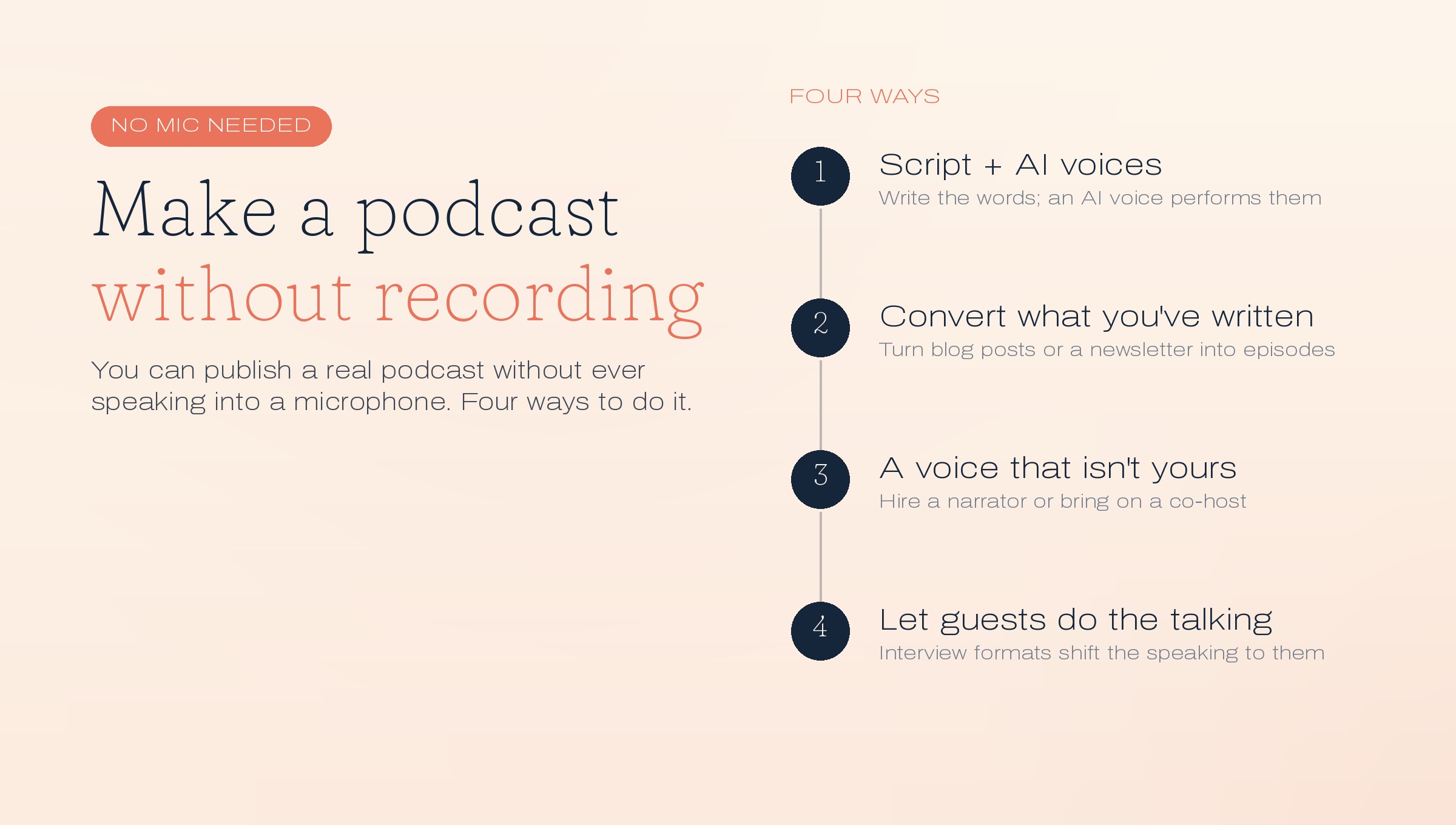
This article is for the second group. You can publish a real podcast without recording a single word yourself, and there are four ways to do it. There are also real trade-offs, and one awkward question about disclosure that most articles on this topic skip. We will get to both.
Why people skip recording#
Worth naming these, because "just record it, you'll get used to it" is unhelpful advice when the reason is not shyness.
You dislike your own voice. Nearly everyone does on playback, and for some people it is enough to stop the project entirely. This is the single most common reason, and it does not fade as fast as people promise.
Recording is slow. A fifteen-minute episode is rarely fifteen minutes of work. It takes, restarts, and editing. That overhead is what kills most shows around episode five.
You are writing in a second language. You may write confidently in a language you would rather not perform in at speed.
Speech difficulties or accessibility reasons. Some people cannot record comfortably, and the advice to "just push through" is not for them.
You want to publish in several languages. You cannot personally voice nine language versions, no matter how much you want to.
Your strength is writing. Some people are excellent on the page and unremarkable on mic. Playing to the wrong strength is a strange choice when you do not have to.
Every one of these is a legitimate reason, and all of them have a workaround.
Method 1: AI voices from a script you write#
This is the main route and the one most people mean. You write the words, an AI voice performs them, and you publish the result. No microphone anywhere in the process.
The important distinction here is what kind of AI audio you produce, because it changes how listenable the result is:
Straight narration. A single AI voice reads your script exactly as written. Fast and faithful. It also inherits everything about how you wrote it, so if your script reads like an essay, it will sound like an essay being read out, which is where most people lose listeners.
A conversational format. Your material gets restructured into a two-host discussion, with one voice explaining and another asking the questions a listener would ask. It sounds more like a podcast because it is shaped like one. The full explanation of that difference is in text to podcast vs text to speech.
If you are writing specifically for audio, a few habits make a large difference. Write shorter sentences than you would for the page. Say the important thing first. Repeat key points, because a listener cannot glance back. And read your script out loud before generating, since anything you stumble over reading, a listener will stumble over hearing.
Method 2: Convert writing you already have#
If you already publish, you may have a back catalogue of episodes sitting there. A blog, a newsletter, an essay archive.
This is the fastest possible start, because the hardest part of podcasting is not the audio, it is having something worth saying every week. If you have written forty posts, you have already done that work. Converting ten of your best gives you a ten-episode back catalogue without writing anything new, which is also enough for a show to look established rather than abandoned when someone finds it.
The mechanics of doing that well, which posts to pick, what to strip out, where to publish, are covered in repurpose blog posts into audio in minutes, and the wider strategy sits in our guide to content repurposing.
One caution: not everything you have written should become audio. Anything heavy on links, tables, screenshots, or step-by-step instructions people follow along with does not survive the trip. Convert the pieces where the value is in the argument.
Method 3: A human voice that is not yours#
Sometimes the answer is a person, just not you.
Hire a narrator. Voice actors are more affordable than most people assume for short-form work, and a good one brings warmth that AI still does not match. If your show is a small number of high-value episodes rather than a weekly grind, this is worth pricing.
Bring in a co-host who likes the mic. You write and produce, they perform. This is a common and durable arrangement, and it plays to both people's strengths.
The trade-off is cost and coordination. A narrator adds a dependency and a bill; a co-host adds a scheduling problem. But if what you want is a human voice and it simply cannot be yours, these are the honest options.
Method 4: Let other people do the talking#
Interview and guest-led formats shift almost all of the speaking away from you. You research, you ask short questions, your guest talks for forty minutes.
This does not eliminate recording, so it is a partial answer rather than a full one, but it minimises it dramatically. Your on-mic contribution can be a handful of prepared questions and some brief transitions. Plenty of well-known shows are effectively this.
It also solves a content problem at the same time, since guests bring their own material and, usefully, their own audience, which is one of the more reliable ways to grow a show. That mechanic is covered in how to grow a podcast audience without ads.
What you give up#
An honest section, because the trade-offs are real and most articles about AI podcasting skip them.
Parasocial connection. A large part of why people become loyal to a podcast is the sense of knowing the host. That comes from a real human voice with real quirks, and an AI voice does not build it in the same way. If your ambition is a devoted audience who feel they know you, recording is genuinely the better path and you should take the discomfort.
Spontaneity. The best moments in podcasting are often unplanned: a tangent, a laugh, a thought arriving mid-sentence. A written-then-voiced episode has none of that, because everything was decided in advance.
A sound of your own. AI voices are good and getting better, but they are shared. Someone else's show may use the same voice as yours, and none of them is distinctively you.
The clearest way to think about it: if the content is the product, not recording costs you little. If you are the product, it costs you a lot. A show explaining a subject can work beautifully without your voice. A show whose appeal is your personality mostly cannot.
Should you tell listeners it is AI?#
This question is coming for everyone publishing AI audio, and it is worth deciding deliberately rather than by default.
The practical case for disclosing: listeners increasingly recognise synthetic voices, and being told after the fact feels worse than being told upfront. A short line in your show notes costs nothing and removes any chance of the discovery becoming the story. Some platforms and directories also have their own rules about labelling AI-generated content, and those change, so check the current terms wherever you publish rather than assuming.
The practical case against making a feature of it: if the value is the ideas and the audio is simply a delivery format, a heavy disclaimer at the top of every episode makes something ordinary sound suspicious.
A reasonable middle position most creators land on: mention it plainly in your show description, do not lead every episode with it, and never claim the voice is you when it is not. That last part is the line worth holding, because presenting a synthetic voice as your own is the version of this that damages trust when it comes out.
What "no recording" does not remove#
Worth setting expectations, because the phrase suggests a shortcut that only partly exists.
You still have to decide what the episode is about, and that is the hard part. You still have to write it, and writing for audio is a skill. You still need somewhere to host the audio and an RSS feed if you want it in Apple Podcasts or Spotify, which the conversion tool usually does not provide, and that setup is covered in how to turn your newsletter into a podcast. And you still need to publish consistently, because the format you chose does not change the fact that abandoned shows do not grow.
What you have removed is the recording, the takes, the editing, and the self-consciousness. That is a meaningful amount of the work and, for many people, the entire reason the project never started. It is not all of it.
Where Sprep fits#
We make Sprep, so treat this as an interested party talking.
Sprep is built for method one and method two. You give it something written, a script, a blog post, a newsletter, a document, and it drafts a two-host conversation rather than a single narrated readout. You then review and edit every word of that script before any audio is generated, which matters more than it sounds: it is where you fix pronunciation of names, cut anything that reads oddly aloud, and make sure the episode says what you meant. Then it generates the audio, in 70+ languages if you want the same episode to reach more than one audience.
Where it is the wrong choice: if your show's appeal is your personality and your voice, record it, and go and read the no-equipment guide instead. If you want music beds and sound design, use a full production studio. And if the writing itself is unclear, conversion will faithfully produce a clear recording of unclear thinking.
You can make your first episode free, with the script editor included, and hear what your writing sounds like before committing to anything. The broader picture of how written material becomes listenable audio is in document to podcast: how to turn any file into audio people finish.
Frequently asked questions
Can you make a podcast without recording your voice?
Yes. The main routes are generating AI voices from a script you write, converting writing you already have such as blog posts or newsletters, hiring a narrator, or running a guest-led interview format where others do nearly all the talking. Only the last still involves any recording.
Can you make a podcast without a microphone?
Yes, and there are two versions of this. If you are willing to speak, your phone in a closet full of clothes works well enough to publish. If you do not want to speak at all, AI voice tools can perform a script you write, so no microphone is involved anywhere in the process.
What is the difference between a podcast with no equipment and one with no recording?
No equipment means you still record, just using what you already own instead of buying gear. No recording means you never speak into anything, and the audio is produced from written material or by someone else. They solve different problems, so it is worth knowing which one applies to you.
Is an AI-voiced podcast still a real podcast?
Technically yes, since a podcast is an RSS feed with audio episodes, and nothing about that definition requires a human voice. Practically it depends on your audience and goal. A show explaining a subject works fine with AI voices; a show whose appeal is the host's personality generally does not.
Should you tell listeners your podcast uses AI voices?
Disclosing it plainly in your show description is the sensible default, since listeners increasingly recognise synthetic voices and finding out later feels worse than being told upfront. Platforms also set their own labelling rules that change over time, so check current terms. The firm line is never claiming a synthetic voice is your own.
What do you lose by not recording a podcast yourself?
Mainly parasocial connection, the sense of knowing the host that drives a lot of podcast loyalty, plus spontaneity and a distinctive voice of your own. If the content is the product, this costs you little. If you are the product, it costs a lot, and recording is worth the discomfort.
How do you write a podcast script for AI voices?
Write shorter sentences than you would for the page, lead with the important point, and repeat key ideas since listeners cannot glance back. Read the script aloud before generating, because anything you stumble over reading, a listener will stumble over hearing. Restructuring into a conversation usually holds attention better than a single narrated voice.
Can you turn old blog posts into podcast episodes?
Yes, and it is the fastest way to start, since the hard part of podcasting is having something worth saying rather than producing audio. Converting ten strong archive posts gives you a ten-episode back catalogue with no new writing. Skip anything heavy on links, tables, screenshots, or follow-along instructions.
Does making a podcast without recording actually save time?
It removes recording, retakes, and editing, which is a significant share of the work and often the reason a show never launches. It does not remove deciding what to say, writing it, arranging hosting and an RSS feed, or publishing consistently. The bottleneck moves from production to having something worth publishing.
Is a narrator better than an AI voice?
For warmth and personality, usually yes, and voice actors are more affordable for short work than most people expect. The trade-offs are cost and an added dependency. AI voices win on speed, on publishing in multiple languages, and on being available at two in the morning when you finish writing.
Make your first episode without saying a word
The free plan turns one thing you have written into a full episode of up to 15 minutes, with the script editor included so you can fix every word before any audio is generated.
See it in action