
You already own everything you need#
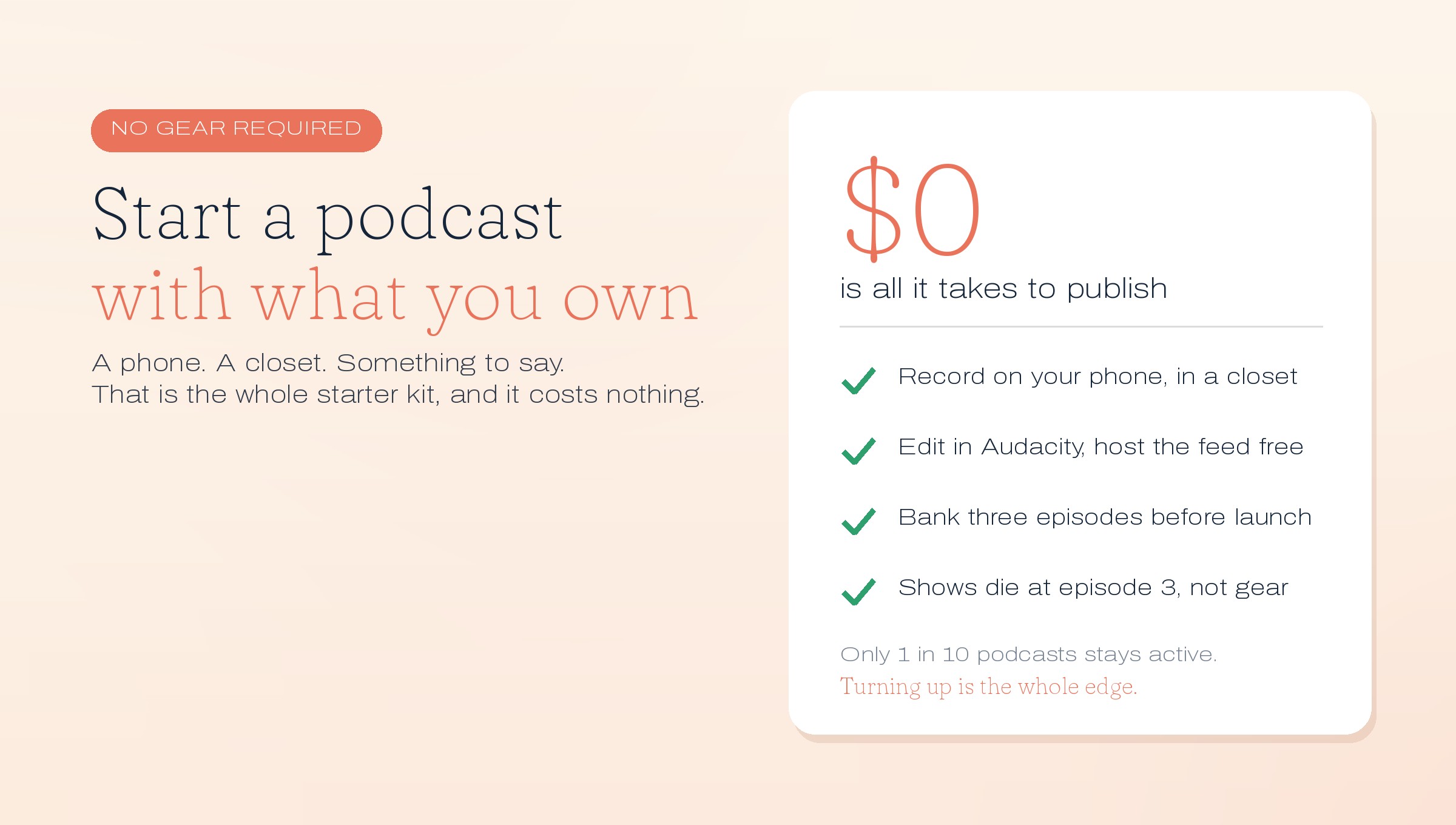
The phone in your pocket can record a publishable podcast episode today. Not a compromise version. A genuinely publishable one.
Modern phone microphones are good. They are close to your mouth, which matters more than almost anything else, and they record at a quality that listeners will not notice or care about once you are three sentences into something interesting.
You also need free editing software and free hosting, both of which exist. Total spend to publish episode one: zero.
This guide is the version nobody writes, because there is no affiliate commission on a phone you already bought.
Why every other guide starts with a microphone#
Search this topic and you will find a remarkably consistent structure. Step one is almost always gear. One of the guides currently ranking opens with "get a decent microphone." Google's own AI summary lists recording with quality equipment as a core step.
There is a reason for that consistency, and it is worth naming plainly: podcast guides make money on gear. Microphone recommendations carry affiliate links. Hosting recommendations carry referral fees. The advice is not dishonest exactly, but it is not neutral either, and it consistently pushes new podcasters toward spending money at the precise moment when spending money is the least useful thing they could do.
We have an interest too, which we will get to at the end. Apply the same skepticism there.
The number that should shape every decision you make#
Roughly 4.7 million podcasts are registered worldwide. Depending on how you define active, somewhere between about 300,000 and 480,000 of them have published anything recently.
So around one in ten is alive.
The failure statistics vary a lot by source and definition, and you should treat any single number with suspicion. A Podnews report cited by Forbes put the share of podcasts that stop after episode three at 90 percent. Podbean's analysis found around 47 percent stop at three or fewer episodes, and that only about 8 percent ever publish ten. Another analysis of the Podcast Index found that of more than four million indexed feeds, only roughly 300,000 to 400,000 have both published recently and accumulated at least ten episodes.
The exact figure is contested. The direction is not. Most podcasts stop very early, and none of them stopped because the microphone was insufficient.
They stopped because of burnout, because the workload was underestimated, because life intervened, or because the creator lost interest. Gear does not prevent any of that. If anything, spending 400 dollars on equipment before episode one raises the emotional cost of quitting, which is a strange thing to do to yourself at the point of maximum uncertainty about whether you even like doing this.
Buying equipment is the most satisfying form of podcast procrastination available. It feels like progress. It produces a package in the mail. It postpones the actual difficult thing, which is talking into a device and publishing the result.
The good news hiding inside that number#
If only around one in ten registered podcasts is active, and fewer still have ten or more episodes, then the competitive field is roughly a tenth of what the headline number suggests.
You are not competing with 4.7 million shows. You are competing with a few hundred thousand, in a market with around 619 million listeners globally.
And your actual competitive advantage as a beginner is not audio fidelity. It is publishing episode four. Do twelve episodes on a phone and you are meaningfully ahead of the overwhelming majority of people who ever registered a feed, several of whom own very nice microphones.
What actually determines whether you sound good#
Here is the part gear-first guides skip, because it does not sell anything.
Your room matters more than your microphone. This is not a motivational reframe, it is basic acoustics. A microphone captures the sound reaching it, which includes your voice plus every reflection of your voice bouncing off bare walls, windows, and hard floors. Those reflections are what make recordings sound hollow, distant, and amateur. An expensive microphone in a bare room captures those reflections in higher fidelity. It sounds worse, not better, than a phone in a good space.
The fix is free and slightly ridiculous. Record in a clothes closet, or sit on the floor with a duvet draped over you and the phone. Soft materials absorb reflections. A closet full of hanging clothes is, acoustically, a treated recording booth that you already own. Professional voice actors have recorded in closets for decades.
Distance is the second lever. Hold the phone about a hand's width from your mouth, slightly off to the side so your plosives do not hit it directly. Closer is better because it improves the ratio of your voice to everything else in the room.
Then the obvious things. Turn off fans, air conditioning, and anything with a compressor. Silence notifications rather than just muting the ringer. Close the window. Record at a time when the building is quiet.
Get those four things right with a phone and you will comfortably out-perform someone with a 300 dollar microphone in an untreated home office. That is not encouragement, it is just how sound works.
Record your first episode with a phone#
Concretely:
- Use the stock voice memo app. It records at an entirely adequate quality. Do not download anything yet.
- Go into the closet. Genuinely. Or drape a duvet over yourself and the phone.
- Put the phone on a folded towel rather than holding it, so you are not transmitting hand movement noise into the recording.
- Record ten seconds and listen back on headphones before recording the whole thing. This single habit will save you more re-records than any equipment purchase.
- Say your first sentence twice. People flub the opening constantly and it is easier to cut a duplicate take than to re-record later.
- Leave three seconds of silence at the start before speaking. Editing software uses that to sample and remove room noise.
- Do not stop when you make a mistake. Pause, take a breath, and say the sentence again cleanly. You will cut the bad take in editing. Restarting from the top is how episodes never get finished.
- Aim for fifteen to twenty minutes for the first episode. Long enough to say something, short enough to actually finish editing.
The free stack#
Editing: Audacity. Free, open source, and considerably more than you need. You will use three functions: cut the bad takes, apply noise reduction using that silent section you recorded, and normalize the volume. That is it. Ignore everything else in the interface.
Hosting: a free tier. Several hosting platforms have free plans with storage limits that are generous enough for a first season. Your host generates the RSS feed, which is the thing you submit to Apple, Spotify, and elsewhere. You do not need to understand RSS beyond that.
Artwork: whatever you can make in a free design tool. It needs to be square, legible at thumbnail size, and not embarrassing. It does not need to be good yet, and it is trivially replaceable later.
Total cost: zero. Total time from finished recording to live episode: an afternoon the first time, under an hour after that.
The parts that actually matter#
Since gear does not determine whether your show survives, here is what does.
A concept narrow enough to sustain. "A podcast about business" runs out of ideas by episode six because it has no constraints to push against. "A podcast about how small manufacturers handle succession" has a nearly endless supply of specific episodes. Narrow topics are easier to sustain, easier to find, and easier to become known for. Findability is largely a metadata problem, and the fix is covered in how to grow a podcast audience without ads.
A format you can repeat without dreading it. Solo commentary is the lowest logistical overhead and the highest demand on you. Interviews outsource the content but add scheduling, which is the single most common reason shows fall behind. Pick based on which failure mode you can live with.
A batch before you launch. Record three episodes before publishing any of them. This is the most effective anti-podfade measure available, because it means the first time life gets busy you have a buffer rather than a gap. The three-episode buffer is roughly the difference between the shows that survive and the ones that appear in the statistics above.
A cadence you can defend on a bad week. Fortnightly that you sustain for two years beats weekly that you sustain for five episodes. It is easy to increase later and demoralizing to reduce.
Publishing before you feel ready. Your first episodes will be worse than your later ones. This is true of literally everyone, and it does not resolve by waiting.If you already run a blog, you may have several episodes' worth of material sitting in the archive already: see repurpose blog posts into audio in minutes.
When to actually buy something#
After roughly ten episodes, if you are still enjoying it, buy in this order:
- Headphones, if you do not have any. Monitoring what you are recording catches problems at the moment.
- A USB microphone in the 60 to 100 dollar range. This is a genuine upgrade over a phone, but only once your room is sorted.
- A pop filter or foam windscreen. Cheap, and it fixes the harsh plosive sounds that are otherwise hard to edit out.
That is the whole list for most solo shows. If somebody is recommending an audio interface and a condenser microphone for episode one, notice what they are being paid for.
If recording is not the part you want to do#
Everything above assumes you want to talk into a device. Some people do not, and it is worth being honest about that case rather than pretending everybody has the same obstacle.
If you already write a newsletter, a blog, a Substack, then your bottleneck is not gear and not ideas. It is that recording, editing, and publishing audio is a second job on top of the writing you are already doing. That is a real reason people never start.
We built a tool for that case, so treat this as an interested party talking. Sprep converts things you have already written into two-host conversational podcast episodes, with a person reviewing and editing the script before any audio is generated. The free plan does one document up to fifteen minutes, which is enough to test whether an audio version of your writing does anything for your audience. It fits into the wider approach we cover in our guide to content repurposing, where the argument is that audio reaches a block of your audience's time that written content simply cannot.
Where it is the wrong answer: If the appeal of your podcast is your voice, your personality, your laugh, and the way you tell a story, record it yourself. Go and get a phone and a closet. That is what this article is about, and no generated audio substitutes for a person who is genuinely good company. Use conversion for turning existing writing into a second format, not as a way to avoid being yourself.
Frequently asked questions
Can you start a podcast with no equipment?
Yes. A modern smartphone records at a quality that is entirely publishable, and free editing software and free hosting tiers cover the rest. The total cost to publish your first episode can be zero. Recording in a soft space such as a clothes closet matters considerably more than what device you use.
What equipment do you actually need to start a podcast?
Strictly, a recording device you already own and somewhere quiet with soft surfaces. Everything else is optimization. If you continue past roughly ten episodes, headphones and a USB microphone in the 60 to 100 dollar range are the first purchases worth making, in that order.
Does microphone quality matter for podcasts?
Less than the room you record in. A microphone captures your voice plus every reflection off hard walls and floors, and better microphones capture those reflections more accurately. Recording in a closet or under a duvet with a phone typically sounds better than an expensive microphone in an untreated room.
How much does it cost to start a podcast?
It can cost nothing. Published estimates commonly range from 50 to over 1,000 dollars, but those figures assume you buy equipment. Using a phone, free editing software, and a free hosting tier, your first episode costs only your time.
What percentage of podcasts fail?
Estimates vary widely by source and definition. One Podnews report put the share stopping after episode three at 90 percent, while other analyses found around 47 percent stop at three or fewer episodes and only about 8 percent reach ten. Of roughly 4.7 million registered podcasts, only about 300,000 to 480,000 are currently active.
Why do most podcasts stop?
Burnout, underestimating the workload, scheduling difficulty, and loss of interest. Equipment is essentially never the cause. This is why recording a buffer of three episodes before launching is more useful than any purchase, since it protects you the first time life gets busy.
How long should your first podcast episode be?
Fifteen to twenty minutes is a sensible target. Long enough to say something substantial, short enough that editing it does not become an ordeal that discourages you from making the next one. Episode length matters far less than whether episode four exists.
How do you record a podcast on your phone?
Use the built-in voice memo app, record in a closet or under a duvet, rest the phone on a folded towel about a hand's width from your mouth and slightly off-axis, leave three seconds of silence at the start for noise removal, and test ten seconds on headphones before recording the full episode.
Is it too late to start a podcast in 2026?
The competitive field is far smaller than headline numbers suggest. Around one in ten registered podcasts is active, and fewer still have more than ten episodes, while the global listener base is projected around 619 million. The barrier to standing out is consistency rather than saturation.
Can AI make a podcast for you?
AI can convert existing written material into audio and draft scripts, which suits creators who already write and do not want to add recording to their workload. It does not replace a host whose personality is the reason people listen. If your voice is the product, record it yourself.
If you already write, try the audio version
The free plan turns one thing you have already written into a complete podcast episode of up to 15 minutes, with the script editor included so you can fix every word before any audio is generated.
See it in action