Feb 27, 2026
Why Enterprises Need Private Audio Platforms
Why Enterprises Need Private Audio Platforms for Security
Andy Suter
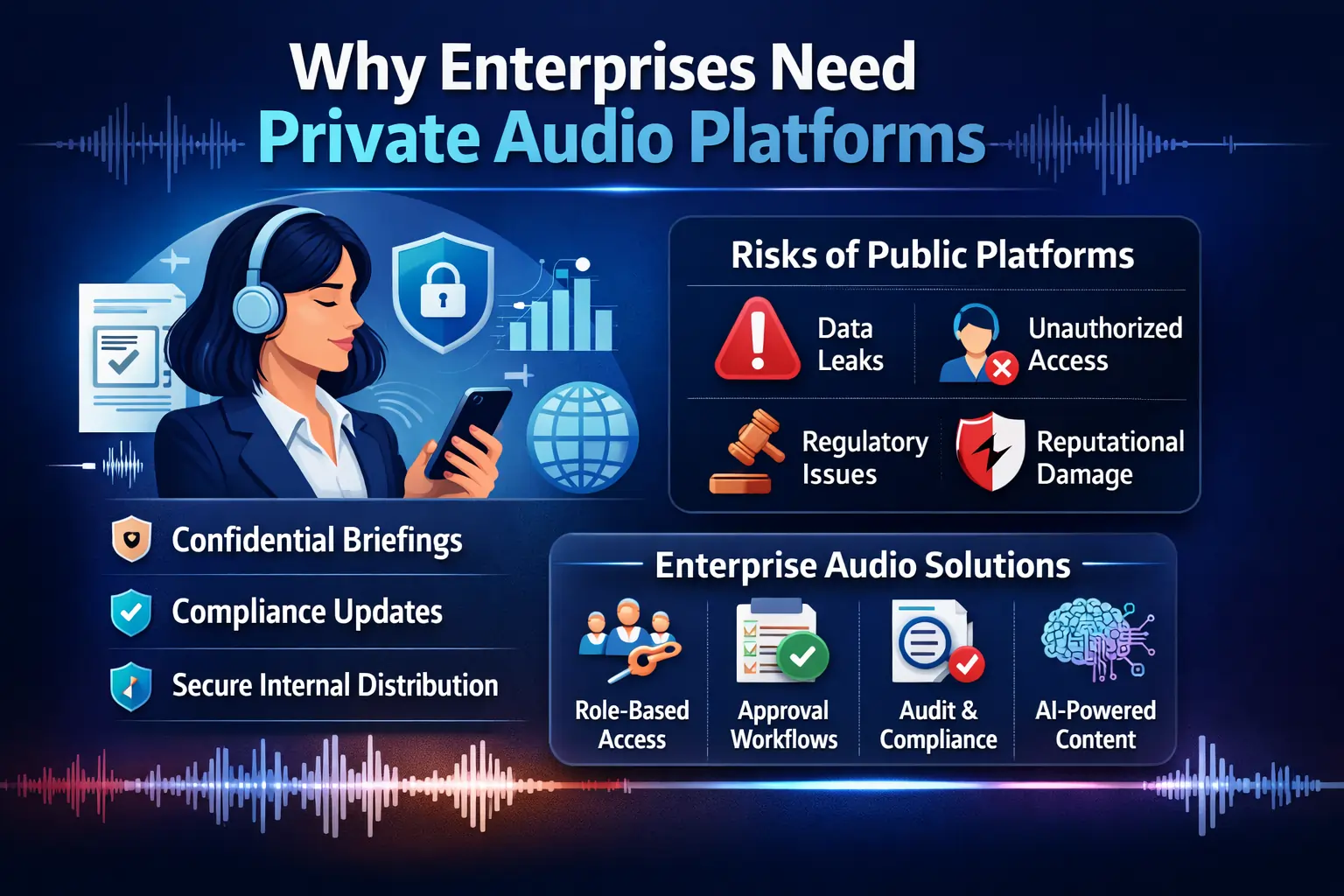
Discover why enterprises need private audio platforms for secure internal communication, compliance control, and risk-free audio distribution.
Introduction: Audio Adoption Is Rising- But So Are Risks
Enterprises are increasingly adopting audio for internal communication. Leadership briefings, training modules, compliance updates, and strategy explainers are now being delivered in audio format.
However, as audio adoption grows, so does the need for control.
Using public podcast platforms or informal distribution tools may work for marketing. But for internal enterprise communication, the risks are significantly higher.
Sensitive business updates, confidential strategy discussions, and regulated compliance information require a secure infrastructure.
This is why enterprises are moving toward private audio platforms designed specifically for internal use.
Read More: Corporate Podcast Generators: How Companies Create Private Audio Channels
The Risk of Using Public Audio Platforms
Public podcast tools are built for open distribution.
They typically lack:
Enterprise-grade access controls
Role-based permissions
Compliance workflows
Audit trails
Content governance mechanisms
If sensitive internal content is distributed through public or semi-public tools, organizations face risks such as:
Unauthorized access
Data leakage
Regulatory non-compliance
Reputational damage
In regulated industries, these risks are unacceptable.
What Makes a Private Audio Platform Enterprise-Ready?
A private audio platform is designed for secure internal distribution. It includes features that align with enterprise IT and compliance standards.
1. Role-Based Access Control
Employees access only the content relevant to their team or department.
2. Approval Workflows
Audio briefings are reviewed before distribution, ensuring accuracy and compliance.
3. Version Tracking
Updates to policies or strategy are reflected in updated audio versions with clear audit history.
4. Secure Hosting & Distribution
Content is distributed internally, not indexed publicly or searchable outside the organization.
5. Ownership & Governance
Clear accountability for who creates, reviews, and publishes content.
Compliance and Regulatory Considerations
In industries such as healthcare, finance, pharmaceuticals, and legal services, internal communication must meet regulatory standards.
Private audio platforms help ensure:
Controlled dissemination of regulated information
Documented approval processes
Audit-ready communication records
Reduced compliance risk
Audio should not become a compliance blind spot.
Read Also: Enterprise AI Audio Platforms: How Companies Deliver Knowledge at Scale
Security Is Not Just IT’s Concern
Internal communication impacts every department.
HR shares policy updates.
Legal shares regulatory guidance.
Leadership shares strategic direction.
Operations shares procedural changes.
Without secure audio infrastructure, every department faces risk exposure.
Security must be embedded into the communication channel itself.
Supporting Distributed and Hybrid Workforces
As enterprises expand globally, employees work across locations and time zones.
Private audio platforms allow:
Secure asynchronous updates
Controlled global distribution
Region-specific content segmentation
Multilingual support
This ensures clarity without compromising security.
AI and Private Audio: Scaling Without Losing Control
AI-powered document-to-audio systems allow enterprises to scale internal communication efficiently.
However, automation must operate within a secure framework.
Private audio platforms combine:
AI-driven content generation
Human validation
Structured approval workflows
Secure distribution controls
This balance enables scalability without sacrificing governance.
Common Mistakes Enterprises Make
Treating internal audio like marketing podcasts
Ignoring access control requirements
Skipping approval workflows
Failing to integrate audio into compliance systems
Using generic consumer tools for enterprise communication
Audio must be treated as official infrastructure- not an experiment.
The Strategic Advantage of Private Audio
Enterprises that implement secure private audio platforms gain:
Higher employee engagement
Reduced meeting overload
Faster information distribution
Improved knowledge retention
Lower compliance risk
Security and clarity can coexist- when the platform is designed correctly.
Final Thoughts
Audio is becoming a core component of enterprise communication.
But without security, governance, and compliance controls, internal audio introduces unnecessary risk.
Private audio platforms provide the structure enterprises need to scale communication responsibly.
For modern organizations, secure audio is not optional- it is foundational.
Read Also: Enterprise AI Audio Platforms: How Companies Deliver Knowledge at Scale
Frequently Asked Questions (FAQs)
1. What is a private audio platform for enterprises?
A private audio platform is a secure, internal system that allows organizations to distribute audio briefings, training modules, and leadership updates exclusively to employees with controlled access.
2. Why can’t enterprises use public podcast platforms for internal communication?
Public podcast platforms are designed for open distribution. They lack enterprise-grade security features such as role-based access control, approval workflows, audit trails, and compliance safeguards.
3. What security features should an enterprise audio platform include?
A secure enterprise audio platform should provide:
Role-based access control
Secure hosting and distribution
Approval workflows
Version tracking
Audit logs
Content ownership management
4. Are private audio platforms compliant with regulatory requirements?
When properly implemented, private audio platforms support compliance by ensuring controlled dissemination, documented approvals, and audit-ready communication records.
5. Which industries benefit most from private audio platforms?
Highly regulated industries such as healthcare, finance, pharmaceuticals, legal services, and enterprise IT environments benefit significantly due to strict compliance and confidentiality requirements.
6. How does AI integrate with private audio platforms?
AI can convert documents into structured audio briefings, summarize reports, and automate updates. However, enterprises typically combine AI with human validation to ensure accuracy and compliance.
7. Can private audio platforms support global teams?
Yes. Private audio platforms can segment content by department, region, or role, enabling secure asynchronous communication across distributed and hybrid workforces.
8. Do private audio platforms replace written documentation?
No. They complement written documentation. Written records remain essential for legal and reference purposes, while audio enhances clarity and accessibility.
9. How do private audio platforms reduce risk?
By restricting access, enforcing approval workflows, and maintaining version history, private audio platforms prevent unauthorized distribution and reduce compliance exposure.
10. What is the strategic value of secure internal audio?
Secure internal audio improves engagement and knowledge retention while maintaining governance and compliance - allowing enterprises to scale communication without increasing risk.