Jan 12, 2026
Why Document-to-Podcast Tools Are Gaining Enterprise Adoption
Why Document-to-Podcast Tools Are Gaining Enterprise Adoption
Andy Suter
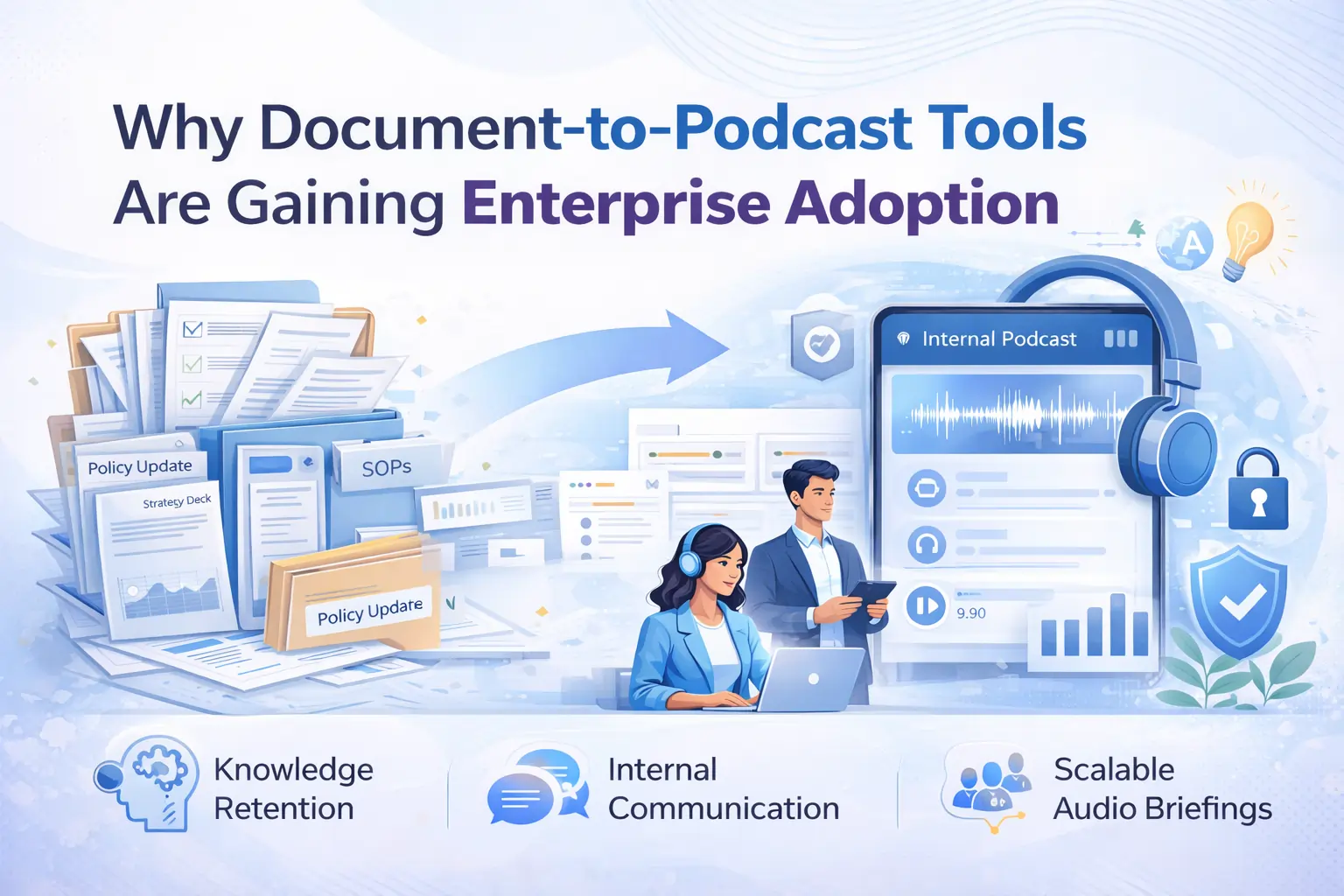
Discover why enterprises are adopting document-to-podcast tools to improve knowledge retention, internal communication, and scalable audio briefings.
Document-to-podcast tools are platforms that convert written business documents—such as reports, SOPs, training manuals, policies, and strategy decks—into structured, listenable audio or podcast-style briefings.
For enterprises, this shift is not about convenience alone. It is about solving a persistent communication and knowledge-retention problem.
Modern businesses generate massive volumes of internal content, yet employees consistently struggle to read, retain, and apply it. Long PDFs, dense language, constant updates, and limited time all work against effective knowledge transfer. Document-to-podcast tools address this gap by turning static information into engaging, accessible, and actionable audio briefings.
As remote work, distributed teams, and asynchronous communication become the norm, enterprises are increasingly adopting document-to-podcast tools to ensure critical knowledge actually reaches employees—without adding more meetings or emails.
Why Document-to-Podcast Tools Are Gaining Enterprise Adoption
The growing adoption of document-to-podcast tools in enterprise environments is driven by a combination of behavioral, operational, and technological factors.
Employees Don’t Read- But They Do Listen
Multiple studies show that employees skim or postpone reading internal documents, especially when they are long or technical. Audio changes consumption behavior.
With document-to-podcast tools, employees can listen:
While commuting
Between meetings
During focused work sessions
While performing routine tasks
This dramatically increases content exposure and completion rates compared to text alone.
Knowledge Retention Is Higher With Audio
Audio engages tone, pacing, and emphasis—elements missing from written documents. When information is delivered as a narrative rather than raw text, employees are more likely to remember key points and understand context.
For enterprises, this translates into:
Better onboarding outcomes
Faster training absorption
Clearer understanding of policies and strategy
Enterprises Need Scalable Communication
As organizations grow, internal communication becomes harder to manage. Document-to-podcast tools allow enterprises to scale consistent messaging across departments, regions, and roles—without relying on live sessions or repeated explanations.
Featured Snippet: How Document-to-Podcast Tools Work (Step-by-Step)
Here is how enterprises typically use document-to-podcast tools:
Upload a document (PDF, Word, slides, SOP, report)
AI analyzes structure and key points
Content is summarized and organized for audio
Human validation or editing ensures accuracy (enterprise-grade tools)
Audio is generated in a natural, professional voice
Podcasts are distributed securely to internal teams
This process turns static documents into structured audio briefings, not just narrated text.
Document-to-Podcast Tools vs Traditional Text-to-Speech
Many enterprises initially confuse document-to-podcast tools with basic text-to-speech software. The difference is critical.
Feature | Text-to-Speech | Document-to-Podcast Tools |
Purpose | Read text aloud | Create structured audio briefings |
Summarization | No | Yes |
Enterprise workflows | Limited | Designed for enterprises |
Human validation | Rare | Often supported |
Distribution control | Public-focused | Private & internal |
Knowledge retention | Low | High |
Enterprises adopt document-to-podcast tools because raw narration is not enough for business communication.
Accuracy and Trust: The Non-Negotiable Enterprise Requirement
Accuracy is the single most important factor driving enterprise adoption.
Internal documents often include:
Compliance requirements
Legal language
Financial data
Strategic decisions
Any misinterpretation or AI hallucination can create serious risk.
That is why enterprise-ready document-to-podcast tools support human-in-the-loop validation. This allows teams to:
Review scripts before audio generation
Edit language for clarity
Approve final content for compliance
Without this layer, audio content loses credibility quickly—and enterprises stop trusting the tool.
Structured Audio: Why Raw Narration Fails
Business documents are written to be read, not heard. Simply converting text to audio often results in:
Long, monotonous narration
Poor listener engagement
Confusion around priorities
Professional document-to-podcast tools restructure content for listening by:
Highlighting key takeaways
Grouping related ideas
Emphasizing decisions and actions
Creating a logical narrative flow
This turns documents into audio briefings, not audio files.
Enterprise Use Cases Driving Adoption
Document-to-podcast tools are being adopted across multiple enterprise functions.
Onboarding and Training
New hires can listen to onboarding podcasts instead of reading lengthy manuals. This accelerates ramp-up time and reduces information overload.
Compliance and Policy Updates
Audio briefings help employees understand what changed, why it matters, and what actions are required—without misinterpretation.
Leadership and Strategy Communication
Executives can share strategic updates as short podcasts, ensuring consistent messaging across the organization.
Internal Knowledge Sharing
Reports, playbooks, and research can be consumed on demand, improving cross-team alignment.
Multilingual and Global Team Enablement
For global enterprises, language consistency is a major challenge.
Document-to-podcast tools that support multilingual audio generation allow organizations to-
Deliver the same message across regions
Preserve meaning and intent
Reduce duplication of effort
This capability is a major reason multinational companies are adopting document-to-podcast platforms.
Scalability Without Losing Control
Speed matters in business communication—but so does governance.
Enterprise adoption depends on tools that:
Generate audio quickly
Scale across departments
Maintain review and approval workflow
Offer visibility into what is published
Document-to-podcast tools designed for enterprises balance automation with oversight, enabling scale without chaos.
Common Mistakes Enterprises Make (And How to Avoid Them)
Mistake 1: Treating Audio as a Replacement for Documents
Audio should complement, not replace, written content.
Mistake 2: Using Consumer Podcast Tools Internally
Most podcast tools are built for marketing, not internal communication.
Mistake 3: Skipping Validation
Unchecked AI audio erodes trust quickly.
Mistake 4: Overloading Employees With Long Audio
Effective audio briefings are concise—typically 5–10 minutes.
Advanced Tips Used by High-Performing Enterprises
Create role-specific audio briefings (executives vs new hires)
Use audio for reinforcement, not first exposure
Combine audio with internal portals or LMS platforms
Track listen completion and engagement patterns
Standardize audio formats across departments
Business Impact of Document-to-Podcast Adoption
Enterprises adopting document-to-podcast tools report:
Higher engagement with internal content
Faster onboarding and training cycles
Reduced meeting load
Better alignment across teams
Improved knowledge retention
Audio turns internal knowledge into a repeatable, scalable asset.
Why Adoption Will Continue to Grow
Document-to-podcast tools are not a trend—they are a response to a fundamental enterprise problem: information overload without understanding.
As organizations become more distributed and fast-moving, audio offers a human-centered way to communicate knowledge at scale. Enterprises that adopt document-to-podcast tools thoughtfully- prioritizing accuracy, structure, and trust—gain a significant advantage in alignment, productivity, and learning effectiveness.
The future of internal communication is not more documents.
It is better delivery of knowledge.
FAQs (People Also Ask)
What is a document-to-podcast tool?
A document-to-podcast tool converts written business documents into structured, listenable audio briefings designed for internal use.
How is it different from text-to-speech?
Text-to-speech reads content aloud, while document-to-podcast tools summarize, structure, and optimize content for listening.
Are document-to-podcast tools safe for compliance content?
Enterprise-grade tools support human validation and approval workflows, making them suitable for regulated information.
How long should enterprise audio briefings be?
Most effective briefings are between 5 and 10 minutes.
Can document-to-podcast tools support global teams?
Yes, many tools offer multilingual audio generation with consistent messaging.
Do employees actually listen to internal podcasts?
Yes—completion rates are typically higher than reading long documents.
Are these tools meant for public podcasts?
No. Enterprise tools are designed for private, internal distribution.