Jan 7, 2026
Why Businesses Are Moving from Documents to Audio
Why Businesses Are Moving from Documents to Audio
Andy Suter
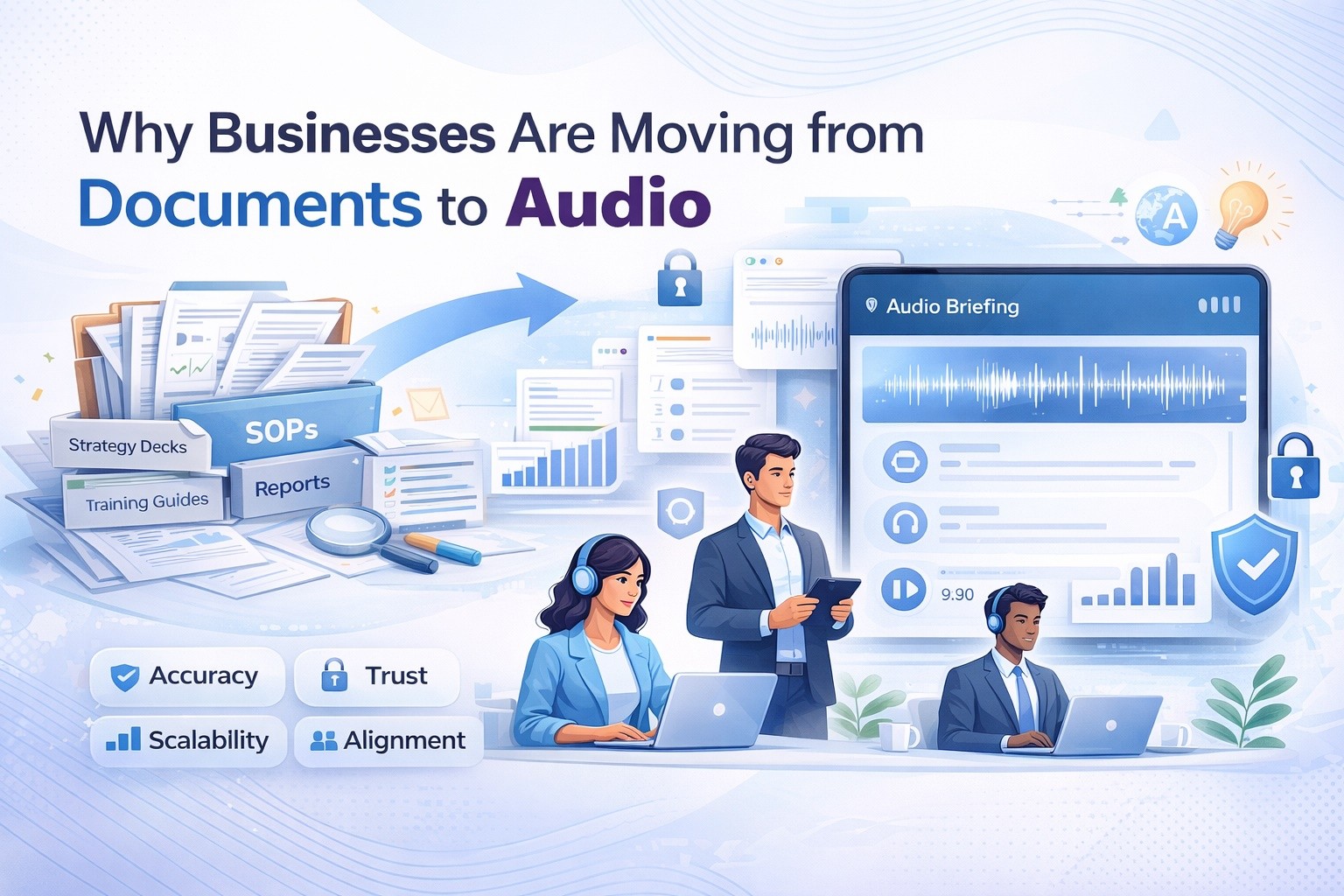
Discover what businesses should look for in document-to-audio tools, from accuracy and trust to scalability and knowledge retention.
Businesses Generate a constant stream of internal documents-strategy decks, SOPs, onboarding guides, compliance updates, reports, and training material. While these documents are critical for day-to-day operations, many organizations face the same challenge: employees don’t consistently read or retain them. Lengthy PDFs, dense language, and time constraints often prevent important information from being absorbed and applied.
This is why documents to audio tools are gaining serious attention in enterprise environments. By converting written documents into structured audio briefings, businesses can make internal knowledge easier to consume, easier to remember, and easier to act on. However, not all document-to-audio tools are built for enterprise needs. Choosing the right solution requires looking beyond basic text-to-speech capabilities and focusing on accuracy, trust, scalability, and alignment with internal workflows.
Why Businesses Are Moving from Documents to Audio
Written documents have long been the default format for internal communication. While they are necessary for record-keeping and compliance, they are not always effective for knowledge transfer. Employees are expected to process large volumes of information quickly, often across multiple platforms and time zones.
Audio changes how information is consumed. Instead of setting aside dedicated reading time, employees can listen to updates while commuting, between meetings, or during focused work sessions. Audio also introduces tone, emphasis, and structure, which helps listeners understand not just what is being communicated, but why it matters.
For businesses, document-to-audio tools are not about replacing written content. They are about extending its reach and impact, ensuring that critical information actually reaches employees in a usable form.
Accuracy and Trust Come First
When businesses evaluate document-to-audio tools, the first and most important factor is accuracy. Internal documents often contain sensitive, regulated, or high-stakes information. Any misinterpretation, incorrect emphasis, or missing context can lead to confusion or compliance issues.
Enterprise-grade document-to-audio tools must go beyond automated conversion. They should support human-in-the-loop validation, where AI-generated audio is reviewed, refined, or approved before distribution. This ensures that the final audio briefing reflects the original intent of the document and meets internal standards for clarity and correctness.
Without this layer of validation, audio content can quickly lose credibility. Trust is essential-especially when audio briefings are used for onboarding, policy updates, or strategic communication.
Structured Audio, Not Raw Narration
Another critical factor to look for is how well the tool structures information. Simply reading a document aloud is rarely effective. Business documents are not written to be listened to verbatim. They require summarization, reordering, and emphasis to work as audio.
A strong document-to-audio tool should be able to:
Identify key points and reduce unnecessary detail
Organize content into logical sections
Highlight decisions, actions, or priorities
Maintain a clear narrative flow for listeners
This structured approach turns long documents into audio briefings, not just audio files. Employees come away with a clear understanding of what matters and what is expected of them.
Enterprise Context and Use-Case Fit
Businesses should also evaluate whether a document-to-audio tool is designed for enterprise use cases, not consumer or creator-focused scenarios. Many audio tools on the market are built for podcasts, marketing content, or personal productivity. These tools may sound polished, but they often lack features needed for internal business communication.
Enterprise-ready document-to-audio tools should align with use cases such as onboarding, training, internal communication, and strategy updates. They should support controlled distribution, consistent messaging, and private access, rather than public publishing.
The ability to integrate audio briefings into existing workflows-learning platforms, internal portals, or communication channels-is another important consideration. Audio should fit naturally into how teams already work, rather than creating an additional tool to manage.
Multilingual and Global Team Support
For businesses with global or distributed teams, language accessibility is a major factor. Document-to-audio tools should support Multilingual Audio Generation while maintaining consistency across versions. Employees in different regions should receive the same message, adapted accurately to their language, without losing nuance or intent.
This capability helps businesses scale internal communication without fragmenting knowledge. Instead of creating separate documents and briefings for each region, teams can rely on a centralized, consistent source of truth delivered in multiple languages.
Scalability and Speed Without Compromise
Speed matters in business communication. Policy updates, operational changes, or strategic announcements often need to be shared quickly. Document-to-audio tools should allow teams to generate audio briefings efficiently, without sacrificing quality or accuracy.
At the same time, scalability is critical. As organizations grow, the volume of internal documentation increases. The right tool should handle this growth smoothly, enabling teams to convert documents to audio consistently across departments, regions, and use cases.
Importantly, scalability should not mean losing control. Businesses need visibility into what content is being converted, reviewed, and shared, ensuring alignment with internal standards and governance.
Measuring Impact on Knowledge Retention
One of the key reasons businesses adopt document-to-audio tools is to improve knowledge retention. The right solution should help organizations understand whether audio briefings are actually being consumed and understood.
While audio itself improves engagement, enterprises benefit from insights such as listening completion, usage patterns, and feedback loops. These signals help teams refine their communication strategy and ensure that important information is not just delivered, but absorbed.
Choosing a Tool That Supports Long-Term Knowledge Strategy
Ultimately, document-to-audio tools should be evaluated not as a one-off feature, but as part of a long-term internal knowledge strategy. Businesses need solutions that support clarity, consistency, and trust over time.
The best tools help organizations move away from information overload and toward intentional, human-centered communication. They transform static documents into living knowledge assets that employees can engage with repeatedly and meaningfully.
Conclusion
Document-to-audio tools are becoming an essential part of modern business communication. However, choosing the right tool requires looking beyond basic automation. Enterprises should prioritize accuracy, structured audio briefings, human validation, enterprise use-case fit, and scalability.
When implemented thoughtfully, document-to-audio tools help businesses ensure that internal knowledge is not just created, but understood, retained, and applied. They turn documents into trusted audio briefings that support alignment, productivity, and informed decision-making across the organization.