Jan 8, 2026
Document-to-Audio Tools for Businesses: What to Look For in 2026
Document-to-Audio Tools for Businesses: What to Look For
Andy Suter
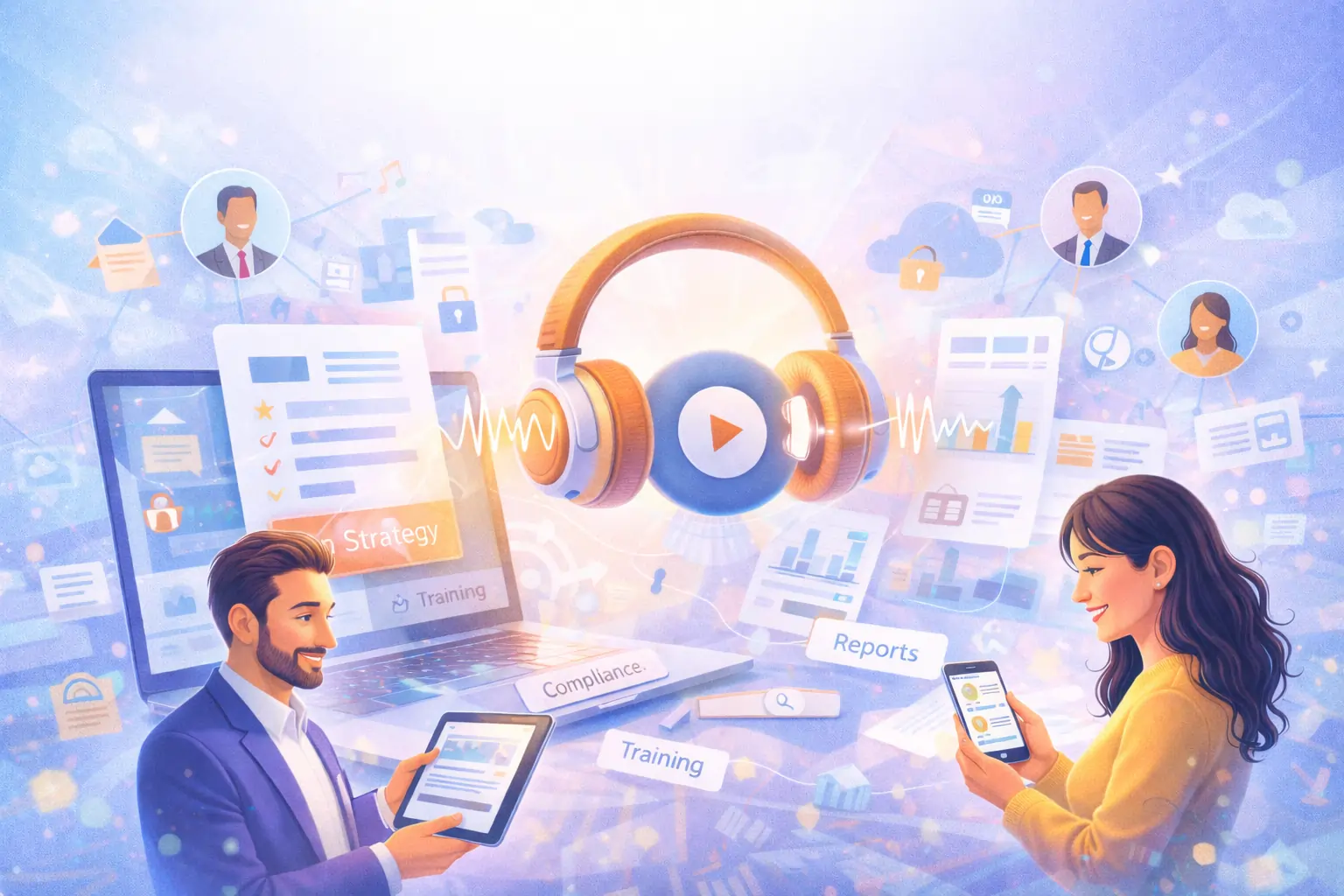
Learn what document-to-audio tools are, why businesses use them, and the key features to look for in enterprise-ready document-to-audio solutions.
Modern businesses generate an enormous volume of internal documents every day- strategy decks, SOPs, onboarding manuals, compliance updates, internal reports, and training material. While these documents are essential for operations, many organizations struggle with a familiar problem: Employees don’t consistently read or retain them.
Long PDFs, dense language, and limited time often prevent critical information from being fully absorbed. This is why document-to-audio tools for businesses are gaining serious attention. By converting written documents into structured audio briefings, companies can improve knowledge accessibility, retention, and actionability across teams.
However, not all document-to-audio solutions are built for enterprise needs. Choosing the right tool requires more than basic text-to-speech functionality.
What Are Document-to-Audio Tools?
Document-to-audio tools are software solutions that convert written business documents into structured, listenable audio briefings, allowing employees to consume internal knowledge hands-free while maintaining accuracy, clarity, and context.
Unlike basic narration tools, enterprise-grade solutions focus on structured audio, validation, and workflow alignment.
Why Businesses Are Moving from Documents to Audio
Traditional Documents remain important for record-keeping and compliance, but they are not always effective for communication. Employees are expected to process large volumes of information quickly, often across multiple platforms and time zones.
Audio changes how information is consumed.
Instead of setting aside uninterrupted reading time, employees can listen:
During commutes
Between meetings
While multitasking during focused work
Audio also introduces tone, emphasis, and structure, helping listeners understand not only what is being communicated, but why it matters.
For enterprises, document-to-audio tools are not about replacing documents—they are about extending their reach and effectiveness.
Accuracy and Trust Come First in Enterprise Audio Tools
When evaluating document-to-audio tools for enterprises, accuracy is the most critical factor. Internal documents often contain sensitive, regulated, or high-stakes information. Any misinterpretation can lead to confusion or compliance risks.
What businesses should look for:
High transcription and summarization accuracy
Context-aware narration
Support for human review and approval
Version control for updates
Enterprise-ready tools often include human-in-the-loop validation, allowing AI-generated audio to be reviewed or refined before distribution. This ensures that the audio briefing reflects the original intent of the document.
Without this trust layer, audio content quickly loses credibility.
Structured Audio Briefings, Not Raw Narration
Simply reading a document aloud rarely works. Business documents are written for reading- not listening.
The best document-to-audio software for businesses focuses on structure.
A strong solution should:
Identify key points and remove unnecessary detail
Reorganize content for audio flow
Highlight decisions, actions, and priorities
Maintain a clear narrative
This transforms long documents into audio briefings, not just audio files. Employees finish listening with clarity, not confusion.
Enterprise Use-Case Fit Matters
Many audio tools on the market are built for podcasts, creators, or marketing content. While these tools may sound polished, they often fail in enterprise environments.
Businesses should choose tools designed for:
Employee onboarding
Internal training
Policy and compliance updates
Leadership and strategy communication
Enterprise-focused document-to-audio tools support private distribution, controlled access, and consistent messaging, rather than public publishing.
Integration with Existing Business Workflows
Audio adoption succeeds when it fits naturally into existing systems.
The right document-to-audio tool should integrate with:
Learning management systems (LMS)
Internal knowledge portals
Team communication platforms
Enterprise content repositories
This ensures audio briefings become part of daily workflows instead of another tool employees must remember to check.
Multilingual Audio for Global Teams
For companies with distributed or global teams, multilingual document-to-audio support is essential.
Enterprise tools should-
Generate audio in multiple languages
Maintain consistency across versions
Preserve tone and intent
This allows businesses to scale communication globally while maintaining a single source of truth.
Scalability Without Losing Control
As organizations grow, so does their documentation.
The right enterprise document-to-audio solution should-
Handle large document volumes
Support multiple departments
Scale across regions and teams
Maintain governance and approval controls
Speed matters, but not at the cost of accuracy or oversight. Scalability should enhance control—not reduce it.
Measuring Knowledge Retention and Engagement
One reason businesses adopt document-to-audio tools is to improve knowledge retention.
Advanced tools provide insights such as:
Listening completion rates
Usage patterns
Engagement feedback
These insights help organizations understand whether internal communication is being consumed and acted upon.
Choosing the Right Document-to-Audio Tool for Long-Term Value
Document-to-audio tools should not be treated as a one-time automation feature. They are part of a broader enterprise knowledge strategy.
The best tools help organizations:
Reduce information overload
Improve clarity and alignment
Create reusable knowledge assets
Support long-term employee learning
They turn static documents into dynamic, human-centered communication.
Key Features Businesses Should Compare
Feature | Why It Matters |
|---|---|
Accuracy & validation | Prevents misinformation |
Structured audio | Improves understanding |
Enterprise access control | Ensures privacy |
Multilingual support | Scales globally |
Analytics & insights | Measures effectiveness |
Final Thoughts
Document-to-audio tools are becoming essential in modern enterprises, but not all solutions are equal. Businesses should look beyond basic automation and prioritize accuracy, structure, trust, and enterprise readiness.
When implemented thoughtfully, document-to-audio tools ensure that internal knowledge is not just created- but understood, retained, and applied.
They help organizations move from information overload to intentional, effective communication.
FAQs (People Also Ask Optimized)
1. What are document-to-audio tools used for in business?
They are used to convert internal documents into audio briefings for better accessibility and retention.
2. Are document-to-audio tools better than PDFs?
They complement PDFs by improving consumption, not replacing written records.
3. Can document-to-audio tools be used for employee training?
Yes, they are commonly used for onboarding and training programs.
4. Do businesses need human review for audio content?
Yes, human validation ensures accuracy and trust for sensitive information.
5. Are document-to-audio tools suitable for large enterprises?
Yes, enterprise-grade tools are designed to scale across teams and regions.
6. Can document-to-audio tools support multiple languages?
Advanced tools support multilingual audio while maintaining consistency.