

What microlearning is, and what actually makes it work#
Microlearning delivers training in short, focused units, typically two to ten minutes, each targeting a single learning objective. That much is uncontroversial, and every guide on the subject agrees.
Here is the part that gets left out: short is not the active ingredient. Brevity is a delivery convenience. It makes something else possible, and that something else is what produces the retention gains. If you take a 90-minute course, slice it into fifteen six-minute modules, and have people watch all fifteen in one afternoon, you have changed the packaging and nothing else. You will get the results of a 90-minute course, because that is what you delivered.
The two mechanisms that actually drive microlearning's benefit are distributed practice and retrieval practice. Both are among the most robustly evidenced findings in cognitive psychology, and both are about when learning happens, not how long each piece is. Most corporate microlearning programs implement neither.
Why the usual justifications are weak#
Before the real mechanisms, it is worth dismissing the two arguments that dominate vendor marketing, because building a business case on them will not survive scrutiny from anyone who checks.
"Attention spans are shrinking." This claim usually traces back to statistics with no credible research behind them, and it is not what the evidence on microlearning actually rests on. People happily watch feature films and binge multi-hour series. Attention is allocated by relevance and motivation, not by a fixed shrinking budget. If your training is being abandoned, that is a relevance and design problem, and shortening it treats a symptom.
"The forgetting curve." Ebbinghaus's 1885 work on forgetting is real and important, and it is routinely misapplied. The forgetting curve describes how memory decays without reinforcement. It is an argument for reinforcement over time, which is the spacing effect. It is not an argument that short content resists forgetting. A five-minute module you never revisit decays just like a fifty-minute one.
Both of these arguments accidentally point at the right answer while explaining it wrongly. The right answer is spacing.
The spacing effect#
Distributing learning across multiple sessions separated by time produces substantially better long-term retention than concentrating the same total study time into one block. This is called the spacing effect or distributed practice, and the evidence base is unusually deep.
The definitive synthesis is Cepeda, Pashler, Vul, Wixted, and Rohrer's 2006 meta-analysis, which examined 839 assessments of distributed practice across 317 experiments in 184 articles. Spaced conditions reliably outperformed massed conditions for retention. It is one of the most replicated findings in memory research.
What makes this immediately relevant to L&D is that the same total time produces different results depending purely on scheduling. You are not being asked to spend more. You are being asked to spread what you already spend, which is why this is one of the rare interventions that improves outcomes at no additional cost.
How to actually space it#
Most articles stop at "space it out" without saying by how much, which is useless in practice. The research gives a concrete answer.
Cepeda and colleagues ran a study with over 1,350 participants, teaching a set of facts, reviewing after gaps of up to 3.5 months, and testing at delays of up to a year. The finding: The optimal gap between sessions is roughly 20 percent of the target retention interval for delays of a few weeks, falling to about 5 percent when the target delay is a year. Their conclusion was that the interaction between gap and test delay implies many common educational practices are highly inefficient.
Translated into a schedule you can actually use:
| You need them to remember it in | Optimal gap between sessions | Practical schedule |
|---|---|---|
| 1 week | ~1 to 1.5 days | Initial session, review next day |
| 1 month | ~6 days | Initial session, review at day 6, again at day 20 |
| 3 months | ~10 to 13 days | Initial, review at ~2 weeks, again at ~6 weeks |
| 6 months | ~2 weeks | Initial, review at 2 weeks, 6 weeks, 3 months |
| 1 year | ~2.5 to 3 weeks | Initial, review at 3 weeks, 2 months, 5 months |
The counterintuitive part, and the reason this rarely gets applied: the longer you need something retained, the longer the gaps should be. Instinct says important material should be reviewed more frequently. The evidence says important material that must last a year should be reviewed at wider intervals than material needed next week.
One honest caveat. These figures come from controlled studies, and field results are messier. A recent classroom study found retrieval practice produced clear gains while its spacing manipulation did not reach significance, which suggests spacing is harder to implement well in real settings than in a lab. Treat the table as a starting schedule to test rather than a precise prescription.
Retrieval practice, the mechanism most programs skip#
If spacing is the first mechanism, this is the second, and in several respects the stronger one.
Retrieving information from memory produces better long-term retention than re-reading or re-watching the same material. This is the testing effect, documented extensively by Roediger, Karpicke, and others. Karpicke and Roediger's conclusion is that repeated retrieval during learning is the key to long-term retention, not repeated exposure.
The practical implication is uncomfortable for how most microlearning is built. The typical corporate microlearning module is passive: a short video, an animation, an infographic, a two-minute audio clip. The learner consumes it. Nothing is retrieved. That module gets the benefit of being convenient and, if scheduled well, the benefit of spacing, but it forfeits the largest single lever available.
Adding retrieval is cheap. Two recall questions at the start of the next module, asking what was covered last time before showing anything, converts passive consumption into retrieval practice. Not a quiz at the end of the same module, which is recognition of something still in working memory. The retrieval has to happen after a delay, which is also why spacing and retrieval work best combined: spaced retrieval practice is the pairing with the strongest evidence behind it.
The sliced-course trap#
Putting the two mechanisms together explains the most common failure in corporate microlearning.
A team takes an existing course, cuts it into short modules, publishes them to the LMS, and assigns the whole set with a completion deadline. Learners work through them in one or two sittings to clear the assignment. The program is now called microlearning.
It has short modules. It has no spacing, because everything was consumed at once. It has no retrieval, because the modules are passive. It captures neither mechanism, and it will perform roughly like the original course. When it does, the conclusion drawn is usually that microlearning does not work.
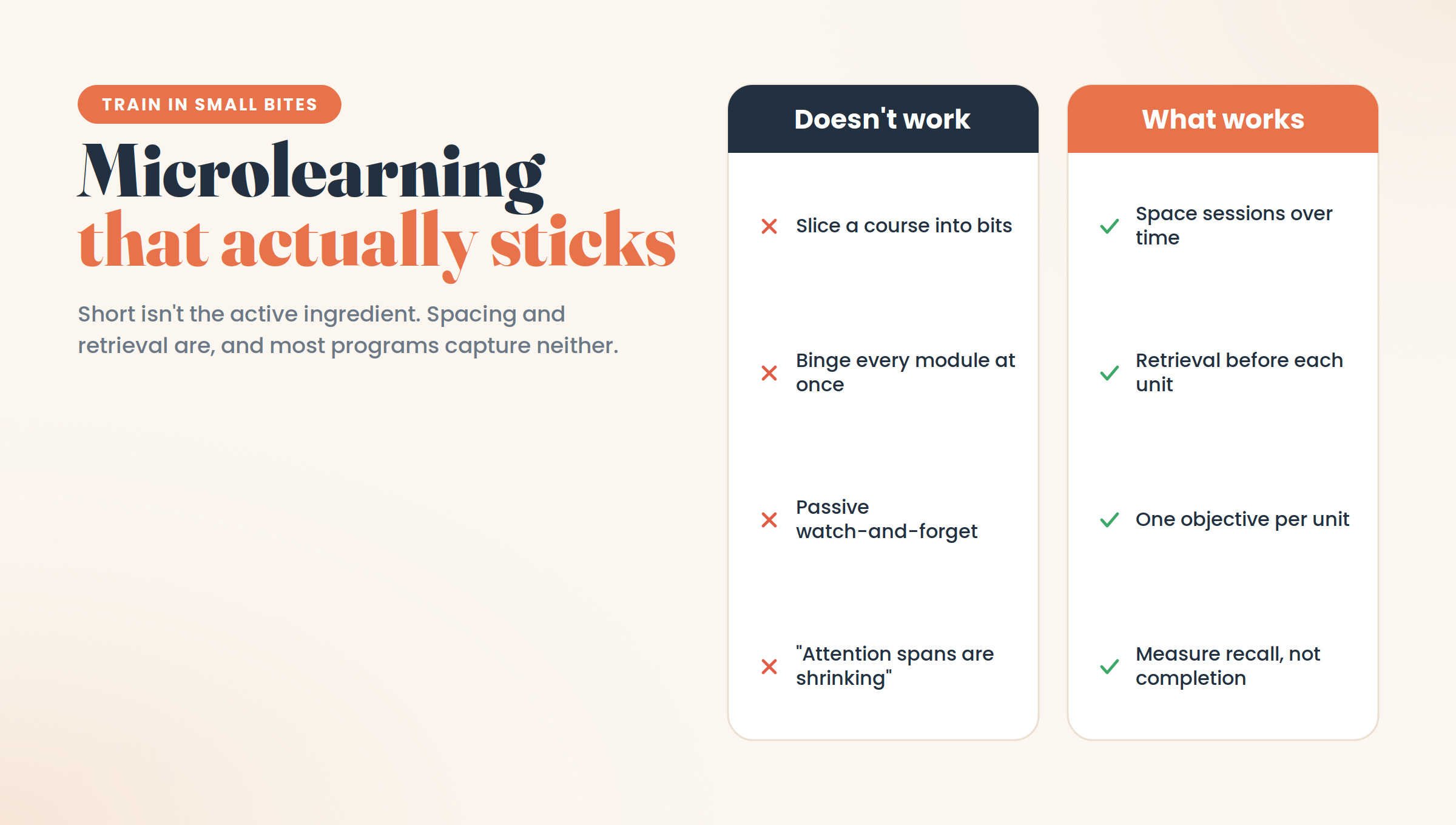
The fix is not more slicing. It is scheduling and retrieval:
- Release modules on a spaced schedule rather than as a single assignment.
- Open each module by asking what the last one covered, before presenting anything new.
- Resist letting people binge the set to clear the deadline, since binging destroys the mechanism you are relying on.The clearest case for getting this right is compliance training, covered in compliance training people actually complete.
Where microlearning genuinely does not work#
Being straight about this, because overselling it is why L&D teams lose credibility internally.
Complex, interconnected topics. Some material only makes sense as a whole. Understanding how a regulatory regime fits together, or why an architecture is designed a certain way, requires holding several ideas simultaneously. Fragmenting it into isolated units can leave people with pieces that never assemble.
Skills requiring sustained practice. Negotiation, difficult conversations, clinical technique, operating machinery. You can teach the concepts in small units, but competence needs extended, supervised practice that a five-minute module cannot provide.
Anything needing deep discussion or case reasoning. Judgment develops through working real cases with feedback. Microlearning can prime it and reinforce it. It cannot replace it.
First exposure to genuinely difficult material. Short units work well for reinforcement and for narrow procedural content. For a difficult new concept, a longer, well-structured first encounter followed by spaced short reinforcement usually beats fragmenting the introduction itself.
The reasonable position is that microlearning is an excellent reinforcement and procedural-training architecture, and a poor primary vehicle for complex conceptual learning.
Building a program that actually works#
A sequence that respects the evidence:
- Pick one recurring training need with a real business consequence. Not your whole catalog. Something with a measurable outcome attached.
- Define one objective per unit. If a module has three objectives, it is three modules.
- Build the spacing schedule before the content. Decide the target retention interval first, then use the table above to set the gaps. This is the step almost everyone skips, and it determines whether any of this works.
- Open every unit with retrieval. Two questions on the previous unit, answered before new material appears.
- Release on schedule, and do not allow binging. If your LMS lets people complete everything in one session, you have an implementation problem, not a content problem.
- Choose format by context, not by preference. Audio for people away from screens or during commutes, video for anything demonstrative, text for anything people need to reference precisely.
- Measure retention at the target interval, not completion at the end. Completion tells you they consumed it. A recall check at three months tells you whether it worked.The wider measurement ladder behind this sits in how to measure internal communications effectiveness.
Format, and where Sprep fits#
On format specifically: the format should follow the context of consumption. The cognitive science of why audio helps in some settings and hurts in others is covered in our post on audio learning, and the short version is that audio carries meaning well and precision badly.
Audio suits microlearning's spaced-reinforcement role reasonably well, because reinforcement units are short, conceptual rather than reference-heavy, and often consumed away from a desk. It suits the retrieval component poorly on its own, since audio cannot easily ask a question and check an answer. In practice, that means audio for the reinforcement unit and something interactive for the retrieval step.
We build a document-to-podcast tool, so treat this as an interested party talking. Sprep converts existing documents, PDFs, decks, and Word files into short two-host conversational episodes, with a person reviewing and approving every script before audio is generated. For training content, that review step matters, since accuracy is not optional and one-shot generation tends to introduce small errors that only surface on reading. Episodes are naturally short, which fits a spaced release schedule, and an approved master script is generated in over 70 languages on Team plans. Output pushes to Slack, Teams, an LMS, or a private feed. Dätwyler uses it for onboarding and internal communications, and the onboarding application is covered in our guide to cutting ramp time with a welcome podcast.
What it does not do: it does not schedule spacing, it does not deliver retrieval questions, and it will not turn a passive module into an active one. Those are the parts that make microlearning work, and they live in your LMS and your program design rather than in any content tool, ours included. If you are building the wider onboarding architecture around this, the process context sits in our complete guide to employee onboarding.
Frequently asked questions
Does microlearning really work?
Yes, but not for the reason usually given. The benefit does not come from content being short. It comes from distributing learning across spaced sessions and from including retrieval practice, both of which are strongly evidenced. Short modules delivered back to back in a single sitting capture neither mechanism and perform roughly like the longer course they were cut from.
How long should a microlearning module be?
Two to ten minutes, with three to seven often cited as the practical range, and one learning objective per module. Length matters less than schedule though. A well-spaced series of seven-minute modules will outperform a tighter series of three-minute modules consumed all at once.
What is the spacing effect?
The finding that distributing study across multiple sessions separated by time produces better long-term retention than concentrating the same total time into one block. Cepeda and colleagues' 2006 meta-analysis examined 839 assessments across 317 experiments and found spaced conditions reliably outperformed massed ones.
How far apart should microlearning sessions be?
Research suggests the optimal gap is roughly 20 percent of your target retention interval for delays of a few weeks, dropping to about 5 percent for a one-year target. If you need retention in a month, review after about six days. If you need it in a year, gaps of two to three weeks are more appropriate. Counterintuitively, longer retention targets call for wider gaps.
What are the disadvantages of microlearning?
It handles complex, interconnected topics poorly, since some material only makes sense as a whole. It cannot replace sustained practice for skills like negotiation or clinical technique, or the case-based discussion that builds judgment. It is also weak as a first exposure to genuinely difficult concepts, working far better as reinforcement than as primary instruction.
What is retrieval practice and why does it matter for microlearning?
Retrieval practice means recalling information from memory rather than re-reading or re-watching it. Research by Roediger, Karpicke, and others consistently finds it produces better long-term retention than repeated exposure. Most corporate microlearning is passive consumption, which forfeits this benefit. Opening each module with two recall questions about the previous one is a cheap fix.
Why doesn't chopping our existing course into short modules work?
Because slicing changes the packaging, not the mechanism. If learners complete all the modules in one or two sittings, there is no spacing, and if the modules are passive, there is no retrieval. You end up delivering the original course in smaller pieces and getting the original course's results.
Are attention spans really getting shorter?
The claim is usually traced to statistics without credible research behind them, and microlearning's evidence base does not depend on it. People sustain attention on content they find relevant. If training is being abandoned, that generally indicates a relevance or design problem rather than a fixed limit that shortening alone will fix.
What content formats work best for microlearning?
Match format to consumption context rather than to learner preference. Audio suits reinforcement units consumed away from a screen, video suits anything demonstrative, and text suits material people need to reference precisely. Retrieval steps need something interactive, since audio alone cannot ask a question and check the answer.
How do you measure whether microlearning is working?
Measure retention at your target interval rather than completion at the end of the module. Completion tells you the content was consumed. A short recall check three months later tells you whether it was retained, which is the only outcome the spacing and retrieval evidence actually promises.
See how this works with your existing training material
If you have training content sitting in documents and want to run it as a spaced series rather than a single course, we can walk you through how other L&D teams are doing it, including script review, distribution into your LMS or Teams, and multilingual versions from one approved script.
See it in action