

Most internal comms teams are measuring the wrong thing#
Around 70 percent of internal communicators are still tracking basic outputs: opens, clicks, and views. Only 16 percent measure outcomes, and just 12 percent connect communication to business impact.
Those figures come from Gallagher's State of the Sector, the internal communication industry's benchmark survey of more than 1,300 practitioners across 40 countries. They describe a profession that can tell you precisely how many people received a message and almost nothing about whether it worked.
This is not a tooling problem. Every internal comms platform reports open rates, and none of them can tell you whether the workforce understood the restructure. The gap is conceptual, and it has a name.
The error has a name, and it is nearly 40 years old#
Communication measurement scholars identified this failure mode decades ago. The classic evaluation error is taking a metric collected at one level of analysis and presenting it as evidence of a result at a higher level. Cutlip, Center and Broom flagged it in successive editions of their standard text from the mid-1980s onward, and Jim Grunig made the same point: practitioners routinely use a metric gathered at one level to demonstrate an outcome at another.
An open rate is a delivery statistic. It tells you a message arrived and a mail client rendered it. Reporting it as evidence that employees are aligned with the strategy is exactly the substitution error, and senior leaders can smell it even when they cannot name it. It is a significant part of why comms functions get treated as a service desk.
The uncomfortable version: if your quarterly report leads with reach and engagement numbers, you are not reporting on effectiveness. You are reporting on activity, and activity reporting is what administrative functions do.
The framework that fixes this#
The industry standard for communication measurement is the AMEC Integrated Evaluation Framework, developed by the International Association for the Measurement and Evaluation of Communication and built on the Barcelona Principles. It has been adopted globally as best practice, and while it was designed with public relations campaigns in mind, the logic transfers cleanly to internal communication.
The framework moves through stages: objectives, inputs, activities, outputs, outtakes, outcomes, and impact. For internal comms purposes, the four that matter most in day-to-day measurement are the last four. Each answers a different question, and confusing them is the substitution error above.
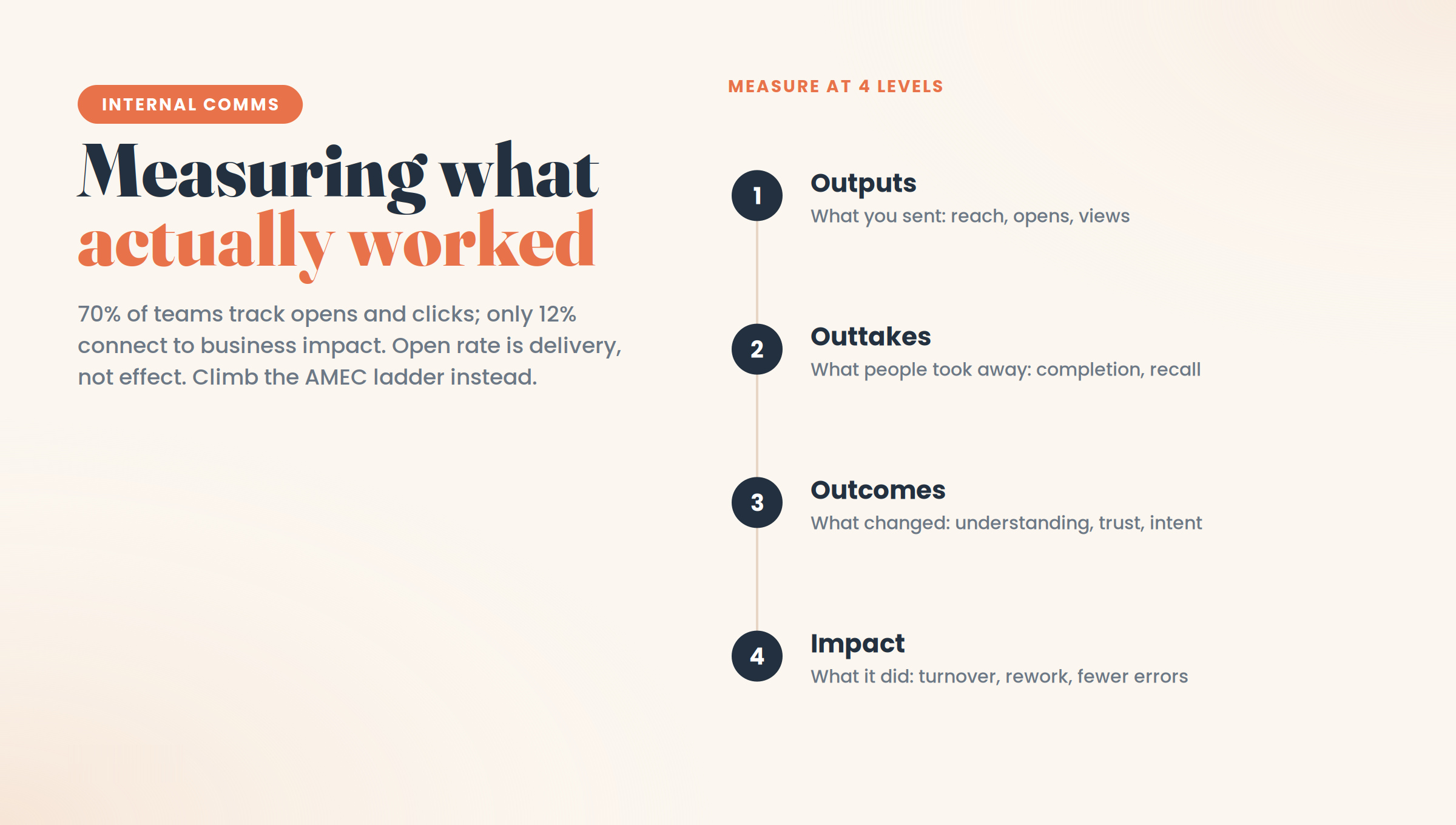
Outputs: what you sent#
Outputs are the tangible things you produced and delivered. The newsletter went out, the town hall happened, the intranet post published, the policy was distributed. Metrics here include reach, delivery rate, open rate, click-through rate, attendance, and views.
Outputs are worth tracking. They are diagnostic: a collapsed open rate tells you something is broken in your distribution or subject lines. What they cannot do is tell you whether communication worked, because they measure what you did rather than what happened to the audience.
Outtakes: what people actually took away#
Outtakes are the audience's immediate response: attention, recall, comprehension, and whether they engaged or sought more information. Did people notice it? Do they remember it a week later? Can they explain what it means for their team?This is hardest to measure for audiences you cannot reach by email in the first place, which is its own problem covered in reaching deskless and frontline workers.
This is the most underused stage in the entire framework and arguably the most commercially important, because it is the first point at which you learn whether communication happened as opposed to distribution happening. It is also where internal comms have an advantage over PR: you have a captive, identifiable audience you can actually ask.For a workforce spread across languages, that asking has to happen in each one, since comprehension measured only in the corporate language flatters the result, a point covered in multilingual internal communications for global teams.
Practical outtake measures: completion rate rather than open rate, a two-question comprehension pulse after major announcements, unprompted recall in a monthly survey, and the volume of clarifying questions managers receive afterward. That last one is free and most teams already have access to it.
Outcomes: what changed#
Outcomes are shifts in understanding, attitude, trust, or intention. Do employees understand the strategy well enough to describe it? Has confidence in leadership moved? Do people intend to follow the new process?
Measure these with targeted pulse surveys tied to specific communications rather than the annual engagement survey, which is too slow and too broad to attribute anything. A three-question pulse two weeks after a major announcement, repeated consistently, produces a trend line you can actually act on.
Impact: what it did for the business#
Impact is the contribution to organizational objectives: reduced turnover in a specific population, faster onboarding ramp, fewer safety incidents, higher training completion, less time lost to rework and repeat questions.
This is the level almost nobody reaches, and it is the one that changes how the function is treated. Gallagher's data shows that connecting communication data to business impact roughly halves the risk of the function being labeled as administrative. It is the single highest-leverage measurement change available to an internal comms team.
Why teams stay stuck at outputs#
Three reasons, and only one of them is about capability.
Leaders ask for the wrong things. In the industry data, leaders primarily request sentiment measures (around 56 percent) and activity or reach measures (around 52 percent), while fewer than three in ten ask for business impact. So comms teams supply what is requested, leadership's expectations calcify around activity reporting, and the function is then judged by the standard it was asked to meet. Breaking this loop almost always means bringing an impact metric to leadership unprompted rather than waiting for someone to ask.
Objectives were never written to be measurable. You cannot measure your way out of a vague goal. If the objective was to raise awareness of the new strategy, there is no threshold that constitutes success. If it was for 70 percent of employees to be able to name the top three priorities within a month, you have something to measure. Vague objectives produce unmeasurable results by construction, and no dashboard fixes that retrospectively.
Capacity. Around 69 percent of organizations have fewer than six people in a communications role regardless of company size, and a third have no dedicated budget. Outtake and outcome measurement takes more effort than exporting an open rate. This is real, and it is why the practical recommendation below is to measure one thing properly rather than everything badly.
A worked example#
Take a common scenario: a change to the expenses policy, announced company-wide.
The output measurement most teams do. Email sent to 4,200 employees. Open rate 61 percent. Click-through to the policy document 18 percent. Reported as: strong engagement with the expenses announcement.
What that actually tells you. That roughly 2,560 mail clients rendered the message and about 760 people clicked something. It tells you nothing about whether anyone understood what changed, and the click-through figure arguably tells you 82 percent did not read the policy.
The outtake layer. Two weeks later, a two-question pulse to a random sample of 200: can you name what changed in the expenses policy, and do you know what you need to do differently? Suppose 44 percent answer the first correctly and 31 percent the second. Now you know something real. You also now know your 61 percent open rate was measuring the wrong thing entirely.
The outcome layer. Track whether people intend to comply and whether confusion persists. Finance reports the number of incorrectly filed expense claims in the month after the change.
The impact layer. Incorrect claims fell from 340 per month to 190, saving finance an estimated 25 hours of rework monthly. That is the number that belongs at the top of your report. It is also the number that gets your function invited to the next planning conversation.
Notice that the impact metric was not generated by a communications tool. It came from the finance team, and getting it required one conversation. Most impact metrics for internal comms live in someone else's system: HR has turnover and ramp time, operations has incident and error rates, finance has rework, IT has adoption. Your measurement problem is often a relationship problem.
Benchmarks worth knowing#
Useful reference points, with the caveat that benchmarks vary by industry and organization size and should be treated as orientation rather than targets.
Internal email open rates commonly average around 64 percent, which means roughly one in three employees never opens a given message. But the more revealing benchmark is the gap between opening and reading. An analysis of 56 million internal messages found about 77 percent opened, only around 37 percent actually read, and 24 percent clicking through. Opening is not reading, and if you report open rate as your headline you are overstating your reach by roughly half.
For comparison across formats, long written content typically sees only 20 to 30 percent of readers reach the end, while podcast episodes average 70 to 80 percent completion. This is why completion rate is a more honest metric than open rate: it is an outtake measure rather than an output measure, and it is the closest single proxy for whether the content was actually consumed.
Start here#
If you are currently reporting opens and clicks, the sequence that works:
- Pick one recurring communication. Not everything. One thing that matters, ideally something with a business consequence attached.
- Write a measurable objective for it retroactively. What specifically should be different after this land? Put a number and a timeframe on it.
- Add one outtake measure. A two-question comprehension pulse to a sample, or completion rate instead of open rate. Two questions, not a survey.
- Find the business metric that already exists. Ask HR, operations, or finance what number would move if this communication worked. Do not build a new metric if an existing one will do.
- Report the outtake and the business metric together, once. Lead with them. Put the open rate in an appendix or leave it out entirely.
- Repeat quarterly before expanding. One well-measured communication reported at the impact level does more for your standing than a dashboard of activity metrics.
The wider strategic context for this sits in our internal communications strategy guide, and measurement is one of the practices covered in our roundup of internal communications best practices.
Where format fits in measurement#
One practical note on completion rate, since it is the outtake metric most within your control.
Completion is partly a function of content quality and partly a function of format fit. A dense written update competes for the most fragmented minutes of an employee's day, and a low completion rate there may be telling you about the format rather than the content. This is worth checking before rewriting the content again.
We build a tool in this space, so treat the following accordingly. Sprep converts documents into short two-host conversational podcasts with a human-reviewed script, and distributes to Slack, Teams, an LMS, or a private feed. The measurement-relevant part is that audio platforms report completion and drop-off point natively, which gives you an outtake metric rather than a delivery metric, and drop-off data tells you where in the message you lost people. Dätwyler uses it for onboarding and internal communications.Audio completion and drop-off are also the core metrics for a recurring internal show, which is set up in corporate podcasting: how to launch an internal podcast.
The honest caveat: changing format does not fix unclear content, and completion rate is still only an outtake. It tells you people consumed the message, not that they understood it or acted on it. You still need the comprehension pulse and the business metric. Any vendor implying that a completion percentage proves effectiveness is doing the same substitution error described at the top of this article, just with a nicer number.
Frequently asked questions
How do you measure internal communications effectiveness?
Measure at four levels rather than one: outputs (what you sent, such as reach and open rate), outtakes (what people took away, such as completion and comprehension), outcomes (what changed in understanding, trust, or intention), and impact (the business result, such as reduced turnover or fewer errors). Most teams stop at outputs, which measures delivery rather than effectiveness.
What are good internal communications KPIs?
The most useful set combines one outtake metric, one outcome metric, and one business metric. In practice that often means completion rate rather than open rate, a short comprehension pulse after major announcements, and an existing operational number such as onboarding ramp time, safety incidents, error rates, or volume of repeat questions to managers.
Is open rate a good measure of internal communication?
No, as a headline metric. It measures delivery, not effect, and it overstates reach considerably. Analysis of 56 million internal messages found roughly 77 percent opened but only about 37 percent actually read. Open rate is useful diagnostically, since a sudden drop signals a distribution or subject line problem, but it should not be your primary indicator.
What is a good internal email open rate?
Internal email open rates commonly average around 64 percent, which is far higher than marketing email but still means about one in three employees never opens a given message. Treat benchmarks as orientation rather than targets, since they vary substantially by industry, company size, and whether the workforce is desk-based.
What is the difference between outputs and outcomes in communication?
Outputs are what you produced and delivered, such as messages sent, reach, and open rates. Outcomes are changes in the audience, such as increased understanding, shifted attitude, higher trust, or intention to act. Reporting an output as evidence of an outcome is a well-documented evaluation error and a major reason comms functions are perceived as administrative.
What is the AMEC framework?
The AMEC Integrated Evaluation Framework is the communications industry's standard measurement model, developed by the International Association for the Measurement and Evaluation of Communication and grounded in the Barcelona Principles. It moves through objectives, inputs, activities, outputs, outtakes, outcomes, and impact. It was designed for public relations but adapts well to internal communication.
How do you prove the ROI of internal communications?
Connect a specific communication to a business number that already exists elsewhere in the organization. Ask HR, operations, or finance which metric would move if the communication worked, then measure it before and after. Most internal comms impact metrics live in other teams' systems, so this is often a relationship exercise rather than a data one.
How often should you measure internal communications?
Continuously at the output level, since it is automatic, and per-communication at the outtake level for anything significant. Outcome measurement works best as a short pulse tied to specific communications rather than relying on an annual engagement survey, which is too slow and too broad to attribute results to particular messages.
Why do leaders not take internal comms measurement seriously?
Partly because of what they ask for. Industry data shows leaders mostly request sentiment and activity measures, and fewer than three in ten ask for business impact, so teams supply activity reporting and get judged accordingly. Connecting communication data to business impact roughly halves the risk of the function being labeled administrative.
Where should a small comms team start with measurement?
With one communication, not a dashboard. Pick something that matters, write a measurable objective for it, add a single outtake measure such as completion rate or a two-question comprehension pulse, find the relevant business metric in another team's system, and report those together. One communication measured properly is worth more than a full set of activity metrics.
See what outtake-level data looks like
If you want completion and drop-off data on your internal communications rather than open rates, we can show you how other comms teams are running it, including how they pair audio completion data with comprehension checks to report at the outcome level.
See it in action