

What an internal podcast actually is#
An internal podcast is an audio show produced by a company for its own employees, distributed through a private feed rather than public directories. It carries the kind of content that would otherwise go out as an all-company email or an all-hands recording: leadership updates, strategy explainers, team stories, training modules, onboarding walkthroughs.
There are three distribution models, and choosing between them is the first real decision you will make.
Private podcasts are accessible only to employees. This is by far the most common model for internal communications, because it is the only one that lets people speak frankly about strategy, numbers, and problems. If your show is going to be worth listening to, it almost certainly needs to be private.
Public podcasts are published to Apple, Spotify, and the usual directories. Companies use these for employer branding and culture showcasing, and employees listen alongside everyone else. American Airlines runs one called Tell Me Why. The tradeoff is obvious: anything you would not say to a journalist cannot go in the episode.
Hybrid setups run a public show for brand visibility and a private one for internal detail. This works well for larger organizations that already have a communications team with capacity, and badly for small teams, since you are now producing two shows instead of one.
For most comms teams reading this, the answer is a private show. The rest of this guide assumes that, and the hosting section below covers exactly how private feeds work in practice.
Why comms teams are turning to audio#
The honest reason is that written channels are saturated. Office workers send and receive an average of 121 emails a day according to Radicati Group figures, and internal announcements compete against every one of them plus chat, meeting invites, and project tools. Adding a better-written email to that pile does not change the arithmetic.
Audio changes the arithmetic because it competes for different time. A written update competes for the scarce, interruption-heavy minutes an employee spends at their desk. A podcast competes for commute time, gym time, walking time, and the gaps between tasks, which is time that would otherwise be completely unavailable to communications. This is the core of what we call the unread problem: the constraint is not how much you can produce, it is how much attention is left to receive it.
Three secondary benefits show up consistently in practice.
Reach for people without desks. Frontline, field, retail, and shift workers are the hardest group to reach with any written channel, because they do not sit at a screen. They also tend to receive the least strategy and change content of any employee group. Audio is one of the few formats that works during physical work. Welsh Water built an internal series specifically aimed at its out-and-about workforce for this reason.
Accessibility and processing differences. Some colleagues absorb spoken information more easily than written information, including many neurodivergent employees. Offering the same content in a second modality is a low-cost accessibility improvement, not just a novelty.
Tone that written updates cannot carry. Hearing a leader explain a difficult decision in their own voice, including the hesitations, conveys something an email cannot. This is the benefit most often cited by companies that have run internal shows for years, and it is the one that is hardest to replicate in text.
Why most internal podcasts quietly die#
Here is the part the vendor guides skip. Most internal podcasts do not fail loudly. They publish four or five strong episodes, then slip from fortnightly to monthly to nothing, and eighteen months later nobody can find the feed. If you are going to launch one, plan against these four failure modes specifically.
Production cost outruns enthusiasm. The first episode is exciting and someone senior clears time for it. By episode six, the person who was booking guests, recording, editing, writing show notes, and chasing approvals is doing that on top of their actual job. Traditional podcast production runs several hours of work per finished episode. Multiply that by a fortnightly cadence and you have effectively created a part-time role that nobody was hired for.
Discovery and subscription friction. Getting employees to add a private RSS feed to a podcast app is genuinely awkward, and every extra step loses people. A show that requires a five-step setup will be heard by the people who were already engaged, which is precisely the group that did not need it.
No editorial spine. Shows launched as "a podcast" rather than as a specific recurring thing run out of ideas by episode eight. The successful ones have a narrow, repeatable premise: this week's decisions explained, one team's work, one customer story, one question answered.
Content that should not have been audio. Policy detail, anything with numbers people need to reference, and anything requiring a searchable written record are all poor fits. Putting them in audio because you now have a podcast produces episodes nobody finishes and a compliance gap where the written record used to be.
None of these are arguments against launching. They are the four things to design around before you record anything.
Choose your show format before you record anything#
Pick one premise and commit to it for at least ten episodes. Four formats hold up well internally.
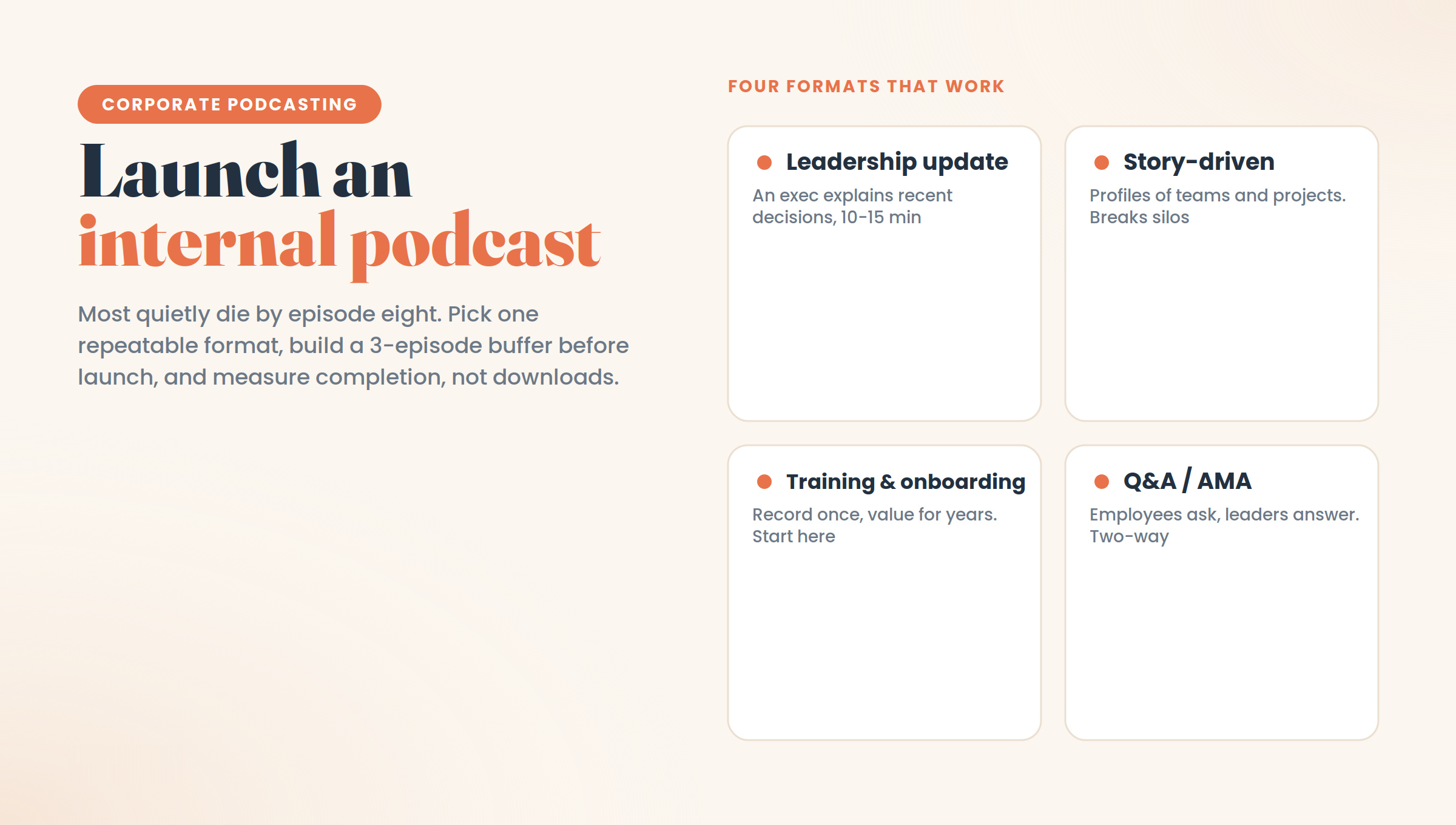
The leadership update. A regular short episode where an executive explains recent decisions and what they mean for teams. Ten to fifteen minutes, fortnightly or monthly. Strength: it directly addresses the trust and direction problems that dominate internal comms research. Risk: it dies the moment the executive's calendar gets busy, so the format has to survive being recorded in twenty minutes.
The story-driven show. Profiles of teams, projects, or customers. Strength: high engagement and genuinely good for breaking down silos across sites and functions. Cost: this is the most production-heavy option, since each episode needs research, interviews, and editing.
Training and onboarding. Evergreen episodes that new hires or teams work through. Strength: you record once, and it keeps delivering value for years, which is the best production economics of any format. It is also the easiest to justify to a finance team, because you can point at ramp time. Dätwyler uses audio in exactly this way for onboarding and internal communications.
The Q&A or AMA. Employees submit questions and leaders answer them on the record. Strength: this is inherently two-way, which is the property most internal communication lacks. Risk: it requires a culture where people will actually submit real questions, and it goes badly if answers are visibly evasive.
If you are unsure, start with training and onboarding. It has the lowest cadence pressure, the longest content shelf life, and the clearest business case, which means it is the format most likely to survive its first year.
The hosting and privacy decision#
This is the most practical question comms teams hit, and the one most guides handle badly. There are three levels of privacy for an internal podcast, with real tradeoffs between security and adoption.
Low: one unlisted RSS feed shared internally. A single private feed URL circulated to all staff. Cheapest and fastest to set up. The problem is uptake, since manually adding a feed URL to a podcast app is not obvious to most people, and one leaked URL exposes the whole show.
Medium: individual private feeds. Each employee registers and receives their own unique feed URL, usually with a one-click button to add it to their listening app. Most hosting platforms that support private podcasting work this way. This is where most companies land, because it balances reasonable access control against adoption that actually works, and it gives you per-listener analytics rather than raw download counts.
High: a dedicated internal podcast app. A custom or vendor-supplied app that keeps audio inside a controlled environment and blocks downloading and sharing. It offers the strongest control and is the most expensive by a wide margin. It also tends to suppress listening, because you are asking people to use a separate app instead of the podcast player already on their phone.
One caveat worth stating plainly, because vendors rarely do: There is no way to make audio on the internet completely private. Anyone with access can record playback or re-share a file, regardless of the tier you choose. Private feeds control casual access, not determined leaks. Treat your internal show the way you would treat an all-hands recording, and keep genuinely sensitive material out of it.
For most teams the medium tier is right. Choose the high tier only if you have a specific regulatory reason, and be honest with yourself that listening numbers will be lower.
A realistic first 90 days#
A launch sequence that accounts for the failure modes above:
- Weeks 1-2: pick the format and the owner. One premise, one named person accountable for publishing. If nobody's job description can absorb it, resolve that now rather than after episode four.
- Weeks 2-3: produce three episodes before launching any. A three-episode buffer is the single best protection against the cadence collapse that kills most shows. If you cannot produce three, you cannot sustain fortnightly.
- Week 3: choose the hosting tier and test the subscription flow yourself. Add the feed to your own phone using the same instructions you will send employees. Count the steps. If it takes more than three, fix it before launch, because every step costs you, listeners.
- Week 4: launch with a written companion. Publish episode one with a short summary and the key points in text. This handles the people who will never listen, gives you a searchable record, and doubles the reach of the same work.
- Weeks 5-8: publish on schedule and resist expanding. Same format, same length, same day. Predictability is what turns a show into a habit.
- Week 9: ask five listeners and five non-listeners what happened. The non-listeners are the more valuable group. Usually you will find a subscription problem rather than a content problem.
- Weeks 10-12: review completion data and decide on cadence. If completion is strong but production is straining, drop to monthly rather than dropping quality. A monthly show that runs for three years beats a fortnightly one that dies in June.
What to measure#
Downloads are the internal podcast equivalent of email open rates: easy to collect and nearly meaningless. An episode downloaded automatically by a subscription is not an episode anyone heard.
Measure completion rate first. It is the metric that justifies the format, since podcast episodes typically see far higher completion than long written updates, and it tells you where in the episode people leave. If everyone drops at four minutes, your intro is too long.
Then measure subscriber growth as a share of the eligible audience, which tells you whether your subscription flow works. Then, if your platform supports it, use per-listener data so you can see whether you are reaching the groups the show was built for, particularly frontline and remote staff. If frontline reach is the main reason you are launching, start with reaching deskless and frontline workers.
Finally, connect one episode to a business outcome at least once a quarter. Fewer repeat questions after a policy episode, faster ramp for onboarding cohorts who used the audio version, higher completion of a compliance module. Internal communications functions that connect their work to business impact are treated substantially more seriously than those reporting activity metrics, and a podcast with no outcome story attached is the first thing cut in a budget review. This is the same measurement ladder we describe in our internal communications strategy guide.
The production problem, and where Sprep fits#
Every failure mode above except discovery traces back to one thing: sustaining production. Booking guests, recording, editing, and approving audio is genuinely time-consuming, and internal comms teams are small. Most organizations have fewer than six people in a communications role regardless of company size, which is why the enthusiasm-to-exhaustion curve is so predictable.
This is what we build, so treat the rest of this section as an interested party talking rather than neutral advice.
Sprep turns documents you already have- PDFs, slide decks, Word files, and articles- into two-host conversational podcasts without recording anything. The relevant part for internal comms is what sits in the middle: the AI drafts a script, and a person reviews, edits, and approves every word before any audio is generated. That review step is available on every plan, including the free one, and it is what makes the output safe to publish under a company's name. Tools that generate audio in one shot sound polished and are usually about ninety-five percent accurate, and the missing five percent tends to be subtly wrong in ways you only catch by reading the script.
Practically, that means an existing strategy deck or policy document becomes an episode without a recording session. Audio Intent Templates calibrate pacing and vocabulary for specific jobs, including Executive Briefing, Compliance Training, and Onboarding. Output pushes to RSS, Slack, Microsoft Teams, an LMS, or a private podcast feed, which covers the hosting tiers described above. For global teams, an approved master script translates into more than 70 languages on Team plans, so you are not producing a separate show per region. It is Swiss-hosted, which matters for data residency questions. Dätwyler uses it for onboarding and internal communications.
Where this is the wrong tool: if the value of your show is hearing your CEO's actual voice and personality, record your CEO. If you want investigative, interview-driven storytelling, that needs real interviews. Document-to-podcast is strongest for the recurring, document-derived content that would otherwise never become audio at all, which in most organizations is the majority of what a comms team publishes.
Frequently asked questions
What is an internal podcast?
An internal podcast is an audio show a company produces for its own employees, usually distributed through a private feed rather than public directories. Typical content includes leadership updates, strategy explainers, onboarding material, training modules, and team stories. Most internal shows are private, since privacy is what allows frank discussion of strategy and performance.
How do you make a podcast private for employees only?
There are three approaches. A single unlisted RSS feed shared internally is cheapest but has poor uptake and leaks easily. Individual private feeds, where each employee gets a unique subscription URL, is what most companies use and what most podcast hosting platforms support. A dedicated internal podcast app offers the most control at the highest cost and usually the lowest listening rates. No option makes audio truly unleakable, so keep genuinely sensitive material out.
How long should an internal podcast episode be?
Ten to twenty minutes suits most internal formats. That fits a typical commute and a single task block, and it is short enough to keep completion rates high. Onboarding and training episodes can run longer if they are chaptered so listeners can navigate to the part they need. Watch your completion data rather than a target length: if people consistently drop at a certain point, the episode is too long for its content.
How often should we publish?
Fortnightly or monthly for most teams. Weekly is achievable only with dedicated resources and almost always slips. The most common launch mistake is committing to a cadence based on initial enthusiasm rather than sustainable capacity. A monthly show that runs for years is more valuable than a fortnightly one that stops after six episodes, and it is easier to increase cadence later than to reduce it.
How do you measure whether an internal podcast is working?
Start with completion rate rather than downloads, since a download triggered by an automatic subscription tells you nothing about whether anyone listened. Then track subscribers as a percentage of the eligible audience, which reveals whether your subscription flow works. At least once a quarter, connect an episode to a business outcome such as reduced repeat questions or faster onboarding ramp.
Do employees actually listen to internal podcasts?
It depends almost entirely on relevance and subscription friction rather than production quality. Shows with a narrow, predictable premise and a one-click subscription flow retain listeners well. Shows that launch broadly, publish irregularly, or require a multi-step setup process tend to reach only the employees who were already engaged, which is the group that needed it least.
What content should not go in an internal podcast?
Anything requiring precise word-for-word reference, anything with figures people need to look up, and anything that needs a searchable written record. Detailed policy documents, compensation specifics, and legal or regulatory notices belong in writing, optionally with an audio summary alongside. Audio works best for context, reasoning, stories, and explanation rather than reference material.
How much does it cost to produce an internal podcast?
The main cost is time, not tooling. Traditional production runs several hours of work per finished episode across booking, recording, editing, and approvals, which is why shows tend to die when the owner's other work intensifies. Hosting on a platform with private feed support is comparatively inexpensive. Document-to-podcast tools change this calculation by removing the recording and editing steps for content that already exists as a document.
Can we turn existing documents into podcast episodes instead of recording?
Yes, and for recurring document-derived content it is usually more sustainable than recording. The important distinction is between text-to-speech, which reads a document aloud word for word, and document-to-podcast, which restructures the material into a conversation written for listening. For anything published under a company's name, choose a tool that lets a person review and approve the script before audio is generated, since one-shot generation tends to introduce small factual errors.
Should we run a public or private internal podcast?
Private for most internal communications, since it is the only model that permits candid discussion of strategy, performance, and problems. Public shows work for employer branding and culture, but constrain what you can say. Hybrid setups run both and suit larger teams with existing capacity, though they mean producing two shows rather than one.
Turn your first document into an episode
If you want to test the format before committing to a production schedule, the free plan turns one document into a full podcast episode of up to 15 minutes, with the script editor included so you can review every word before any audio is generated.
See it in action