

The most expensive unread document in B2B#
A whitepaper is often the single most resource-intensive content asset a B2B team produces. Weeks of subject-matter interviews, writing, design, and review go into a document that, on the numbers, most downloaders never finish and many never open.
That is the problem worth solving, and it reframes what converting a whitepaper to audio actually is. It is not a production task, a nice-to-have extra format. It is a distribution decision: a second, more finishable path to the audience you already paid to reach. The written whitepaper stays the anchor asset. The audio version exists to reach the large share of your audience who downloaded it, meant to read it, and never did.
This guide covers how to convert a whitepaper well, where audio helps and where it does not, and how to fit it into a B2B funnel rather than treating it as a novelty. We make a document-to-podcast tool, Sprep, so we will be clear about that and about the limits.
Why whitepapers specifically go unread#
Every long document struggles to get finished, but whitepapers have a particular set of reasons stacked against them, which is exactly why audio suits them.
They are long and dense by design. A whitepaper signals authority partly through depth, which means length. Long-form written content typically sees only 20 to 30 percent of readers reach the end, and whitepapers sit at the longer, denser end of that range.
They are downloaded at one moment and meant to be read at another. The classic pattern: someone hits a gated form, gives their email, downloads the PDF, tells themselves they will read it properly later, and never returns. The intent was real. The follow-through competes with everything else in their week, a problem covered in information overload at work.
They are read by busy senior people. Whitepapers often target exactly the audience with the least uninterrupted reading time: decision-makers and senior practitioners. That audience has commutes, travel, and gym time where reading is impossible but listening is easy.
This is the underlying case in the unread problem: the constraint on a whitepaper landing is rarely its quality. It is whether the format fits the reader's available attention. Audio fits a slice of attention the PDF cannot reach.
What survives the trip to audio, and what does not#
Before converting, be honest about which parts of a whitepaper work as audio, because a whitepaper is rarely all one kind of content.
Converts well:
- The argument and the narrative. The problem framing, the thesis, the "why this matters." This is the spine of most whitepapers and it translates naturally to a conversation.
- The insights and the implications. What the findings mean, what the reader should do about them. This is often the part readers most want and least reach, because it tends to sit near the end.
- Case examples and stories. Anything narrative carries well in audio.
Converts badly:
- Data tables and detailed figures. Numbers do not survive being spoken. A listener cannot hold a table in their head.
- Charts and diagrams where the visual is the argument. If the chart makes the point, audio removes the point.
- Precise technical specifications. Anything a reader needs to reference exactly belongs in the written version.
- Citations and methodology details. Important for credibility on the page, tedious and unfollowable in audio.
The practical consequence: a good whitepaper-to-audio conversion is not the whole document read out. It is the argument and the insight, restructured for listening, with an explicit pointer back to the written whitepaper for the data, charts, and detail. The audio sells the thinking; the document holds the proof.
This selectivity is what separates converting a whitepaper from converting a simpler document. With a blog post or an article, you can often convert the whole thing. A whitepaper forces a decision about what belongs in audio and what belongs on the page, and that decision is the difference between an episode people finish and one they abandon three minutes in. The general principles of matching a file to the format are in our guide to turning any document into a podcast; the whitepaper case is simply the one where getting that selection right matters most.
Step by step: converting a whitepaper to audio#
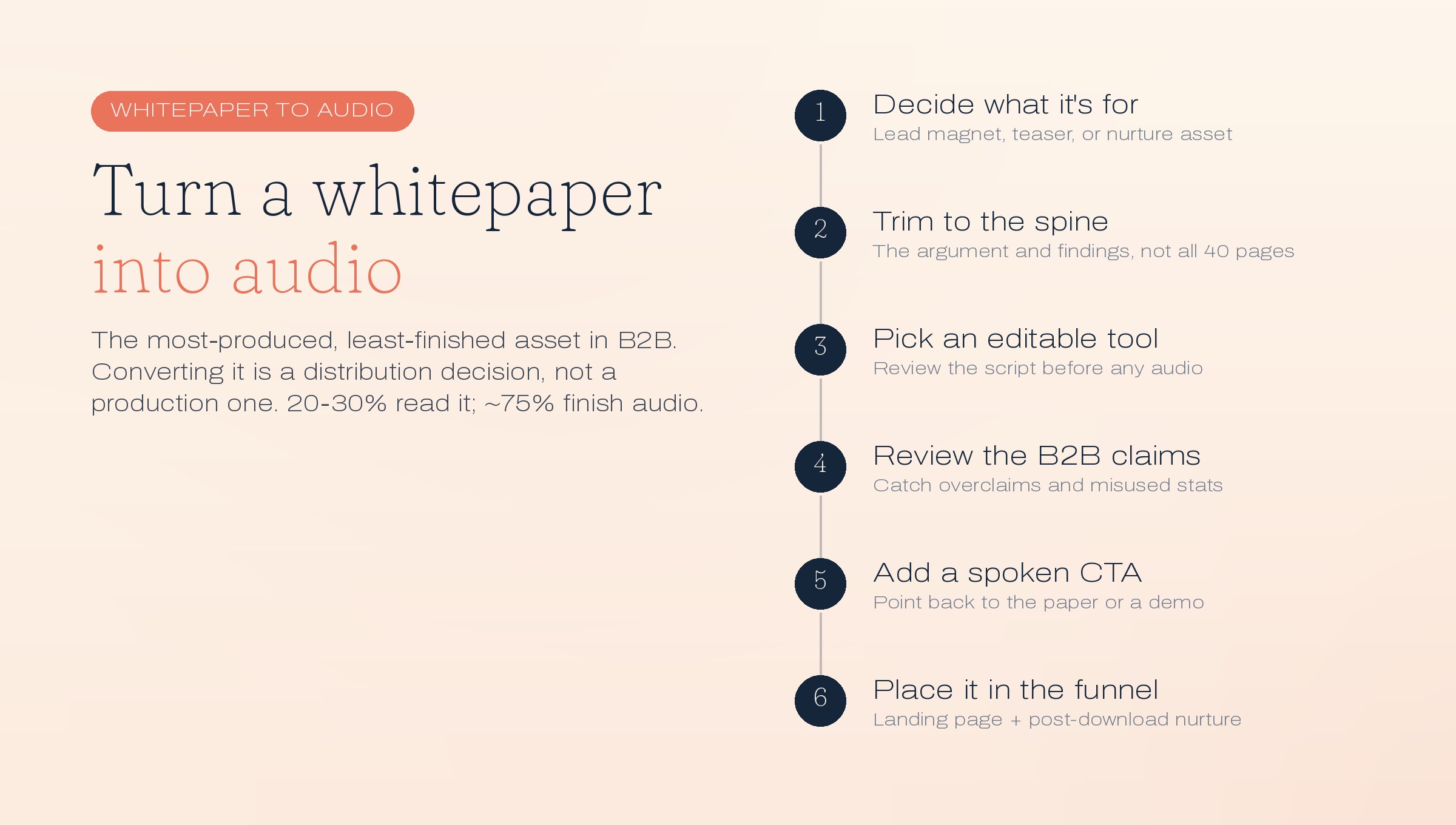
The mechanics are close to converting any PDF, which is covered generally in how to turn a PDF into a podcast. The whitepaper-specific decisions are what this section adds.
1. Decide what the audio is for. A gated lead magnet, an ungated top-of-funnel piece, or a nurture asset for people who already downloaded the PDF. This decides length, tone, and where the call to action points. Most whitepaper audio works best as the third: a follow-up that rescues the download that never got read.
2. Trim to the spine. Do not convert all forty pages. Select the argument, the key findings, and the implications, and leave the appendices, the detailed tables, and the methodology in the written version. A focused twelve-to-fifteen-minute episode outperforms a complete but exhausting forty-minute one.
3. Choose a tool that lets you edit the script. For a whitepaper this is not optional. It carries your company's name and makes claims your audience will act on, so you need to review the script before any audio exists. Generate-and-hope tools are fine for personal reading and wrong for a published brand asset.
4. Review the script for the things that matter in B2B. Beyond the usual name and pronunciation fixes, whitepaper audio has specific risks: a hedged research finding turned into an overclaim, a competitor or customer named in a way legal would not approve, a statistic stated without its qualifying condition. Pull each of these back to exactly what the whitepaper says. In regulated B2B, this review step is the difference between a usable asset and a compliance problem, as covered in NotebookLM compliance for regulated teams.
5. Add a spoken call to action. The audio should point somewhere: back to the full whitepaper for the data, to a demo, or to a next asset. A listener who finishes the audio is more engaged than one who abandoned the PDF, so give them a next step.
6. Generate, then place it where the audience is. Embed the player on the whitepaper's landing page, include it in the nurture email that follows a download, and consider a private or public podcast feed if you produce these regularly.
Where to put whitepaper audio in the funnel#
This is where B2B teams get the most value, and where most stop short by treating the audio as a one-off.
On the landing page. Add an audio player next to the download button. Some visitors will listen who would never have read, and it signals the asset respects their time.
In the post-download nurture sequence. This is the highest-leverage placement. The person downloaded the PDF and, statistically, did not finish it. An email a few days later, "short on time? here's the 12-minute audio version", recovers a lead you have already paid for but not yet activated.
As an ungated top-of-funnel version. A shorter audio episode of the whitepaper's argument, published openly on a podcast feed, can pull new audiences toward the gated full version, reversing the usual flow.
In sales follow-up. A rep can send the audio version to a prospect who has gone quiet, with a genuinely low ask: fifteen minutes on a commute rather than forty pages at a desk.
The through-line is that the audio is not a replacement for the whitepaper. It is a way to extract more return from an asset you have already built, which is the same logic as broader content repurposing.
Measuring whether it worked#
Two numbers tell you if whitepaper audio is earning its place, and neither is downloads.
Audio completion rate. If people finish the audio at a materially higher rate than they read the PDF, which they usually do, the format is doing its job of getting your argument fully received. Podcast-style completion commonly runs 70 to 80 percent against 20 to 30 percent for long documents, so the gap is often large.
Downstream engagement from audio listeners. The question that matters to marketing: do people who consume the audio version convert, book demos, or progress in the funnel at a different rate than those who only downloaded the PDF? If audio listeners engage more, you have found an activation lever, not just a content format.
If neither moves, the honest conclusion may be that this particular whitepaper was not a good audio candidate, which is useful to know before converting the next ten.
Where Sprep fits#
We make Sprep, so treat this as an interested party talking.
Sprep converts a whitepaper into a two-host conversational episode rather than a narration, which suits the "sell the argument" job described above. The AI drafts the script, then stops so you can review and approve every word before audio is generated, which is the step that makes a brand asset safe to publish: you catch the overclaim, the misstated stat, the mispronounced product name. It produces audio in 70+ languages from one approved script, which matters for whitepapers distributed across regions, and it exports MP3 or WAV and embeds a player or pushes to a feed for the funnel placements above. It is Swiss-hosted, which is relevant for regulated B2B.
Where Sprep is the wrong tool: it will not turn your data tables into good audio, because nothing will; keep those in the written version. It does not do research Q&A across a library of whitepapers. And it cannot rescue a whitepaper that was unclear on the page, since a faithful conversion of muddled thinking produces muddled audio. It converts the argument well and leaves the proof where it belongs, in the document.
You can convert one whitepaper free, with the full script editor, on the free plan.
Frequently asked questions
How do you convert a whitepaper into audio?
Select the argument and key findings rather than the whole document, choose a tool that lets you edit the script, review the script for overstated claims and misused statistics, generate a two-host audio version, and place it on the landing page and in the post-download nurture sequence. Keep data tables and detailed figures in the written version.
Why convert a whitepaper to audio at all?
Because most whitepapers go unread. Long documents see only 20 to 30 percent of readers reach the end, while audio versions get finished at a much higher rate. Converting to audio is a distribution decision that recovers value from an expensive asset most of your audience downloaded but never read.
Should you convert the entire whitepaper to audio?
No. Convert the argument, findings, and implications, and leave data tables, charts, methodology, and citations in the written version. A focused twelve-to-fifteen-minute episode that points back to the document for detail outperforms a complete forty-minute readout that listeners abandon.
What parts of a whitepaper don't work as audio?
Data tables, detailed figures, charts where the visual carries the argument, precise technical specifications, and citations. These rely on being seen and referenced rather than heard. The written whitepaper remains the place for proof; the audio carries the thinking and points back to the document.
Where should whitepaper audio go in the funnel?
The highest-leverage placement is the post-download nurture sequence, where an audio version recovers leads who downloaded the PDF but never read it. It also works on the landing page next to the download button, as an ungated top-of-funnel teaser, and in sales follow-up to re-engage quiet prospects.
Is AI-generated whitepaper audio accurate enough to publish?
Only if you review the script first. AI audio is typically around 95 percent accurate, and for a whitepaper the risky few percent is an overstated finding or a misused statistic that your audience acts on. A tool that lets you edit the script before generating audio is what makes it safe to publish under your brand.
How long should a whitepaper podcast be?
Around twelve to fifteen minutes for most whitepapers, matching a commute. This usually means converting the spine of the argument rather than the full document. Length matters less than focus: a tight episode gets finished, while a complete but long one gets abandoned partway through.
Can you measure whether whitepaper audio works?
Yes. Track audio completion rate against PDF read-through, which is usually much higher, and track whether audio listeners convert or progress in the funnel differently than PDF-only downloaders. If audio listeners engage more, the format is an activation lever rather than just an extra deliverable.
Does a whitepaper audio version hurt lead generation from the PDF?
No, if positioned correctly. The audio recovers downloaders who would not have read the PDF and can feed an ungated teaser into the gated full version. The written whitepaper stays the primary gated asset; the audio extends its reach rather than replacing the gate.
What is the difference between a whitepaper audiobook and a whitepaper podcast?
An audiobook version reads the whitepaper aloud word for word, including the parts that do not suit audio. A podcast version restructures the argument into a conversation built for listening and leaves the data and detail in the document. For most B2B distribution goals, the conversational version gets finished more often.
Convert your first whitepaper free
The free plan turns one whitepaper into a full episode of up to 15 minutes, with the script editor included so you can review and correct every claim before any audio is generated.
See it in action