Jan 2, 2026
AI Audio for Companies- Use Cases Beyond Marketing Podcasts
AI Audio for Companies- Enterprise Use Cases Beyond Podcasts
Andy Suter
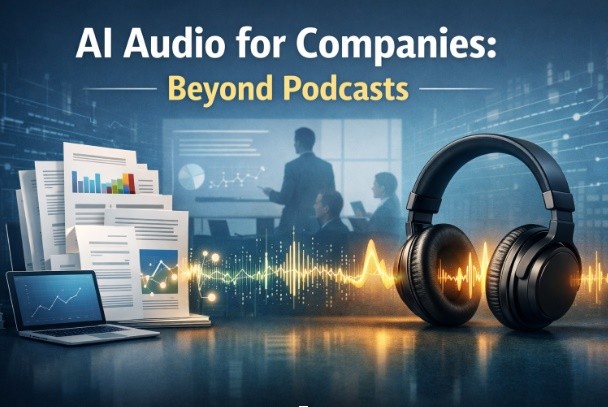
Discover how companies use AI audio beyond marketing podcasts-from leadership briefings to internal knowledge sharing using human-validated enterprise audio.
Most companies don’t struggle with creating information. They struggle with getting people to actually consume it.
Every week, organizations produce internal reports, leadership updates, research documents, policies, training manuals, and strategy decks. This content is important. It’s often well-written and thoughtfully prepared. Yet much of it goes unread. Long emails are skimmed. PDFs are downloaded and forgotten. Critical insights get buried under everyday noise.
This is where AI audio for companies is starting to make sense-not as a marketing tactic, but as a practical way to fix internal communication.
Why Text-First Communication Is Breaking Down
Inside growing organizations, written communication simply doesn’t scale well. Employees are expected to stay informed while managing meetings, deadlines, and constant notifications.
A few things usually happen-
Long emails rarely get read completely
Important PDFs are saved and never revisited
Teams rely on meetings to explain what was already written
Critical updates get lost in inboxes
The problem isn’t effort. It’s attention.
People don’t ignore documents because they’re useless. They ignore them because time is limited. This creates gaps in alignment and forces companies to repeat the same information again and again.
Why Audio Fits Modern Workflows
Audio works because it respects how people actually work.
Short, focused audio briefings can be consumed while commuting, walking between meetings, or during low-attention moments in the day. Unlike reading, audio doesn’t demand full visual focus.
This is why enterprise audio briefings are Becoming useful inside organizations. They allow teams to stay informed without adding more screen time or more meetings.
AI makes this scalable. Instead of recording everything manually, companies can convert existing documents into audio-quickly and consistently.
Moving Beyond Marketing Podcasts
When people think about Audio, they usually think about external podcasts. Those are designed for brand awareness and storytelling. Internal enterprise communication has very different needs.
Inside companies, audio must be-
Accurate and context-aware
Aligned with source documents
Secure and Access controlled
Suitable for regulated or high-stakes environments
This is where AI audio for companies differs from creator-focused tools. It’s not about entertainment. It’s about clarity, trust, and usefulness.
Practical Use Cases for AI Audio Inside Companies
1. Executive and Leadership Updates
Leadership teams often need to communicate strategy, priorities, and decisions clearly. Turning written updates into audio briefings for leadership allows employees to hear the message directly, without adding another meeting to the calendar.
Teams stay aligned, and inbox clutter is reduced.
2. Enterprise Knowledge Sharing
Organizations invest heavily in research and documentation, but much of that knowledge remains locked inside folders and shared drives.
With document to audio conversion, reports and internal documents can be transformed into short, structured audio briefings. This makes knowledge easier to access, easier to revisit, and easier to remember.
3. Training and Enablement
Training manuals and onboarding documents are rarely read end to end. Audio changes that.
By converting training material into private enterprise podcasts, companies support micro-learning and on-demand education. Employees can learn at their own pace, without interrupting their workday.
4. Asynchronous Communication for Distributed Teams
Global teams work across time zones. Scheduling meetings for everyone is inefficient and often unnecessary.
Audio supports asynchronous communication. Updates can be shared once and consumed whenever it suits the listener-without losing context or clarity.
5. Regulated and High-Stakes Communication
In industries like healthcare, finance, and enterprise SaaS, accuracy matters more than speed. Purely automated AI audio introduces risk-misinterpretation, loss of context, or confident sounding errors.
This is why human-validated AI is critical. AI handles structure and speed, while humans review and approve content before it’s shared. The result is compliance-grade audio content that teams can trust.
Why Human Validation Matters
On paper, full automation sounds perfect. In real enterprise environments, it breaks down.
AI can misunderstand complex information or remove important nuance. For internal strategy, leadership communication, or medical and scientific content, these mistakes are unacceptable.
Human-in-the-Loop workflows ensure-
Accuracy and contextual integrity
Clear ownership and accountability
Confidence for listeners
Speed alone isn’t enough. Trust is what makes audio usable inside companies.
Audio as a Core Enterprise Channel
Audio is no longer just a marketing format. It’s becoming a core layer in the enterprise knowledge stack-alongside documents, dashboards, and internal tools.
Enterprise audio briefings reduce cognitive overload and help teams stay informed without demanding more attention. Instead of competing for focus, audio fits naturally into real workdays.
This shift is already happening in organizations that care about clarity and alignment.
How Sprep Enables Trusted Enterprise Audio
Sprep is built specifically for enterprise use cases. It transforms written content into secure, validated audio briefings-without studios, microphones, or complex production workflows.
By combining AI audio for companies with human-validated AI, Sprep allows organizations to scale audio communication while maintaining accuracy, compliance, and control.
Existing documents become structured audio. Internal knowledge becomes easier to consume. Communication becomes simpler.
The Takeaway
AI audio isn’t just about podcasts. It’s about fixing how information moves inside organizations.
Companies that move beyond text-heavy communication and adopt validated audio will reduce overload, improve alignment, and make sure important information is actually heard.
For enterprises, this isn’t a trend.
It’s a more practical way to communicate.