Jan 5, 2026
How Enterprise Audio Briefings Improve Knowledge Retention
Enterprise Audio Briefings for Better Knowledge Retention at Work
Andy Suter
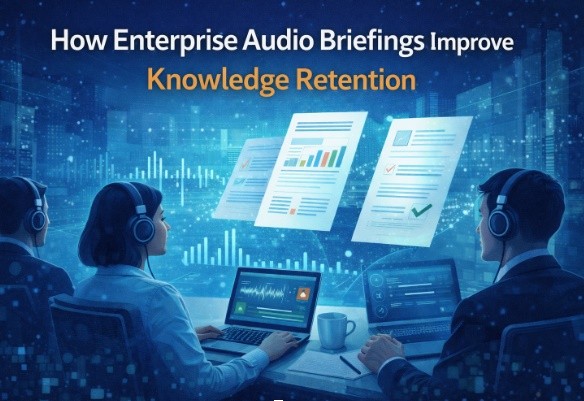
Discover how enterprise audio briefings help employees retain knowledge better. Learn AI-driven audio strategies for training, updates, and corporate communication.
Employees often face an overwhelming amount of information-emails, reports, presentations, and memos. Traditional text-heavy communication can make it difficult for them to absorb and retain key knowledge. Enterprise audio briefings transform critical information into engaging audio formats, Helping teams remember and apply insights more effectively.
1. The Rise of Enterprise Audio
Advances in AI-driven Audio Technologies have made it easier for Companies to implement audio briefings for internal communication and training. Key drivers include-
Information Overload- Employees struggle to process long text documents efficiently.
Remote & Hybrid Work- Audio allows employees to stay informed while multitasking or on the move.
Engagement Gap- Audio briefings are often more compelling than long emails or PDFs.
AI platforms can automatically summarize reports, convert key insights into short audio snippets, and deliver them across enterprise communication channels.
2. How Audio Improves Knowledge Retention
Cognitive Science research shows that listening to audio can improve memory retention, especially when paired with repetition and active engagement. Benefits include-
2.1 Multi-Sensory Engagement
Listening engages the Auditory Senses, complementing the visual processing from reading.
Audio briefings help employees hear and process key concepts, reinforcing understanding.
2.2 Flexibility and Convenience
Employees can listen anywhere-during commutes, workouts, or breaks.
Greater convenience leads to higher completion rates compared to long written documents.
2.3 Better Recall Through Storytelling
Audio briefings often use stories, case studies, or a conversational tone.
Humans remember stories better than isolated facts, boosting long-term retention.
2.4 Consistent Messaging
Audio briefings ensure uniform communication, so all employees receive the same information.
Reduces misinterpretation and knowledge gaps across teams.
3. Applications of Enterprise Audio Briefings
Enterprise audio can be used in various corporate functions-
Use Case | Benefits |
Internal News Updates | Keeps employees informed without cluttering inboxes. |
Training & Onboarding | Accelerates learning for new hires. |
Executive Summaries | Condenses reports into short audio insights for decision-makers. |
Compliance & Policy Updates | Ensures employees understand regulations clearly. |
Product Launch Briefings | Communicates critical product information effectively. |
4. AI-Driven Enhancements
AI tools make audio briefings even more effective-
Text to speech Engines- Convert long reports into natural-sounding audio.
Natural Language Summarization- AI creates 5-10 minute briefings from dense documents.
Multilingual Audio- Supports teams globally with content in multiple languages.
Interactive Features- Some platforms allow voice commands or quizzes to reinforce learning.
These tools save time and enhance engagement, especially for global teams.
5. Tips for Maximizing Knowledge Retention via Audio
To help employees retain key insights, companies can adopt these practices-
Keep Briefings Short- 5-10 minutes per session prevents cognitive overload.
Focus on Key Takeaways- Highlight essential points, actions, or metrics.
Repeat and Reinforce- Weekly or monthly summaries strengthen learning.
Combine with Visuals- Complement audio with slides, infographics, or transcripts.
Track Engagement- Analytics can show listening patterns and comprehension.
6. Benefits Beyond Knowledge Retention
Enterprise audio briefings also transform corporate communication-
Higher Employee Engagement- Employees feel more connected to company updates.
Faster Decision-Making- Leaders quickly grasp critical insights.
Reduced Information Overload- Short audio snippets replace lengthy reports.
Global Alignment- Multilingual audio keeps worldwide teams synchronized.
7. Case Example
A multinational tech company introduced AI-generated Audio Briefings for product updates. Within three months-
85% of employees reported better understanding of new features.
Training time for new hires decreased by 30%.
Engagement with internal communications increased by 50%.
This shows how audio can turn information into actionable knowledge effectively.
Conclusion
Enterprise audio briefings help employees absorb, retain, and act on critical information. By delivering concise, engaging content, companies can improve learning outcomes and overall efficiency. When combined with AI-driven summarization and multilingual support, audio briefings provide an effective, Scalable Solution for modern corporate communication.